Introduction
In today’s fast-evolving digital landscape, agility, intelligence, and autonomy are no longer optional — they’re essential. As enterprises shift toward composable, cloud-native architectures, the convergence of Agentic AI and Microservices is unlocking a new era of intelligent, goal-driven systems.
But before we explore the synergy between these two paradigms, let’s first understand what they are.
Understanding Microservices
Microservices are a software architectural style where applications are broken down into small, independent services. Each service is:
- Focused on a specific business capability.
- Independently deployable and scalable
- Communicating via lightweight APIs (REST, GraphQL, gRPC etc.)
This modularity enables faster development, easier maintenance, and greater resilience — making microservices the backbone of modern digital platforms.
Understanding Agentic AI
Agentic AI refers to autonomous, goal-driven AI agents that can:
- Perceive their environment
- Make decisions based on context and goals
- Take actions proactively
- Learn and adapt over time
Unlike traditional AI models that are reactive, Agentic AI systems are proactive, context-aware, and capable of multi-step reasoning — making them ideal for orchestrating complex workflows across microservices.
Why Combine Agentic AI with Microservices?
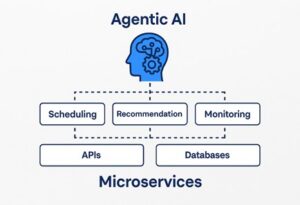
Microservices and AI agents serve complementary roles. Microservices provide modular, reusable and independently deployable business capabilities. AI Agents provide reasoning, planning, and adaptive orchestration. Rather than replacing microservices, AI agents utilize them as trusted enterprise capabilities.
1. Autonomous Orchestration
Agentic AI can dynamically coordinate multiple microservices to achieve a business goal — such as processing a customer order, resolving a support ticket, or managing a supply chain disruption.
2. Context-Aware Decision Making
Agents maintain memory and context, enabling them to make smarter decisions across services. For example, a virtual care agent can fetch patient records, analyze history, and schedule follow-ups — all autonomously.
3. Real-Time Adaptability
Agents can respond to real-time events (e.g., inventory changes, user behavior, system failures) and reconfigure workflows on the fly.
4. Scalability and Modularity
Each microservice can expose APIs that agents consume. This allows for:
- Plug-and-play intelligence
- Parallel execution of tasks
- Easy integration of new capabilities
Real-World Use Cases
Now let’s understand its real-world use cases and learning with Examples.
Healthcare: Virtual Care Agent
- Goal: Improve patient engagement and reduce manual overhead
- Agentic AI Tasks:
- Understand patient intent (e.g., “I need a diabetes checkup”)
- Fetch medical history from the Patient Records Service
- Check doctor availability via Appointment Service
- Recommend follow-ups based on clinical rules
- Trigger notifications and reminders
This agent operates across multiple microservices and makes context-aware decisions within predefined policies. Clinical recommendations, exceptions, and high-impact actions remain subject to appropriate human review.
Retail & eCommerce: Personalized Shopping Agent
- Scenario: A customer browses an online app.
- Agentic AI Tasks:
- Tracks user behavior across channels
- Calls microservices for product catalog, pricing, inventory, and recommendations
- Offers personalized suggestions based on preferences and purchase history
- Adjusts recommendations in real-time based on availability or promotions
This creates a seamless, intelligent shopping experience — increasing conversions and customer satisfaction.
Other Domains
The following examples illustrate how the combination of Agentic AI and Microservices is applied across different domains.
- Finance: Fraud detection agents continuously monitor transactions across multiple microservices, identify suspicious patterns in real time, and automatically block or escalate potentially fraudulent activities.
- Manufacturing: AI agents optimize production processes by dynamically adjusting supply chain operations, inventory levels, and machine performance based on real-time data and demand fluctuations.
Key Benefits
- Governed Autonomy: Agents can independently handle routine and low-risk decisions within defined policies while escalating exceptions and high-impact actions for human review.
- Adaptability: Agents learn and evolve with changing data and environments.
- Resilience: Microservices isolate failures, while agents reroute or retry intelligently.
- Speed: Enables faster responses to events and user actions.
- Modularity: Allows new services or agents to be added without disrupting the system.
- Continuous Innovation: New services and capabilities can be introduced without disrupting existing systems, enabling faster innovation cycles.
Architecture, Governance, and Responsible AI Considerations
While the combination of Agentic AI and microservices creates significant opportunities, successful implementation requires strong architectural foundations.
Security and Access Control
AI agents should access enterprise capabilities through secure, authenticated APIs rather than directly interacting with underlying databases or systems.
Organizations should implement:
- Identity-based access controls
- API security policies
- Data protection mechanisms
- Role-based authorization
Observability and Monitoring
Since AI-driven decisions may span multiple systems, organizations need comprehensive observability across:
- Agent actions
- API invocations
- Service interactions
- Decision logs
- Audit trails
Distributed tracing and centralized monitoring help organizations understand how an agent arrived at a specific outcome.
Resilience and Reliability
Enterprise-grade implementations should incorporate:
- Circuit breakers
- Retry mechanisms
- Timeout controls
- Compensation workflows
- Idempotent operations
These patterns help prevent failures from cascading across distributed services.
Human-in-the-Loop Controls
High-impact areas should include appropriate human review and approval mechanisms, such as:
- Healthcare
- Finance
- Security
- Compliance
The goal is not to eliminate humans from critical processes but to augment human decision-making with intelligent assistance.
Future of Agentic AI in Microservices
As enterprises embrace AI-first architectures, Agentic AI will become the brain of distributed systems — enabling:
- Self-healing infrastructure that detects and resolves issues autonomously
- Hyper-personalized customer experiences driven by contextual understanding
- Autonomous business operations that adapt in real-time to changing environments
The fusion of Agentic AI and microservices is more than a technical trend — it’s a strategic shift towards intelligent, adaptive, and autonomous systems. As enterprises move towards composable architectures, this synergy will be key to unlocking agility, innovation, and competitive advantage.