How AI-generated data is reshaping model training, enterprise architecture, and the future of intelligent systems.
The Next Training Revolution May Not Need More Human Data
Imagine a future where an AI model generates millions of training examples, another model validates them, and a third model learns from them. The newly trained model then generates an even better dataset for its successor. Human involvement gradually shifts from creating training data to defining boundaries, validating outcomes, and governing the process.
This is no longer entirely theoretical. Techniques such as knowledge distillation, self-instruction, and AI-generated feedback already demonstrate different forms of AI-to-AI learning. What is emerging is something bigger: the possibility of treating synthetic data generation as an industrial capability rather than an isolated machine-learning experiment.
The question is not simply whether AI can generate its own training data. It is whether we can trust what it generates.
From Human Data to Machine-Generated Data
Traditional AI training depends on real-world datasets, human annotations, and observed interactions. However, obtaining high-quality data is increasingly expensive and complicated by privacy restrictions, regulatory obligations, data scarcity, and the difficulty of representing rare scenarios.
Synthetic data addresses this challenge by creating artificial examples that reproduce selected characteristics of real-world data. Unlike anonymization, which transforms actual records, synthetic data generates new records. Unlike augmentation, which modifies existing examples, it can construct entirely new scenarios.
Consider a banking fraud model. Real transaction datasets may contain very few examples of sophisticated, coordinated fraud. A synthetic data generator can construct thousands of plausible transaction sequences, including unusual merchant patterns, transaction timings, and account relationships.
However, synthetic data is not automatically equivalent to real data. Its usefulness depends on statistical fidelity, diversity, domain correctness, and whether it represents scenarios that matter operationally.
Inside a Synthetic Data Factory
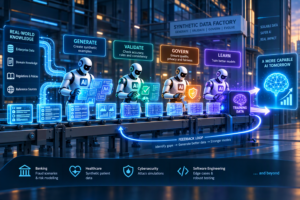
A synthetic data factory is fundamentally different from a script that asks an LLM to generate sample records. It is an orchestrated ecosystem that continuously produces, validates, versions, and delivers datasets for specific AI objectives.
A reference architecture would contain several layers:
- Knowledge and ingestion layer: Connects governed enterprise datasets, domain knowledge, schemas, and approved reference sources.
- Generation layer: Uses foundation models, specialized teacher models, simulation engines, and scenario generators to produce synthetic examples.
- Validation layer: Applies schema validation, business rules, statistical checks, semantic verification, and domain-specific evaluators.
- Quality and governance layer: Performs deduplication, bias assessment, privacy checks, provenance tracking, and human review.
- Training and evaluation layer: Publishes approved datasets to model fine-tuning pipelines and measures performance against independent evaluation benchmarks.
These components can communicate through APIs and event-driven workflows, while distributed processing handles large-scale generation and validation.
The interesting part is the feedback loop. A teacher model generates instructions or scenarios; validation services filter them; a student model learns from the approved dataset; evaluation identifies weaknesses; and subsequent generation targets those gaps.
This connects several distinct techniques. Knowledge distillation transfers behavioral information from a teacher model to a student, often through its outputs or probability distributions. Self-instruct generates instructions and examples to improve instruction-following capabilities. Self-training uses a model’s own predictions as additional training material. Reinforcement learning with AI feedback uses model-generated evaluations or preferences as reward signals. These techniques can complement one another, but they are not interchangeable.
Where This Becomes Powerful
The enterprise opportunities are significant.
In banking, synthetic transaction histories can help develop fraud detection models without exposing sensitive customer records. Rare-event scenarios can be generated to test risk models, while synthetic customer conversations can improve virtual assistants handling complex service requests.
In healthcare, synthetic patient records can support software testing and research workflows where access to real patient information is restricted. In cybersecurity, synthetic attack sequences can expand the range of scenarios used to test detection systems.
Software engineering offers another compelling application. A teacher model could generate API edge cases, malformed payloads, authentication failures, and integration scenarios. A student model could learn to identify potential defects or generate more effective automated tests.
The common advantage is controlled exposure to scenarios that are difficult, expensive, or impractical to collect at scale.
The Hidden Danger: When AI Learns from AI
There is a fundamental risk in recursively generated training data: models can gradually lose information about the real-world distribution they were originally trained to understand.
Research published in Nature in 2024 by Shumailov and colleagues demonstrated this phenomenon, known as model collapse. Their experiments showed that indiscriminate training on recursively generated data can progressively eliminate less common characteristics of the original distribution.
This is particularly concerning for enterprise systems. A fraud model trained on synthetic examples generated by an earlier fraud model might repeatedly learn familiar attack patterns while becoming less sensitive to emerging, unusual behavior.
Hallucinations create another problem. If a teacher model generates an incorrect answer and a student learns it as ground truth, the error becomes part of the training ecosystem. Repetition does not turn an incorrect answer into a verified fact.
Bias can also be amplified, while rare cases and minority patterns may disappear. Even sophisticated validation models can introduce blind spots when they share the same assumptions as the generator.
The danger, therefore, is not synthetic data itself. It is treating generated information as independently verified knowledge.
The Architecture Perspective
From an enterprise architecture standpoint, synthetic data factories should be treated as governed data products, not simply extensions of model inference services.
Enterprises must establish dataset lineage, model-version traceability, reproducible generation configurations, quality thresholds, access controls, and approval workflows. Every dataset should carry information about its source, generating model, prompts, validation results, and intended use.
Equally important is maintaining independent evaluation datasets containing trusted real-world or expert-verified examples. Synthetic training data must never become its own unquestioned measure of success.
A modular architecture integrated with existing data and machine learning platforms is preferable to an entirely disconnected technology stack. Generation, validation, governance, and training should be designed as independently scalable services.
In this architecture, data quality engineering becomes as important as model engineering.
What Comes Next?
Synthetic data factories could become a defining capability of enterprise AI, much like data engineering platforms became essential to modern digital systems.
The competitive advantage may increasingly come not from building the largest model, but from creating the most reliable ecosystem for generating, validating, and learning from data.
However, there is a distinction between an AI system that produces more data and one that produces better knowledge.
Perhaps the real question for the next generation of AI architects is this:
When AI becomes its own teacher, who ensures that the lessons it teaches are actually true?