Enterprise AI has moved quickly from experimentation to adoption. Across industries, organizations are building copilots, knowledge assistants, software engineering agents, customer service bots, and domain-specific AI workflows. The early conversation has been dominated by capability: which model performs best, which use cases can be automated, and how quickly teams can ship pilots.
But as these pilots move into production, a different question is emerging.
Can enterprises afford to scale AI the way they are currently building it?
The answer depends on more than model selection. It depends on how intelligently organizations manage the information they send into models, how often they send it, how much context they include, and how efficiently the model responds. This is the emerging discipline of token economics.
For many enterprises, the cost of AI does not arrive as one large obvious expense. It builds quietly through thousands of micro-decisions. A knowledge assistant sends an entire policy document into every request because retrieval was not tuned. A support copilot repeats the same system instructions on every turn. An agent carries its complete interaction history because memory summarization was deferred. A document assistant retrieves more context than needed because the team wanted to avoid missing relevant information.
Each of these choices feels reasonable in isolation. At scale, they become expensive.
This is why prompt optimization is becoming a boardroom-relevant engineering concern. The actual cost of an enterprise AI application is often determined less by the model alone and more by the discipline applied to context, prompts, memory, routing, and response design.
One of the most debated techniques in this space is prompt compression. The idea is simple: reduce the number of tokens sent to the model while preserving the meaning required to answer accurately. Smaller prompts should mean lower costs, faster responses, and more efficient AI systems.
At least, that is the theory.
To test the theory, I ran a practical experiment focused on prompt compression in an enterprise-style knowledge assistant scenario. The goal was not to prove that compression works in general. The goal was to understand where compression works, where it stops helping, and where it may quietly begin to hurt.
Why prompt compression matters
Large language models process information as tokens. Every instruction, document excerpt, chat message, retrieved passage, and model response consumes tokens. Most enterprise teams focus heavily on the input side of this equation because it is visible. If a prompt is long, it feels expensive. If the prompt is shorter, it feels optimized.
That intuition is directionally correct, but incomplete.
In production AI systems, total cost includes both input tokens and output tokens. If the prompt becomes too compressed, the model may respond by generating longer answers. It may hedge more. It may explain more. It may reconstruct missing context. It may compensate for uncertainty created by the compression itself.
This means reducing input tokens does not always reduce total cost in a linear way.
That is the compression paradox.
The more aggressively an enterprise compresses context, the more it risks changing the model’s response behavior. At some point, the tokens saved on the input side can be partially offset by additional tokens generated on the output side. Even more importantly, answer quality may begin to degrade, especially for complex reasoning tasks.
The question for enterprise AI teams is therefore not, “How much can we compress?”
The better question is, “What level of compression creates the best balance of cost, quality, and business outcome?”
The experiment
To explore this, I created a small knowledge assistant scenario using a fixed set of reference documents and 25 test questions. The questions were intentionally varied. Some were simple factual lookups. Some required synthesis. Others required multi-hop reasoning across multiple pieces of context.
Each question was sent to the same model five times:
- With the full, uncompressed context
- With context compressed at 2x
- With context compressed at 5x
- With context compressed at 10x
- With context compressed at 20x
The compression was performed using LLMLingua-2, an open-source prompt compression framework from Microsoft Research. The framework is designed to reduce prompt size by removing lower-value tokens while attempting to preserve the core semantic meaning.
For each model call, I captured five metrics:
- Input tokens
- Output tokens
- Cost
- Latency
- Response quality
Quality was evaluated by comparing the compressed response against the uncompressed baseline on a 1 to 5 scale for correctness and completeness.
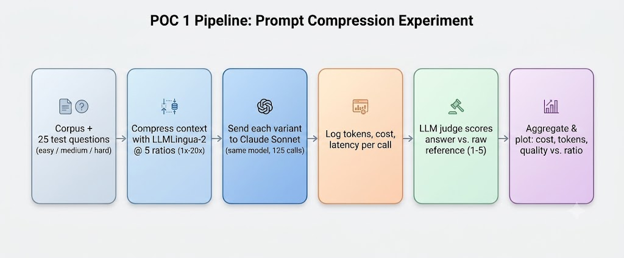
The hypothesis going into the experiment was straightforward: as prompts become smaller, costs should fall. A 20x compression ratio should deliver much greater savings than a 2x compression ratio.
The results were more nuanced.
What the data showed
The uncompressed baseline averaged 3,455 input tokens per question, with an average cost of $0.0167 and a response time of 5.4 seconds.
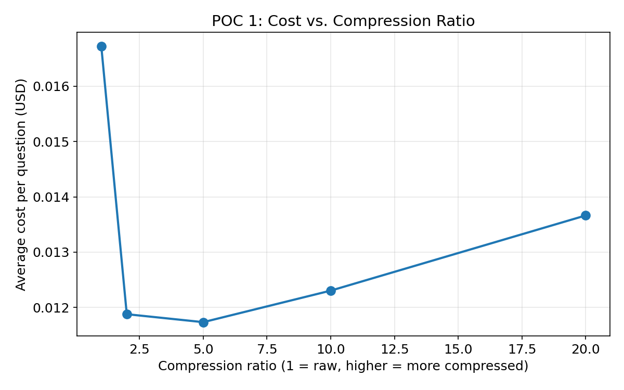
At first, compression behaved as expected.
At 2x compression, cost dropped sharply. The average cost fell by 29 percent. Quality remained very strong, scoring 4.87 out of 5. This was the ideal outcome: meaningful savings with almost no visible quality loss.
At 5x compression, cost continued to improve slightly, reaching the lowest average cost in the experiment at $0.0117 per question. This represented close to 30 percent savings compared with the uncompressed baseline. Quality declined somewhat to 4.37, but the answers remained broadly usable.
Then the pattern changed.
At 10x and 20x compression, input tokens continued to shrink, but total cost savings began to deteriorate. By 20x compression, the average cost saving was only 18 percent compared with the raw baseline. That was worse than the savings achieved at 2x compression, even though the prompt itself was far smaller.
This is where the experiment became more interesting.
The reason was visible in output tokens.
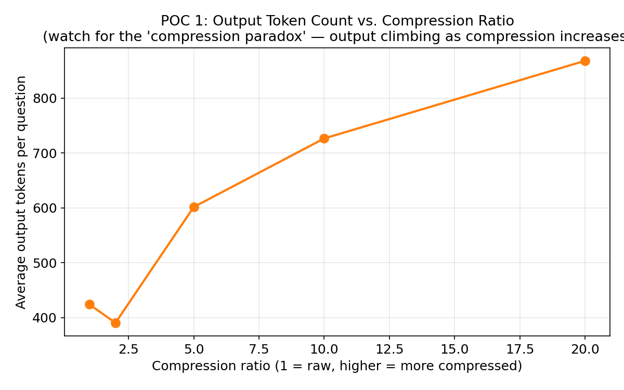
At the uncompressed baseline, the average answer was 424 output tokens. At 20x compression, the average answer grew to 868 output tokens. The model was producing more than twice as much output.
That is the compression paradox in action.
The prompt was smaller, but the answer got larger. As more context was removed, the model appeared to compensate by generating longer explanations, adding qualifiers, and reconstructing context that was no longer explicitly present. In practical terms, the model had less to work with, so it used more output tokens to produce an answer that still felt complete.
This matters because output tokens are not free. In many pricing models, output tokens can be more expensive than input tokens. Even where pricing structures vary, longer outputs still impact cost, latency, and user experience.
The key lesson is simple: prompt compression should not be evaluated only by how much it reduces input tokens. It must be evaluated by how it changes total system behavior.
Quality did not collapse, but it did drift
Cost was only one side of the experiment. Quality told a related story.
At 2x compression, quality was nearly indistinguishable from the uncompressed baseline. This suggests that many prompts contain enough redundancy that light compression can remove waste without harming the answer.
At 5x compression, quality dropped but remained acceptable. At 10x, it recovered slightly. At 20x, it settled at 4.29 out of 5. The system did not fail. The answers were still usable. But the pattern was clear: beyond moderate compression, quality became less stable.
The most important insight emerged when the results were segmented by question difficulty.
Simple factual questions handled compression well. These questions often needed only a small piece of context, so removing extra text had limited impact.
Multi-hop questions were much more fragile. These were the questions that required the model to connect facts, reason across sources, and preserve broader context. For these harder questions, quality declined steadily from 5.00 at 2x compression to 3.87 at 20x compression.
This is an important enterprise finding.
The tasks most sensitive to aggressive compression are often the tasks that matter most: complex claims analysis, financial interpretation, contract review, policy reasoning, clinical documentation support, and multi-document research. These are not the scenarios where organizations can afford subtle degradation.
In other words, compression risk is not evenly distributed. It increases precisely where context matters most.
The real lesson: optimize intelligently, not aggressively
The starting assumption was that more compression would produce more savings. The experiment showed that this assumption only holds up to a point.
In this case, the practical sweet spot was between 2x and 5x compression. That range delivered roughly 30 percent cost reduction, strong response quality, and in some cases better latency.
Beyond that point, the return curve changed. More compression did not create better economics. It created a tradeoff: lower input tokens, higher output tokens, and declining answer quality.
This is why enterprise AI teams should treat compression as an optimization strategy, not a blunt cost-cutting tool.
The goal should not be the highest compression ratio. The goal should be the best unit economics for the business outcome.
That distinction matters.
A support bot answering simple FAQs may tolerate aggressive compression. A financial planning copilot may not. A legal assistant reviewing contractual obligations may need far more context than a document summarizer. A software engineering agent may require detailed history and code context to avoid errors.
One compression policy will not fit every workload.
What this means for enterprise AI leaders
There are four practical implications for CIOs, CTOs, AI platform teams, and enterprise architects.
1. Stop measuring only input tokens
Input token reduction is easy to celebrate, but it is not the full economic picture. Teams need to track input tokens, output tokens, latency, quality, and task success together.
A compressed prompt that produces a longer, weaker, or slower answer may not be an improvement.
AI cost dashboards should show total token consumption per task, not just prompt size.
2. Match compression to task complexity
Compression should be adaptive. Simple lookups can use higher compression. Complex reasoning tasks should preserve more context. Enterprise systems should classify requests by difficulty, importance, risk, and context dependency before deciding how aggressively to compress.
This is where prompt compression begins to connect with broader context engineering.
The right question is not, “Can this prompt be shorter?”
The right question is, “How much context does this task need to produce a reliable business outcome?”
3. Combine compression with other optimization layers
Prompt compression is powerful, but it should not operate alone.
The strongest AI cost optimization strategies will stack multiple techniques:
- Semantic caching to avoid repeated calls
- Prompt compression to reduce unnecessary input
- Model routing to avoid overusing premium models
- KV cache optimization to reuse stable context
- Agent memory pruning to prevent history bloat
- Batch processing for non-urgent workloads
- Small language models for repetitive domain-specific tasks
Compression is one lever in a broader AI economics architecture.
4. Build experimentation into the AI operating model
The most important takeaway is that optimization claims must be tested on the enterprise’s own workloads.
A compression ratio that works well for one dataset, model, or use case may not work for another. The right threshold depends on document structure, question complexity, model behavior, pricing, latency requirements, and quality tolerance.
Enterprises should create repeatable evaluation pipelines that test cost, quality, and latency before optimization changes are deployed into production.
This is how AI cost management becomes engineering discipline rather than financial cleanup.
From token savings to business value
Prompt compression is often framed as a technical exercise. In reality, it is a business design question.
Every token sent to a model should earn its place. Some tokens provide essential context. Some are redundant. Some reduce uncertainty. Some increase accuracy. Some are simply waste.
The enterprise challenge is to distinguish between the two.
The broader opportunity is to move from token minimization to token intelligence. That means understanding which tokens drive better outcomes, which tasks justify richer context, which workloads can be compressed safely, and where cost savings create unacceptable quality risk.
This is where enterprise AI maturity is heading.
The next generation of AI platforms will not simply call models. They will actively manage the economics of every call. They will observe usage, classify workloads, apply optimization policies, route requests, measure quality, and translate token consumption into business outcomes.
That is the foundation for AI FinOps.
Conclusion
The experiment reinforced a simple but important truth: prompt compression works, but only when applied with discipline.
Light-to-moderate compression can deliver meaningful savings with limited quality impact. In this experiment, the best range was between 2x and 5x compression, where cost savings approached 30 percent while answer quality remained strong.
But more compression was not always better. At extreme levels, output tokens increased, total savings declined, and complex reasoning tasks became more fragile.
That is the compression paradox.
The future of enterprise AI will not be defined only by larger models or longer context windows. It will be defined by how intelligently organizations manage the information flowing into and out of those models.
For technology leaders, the message is clear.
Do not chase the smallest prompt. Chase the best economics.
Do not optimize for token reduction alone. Optimize for business value per token consumed.
And most importantly, do not assume that compression saves money everywhere. Test it, measure it, and find the point where efficiency and quality meet.
That is where enterprise AI becomes scalable.