Industrial environments are undergoing a profound transformation. Operational Technology (OT) networks that once operated in relative isolation are now deeply connected to enterprise IT systems, cloud platforms, remote maintenance services, and industrial IoT ecosystems. While this convergence unlocks efficiency and innovation, it also introduces an unprecedented level of cyber risk.
For security leaders, the challenge is clear: how do you strengthen cyber defense without compromising safety, availability, or operational continuity?
The answer isn’t autonomous security. It’s intelligent augmentation.
As artificial intelligence continues to reshape cybersecurity, its most meaningful contribution to OT security operations isn’t replacing human expertise. Instead, AI is enabling the next generation of OT Security Operations Centers (SOCs) to work faster, see deeper, and respond more effectively while keeping operators firmly in control.
Why Traditional Security Approaches Fall Short in OT
Unlike enterprise IT environments, OT systems power physical operations. Manufacturing lines, energy grids, utilities, transportation systems, and critical infrastructure depend on continuous uptime and predictable processes.
A false positive in IT may result in a minor inconvenience. In OT, it can disrupt production, impact safety, trigger environmental incidents, or lead to significant financial loss.
This reality fundamentally changes how security operations must function.
Many OT SOCs struggle not because they lack detection technologies, but because foundational capabilities are still maturing:
- Incomplete asset inventories
- Limited visibility into industrial networks
- Fragmented monitoring across sites
- Inconsistent telemetry quality
- Growing dependence on third-party remote access
- Scarcity of specialists who understand both cybersecurity and industrial operations
Without addressing these fundamentals, even the most advanced security tools create more noise than value.
This is where AI begins to make a measurable difference.
The Real Role of AI in the OT SOC
The cybersecurity industry often frames AI through the lens of autonomy. In OT environments, however, complete automation is neither practical nor desirable.
The greatest value of AI lies in accelerating core SOC functions while respecting operational boundaries.
Rather than acting as a replacement for analysts and engineers, AI becomes a force multiplier, helping security teams process more information, identify risks faster, and make better-informed decisions.
The most impactful OT SOC use cases fall into six key areas.
1. Asset Intelligence
You cannot protect what you cannot see.
Industrial environments frequently contain legacy devices, proprietary systems, engineering workstations, PLCs, sensors, and equipment that may not appear in traditional asset inventories.
AI-driven asset intelligence continuously analyzes network communications and operational patterns to improve discovery, classification, and criticality mapping. This creates a living inventory that serves as the foundation for risk management and threat detection.
2. AI-Assisted Triage
Security teams spend a significant portion of their day investigating alerts that ultimately prove harmless.
AI-assisted triage reduces this burden by automatically correlating events, enriching alerts with contextual information, and building investigative narratives.
Instead of manually assembling evidence from multiple systems, analysts receive a clearer picture of what happened, when it happened, which assets were affected, why it matters, and what actions should be considered next.
The result is faster investigations and more consistent decision-making across teams.
3. Guided Threat Hunting
Advanced attackers rarely reveal themselves through obvious indicators.
AI helps OT SOC teams uncover subtle patterns that may otherwise go unnoticed by analyzing vast volumes of telemetry across multiple sites.
By combining industrial process awareness with cybersecurity intelligence, AI can suggest hypotheses, identify weak signals, and accelerate investigations aligned to real-world industrial attacker behaviors.
This transforms threat hunting from a time-intensive exercise into a scalable operational capability.
4. Enhanced Detection
Traditional detection systems often generate excessive alerts because they lack industrial context.
AI improves detection quality by incorporating:
- Industrial protocol behavior
- Process conditions
- Device relationships
- Identity context
- Historical operating patterns
The result is greater precision, fewer false positives, and improved visibility into cyber-physical threats.
5. Cross-Domain Correlation
Modern attacks rarely stay confined to a single environment.
A compromise may begin with an employee credential, move through cloud resources, traverse enterprise systems, and eventually reach OT assets.
AI enables security teams to connect signals across IT, cloud, identity, and OT domains, creating a unified investigative timeline that reveals attack paths which would otherwise remain hidden.
6. Predictive Intelligence
Perhaps the most exciting opportunity lies at the intersection of operational reliability and cybersecurity.
Using long-term behavioral analysis, AI can identify deviations that may indicate emerging integrity issues, process anomalies, equipment degradation, or security concerns.
This convergence allows organizations to strengthen both operational resilience and cyber defense simultaneously.
The Three Principles of Safe AI in OT
As organizations expand AI adoption, success depends on designing solutions around OT realities.
Three principles should guide every AI-enabled OT SOC initiative.
1. Consequence-Aware Automation
Not every security action is safe in an industrial environment.
Stopping a process, isolating a control system, or blocking communications can have unintended consequences.
AI must understand operational context and potential impacts before recommending actions. Automation should be cautious by design, accelerating workflows without creating new risks.
2. Contextual Detection
OT security requires more than analyzing packets and logs.
Effective detection depends on understanding how industrial processes operate.
A deviation that appears suspicious in one environment may be entirely normal in another. AI models must incorporate process awareness to produce meaningful and actionable insights.
3. Human-Approved Response
The final decision-making authority must remain with people.
AI can recommend actions, prioritize investigations, and surface evidence. However, response activities that may affect physical processes should always require human validation.
This balance delivers speed without sacrificing safety.
Building the Next-Generation OT SOC
The future OT SOC is not defined by isolated tools. It is defined by convergence.
Successful organizations are creating integrated environments where IT, OT, identity, cloud, and threat intelligence data are brought together into a common operational framework.
A modern architecture typically includes three interconnected layers:
The Edge Layer, operating at plant sites, provides local visibility, behavioral baselining, rapid anomaly detection, and resilience during connectivity disruptions.
The Central SOC Layer delivers enterprise-wide analytics, threat intelligence integration, cross-site correlation, and AI model orchestration.
The Governance Layer ensures accountability through model management, explainability, performance monitoring, compliance oversight, and risk management.
Together, these layers create a hybrid operating model that balances local autonomy with centralized intelligence.
The Future Is Augmented, Not Autonomous
The conversation around AI in cybersecurity often focuses on replacing analysts with machines.
OT environments demand a different vision.
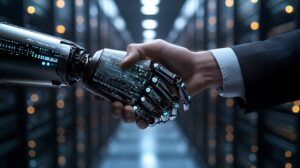
The next-generation OT SOC is not an autonomous SOC. It is an augmented SOC, where AI and human expertise work together to improve visibility, accelerate investigations, reduce operational burden, and strengthen resilience.
Organizations that embrace this approach will move beyond reactive defense toward proactive risk management. They will detect threats earlier, respond with greater confidence, and maintain the safety and reliability that industrial operations demand.
Ultimately, the future of OT security isn’t about handing control to AI. It’s about giving defenders the intelligence they need to protect critical operations at the speed of modern threats.
By Michel Bruggeman
Source inspiration: Infosys Viewpoint “AI Driven OT Security: Building the Next Generation OT SOC.” This blog has been independently rewritten and restructured with original wording for publication purposes.