Most conversations with AI still happen through a single medium: text. You ask, it answers, in a scrolling wall of prose. But a growing share of real tasks — booking a flight, filling out a form, comparing products, exploring a dataset — are fundamentally visual and interactive. Text is a bad interface for those.
Generative UI (GenUI) is the emerging answer, instead of only replying with words, an AI agent generates, selects, or controls parts of the user interface at runtime — rendering the widget, form, or layout the moment actually calls for, rather than forcing everything through a chat bubble.
Why It Matters?
Text is a poor interface for structured tasks. A date picker, a comparison table, or a multi-step form is faster and clearer than the equivalent paragraph of prose. It closes the gap between “chatbot” and “app.”
Instead of hand-coding a screen for every possible user intent, you build a component library and let the model assemble or select from it based on context. It reduces development overhead. The interface adapts to what the user actually needs in the moment, rather than being fully predetermined by a developer months in advance.
Search interest in the term has roughly doubled over the past year, and the framework names around it — Vercel AI SDK, CopilotKit, AG-UI — are seeing steadily rising, low-competition search volume, a sign that tooling is still catching up to demand.
How It Works?
Generative UI implementations generally fall into one of three architectural patterns, trading off control for flexibility.
1. Controlled Generative UI
High control, low freedom. You pre-build a fixed set of components. The agent’s only job is to decide when to show one and what data to pass into it — typically via standard tool/function calling. This is the safest, most predictable pattern, and the one most production apps use today for transactional flows (checkout, settings, bookings).
2. Declarative Generative UI
Shared control. The agent returns a structured schema — JSON describing cards, lists, forms, layout — and the frontend renders it against a known component catalog. The agent can compose novel arrangements, but only from primitives you’ve already built, so output stays bounded.
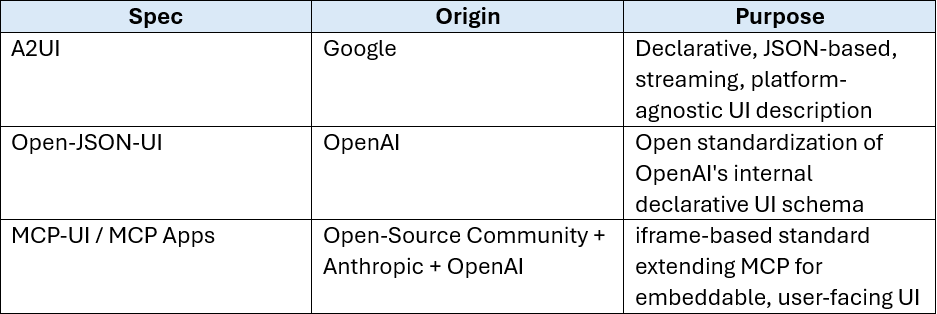
This is where specs like A2UI and Open-JSON-UI live.
3. Open-Ended Generative UI
Low control, high freedom. The agent returns an entire UI surface — raw HTML/SVG/Canvas, or a full iframe served by an external MCP server. The frontend becomes a sandboxed container that just displays whatever comes back.
This is the most powerful pattern — capable of rendering diagrams, 3D scenes, D3 force layouts, or live simulations — but it requires careful sandboxing, since you’re rendering agent-generated code directly.
The Protocol Stack Underneath
Three open, complementary protocols have emerged, each addressing a different layer of the agentic stack:
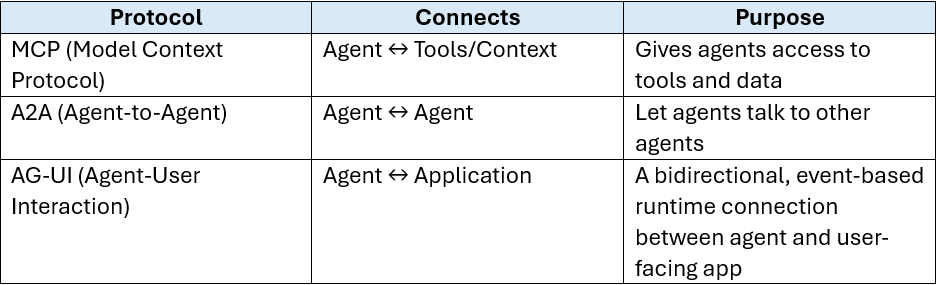 AG-UI is not itself a generative UI spec — it’s the transport layer. The actual UI description formats that ride on top of it (or work independently) are:
A Typical Modern Pipeline
MCP fetches tools/data → the agent describes UI via A2UI or Open-JSON-UI → AG-UI streams that state to the frontend → a rendering library (CopilotKit, Vercel AI SDK) turns it into live components.
Generative UI Technology Landscape
- Frameworks
- Vercel AI SDK — AI SDK is an open-source, framework-agnostic, TypeScript toolkit that simplifies the integration of AI capabilities into modern applications. It provides powerful abstractions for handling chat interactions, streaming responses, and real-time UI updates, enabling developers to build responsive, intelligent, and engaging AI-powered user experiences with less complexity and faster development cycles.
- CopilotKit — open-source framework, adopted by teams at Google, AWS, Microsoft, and LangChain. Created the AG-UI protocol. Best when you want a full “copilot” experience: chat surface, shared state, agent orchestration, and generative UI together, not just rendering.
- Developer Platform
- Thesys (json-render / Crayon) — a format-authoring approach where the model outputs JSON describing a component tree. Fast to prototype with, framework-agnostic.
- UI Protocol
- Google A2UI — focused on cross-platform, portable generative UI — not limited to a single frontend framework or the browser.
- Developer Tool
- Tambo — a leaner, React-only alternative to CopilotKit for teams that don’t need the full agent-orchestration surface.
- Orchestration
- LangGraph / Mastra — not UI frameworks themselves, but the most common agent-orchestration “brains” paired with the frameworks above.
- Standard
- MCP Apps — an emerging standard under the Agentic AI Foundation (Linux Foundation) for exposing generative UI through MCP tool servers. Early momentum is encouraging, but the technology has not yet reached a level of maturity that warrants broad adoption.
Considerations For Picking A Framework
- Your existing stack : If you’re already deep in a frontend technology, a tightly integrated SDK will get you further, faster, than a framework-agnostic one. If your frontend is more heterogeneous, portability matters more than integration depth.
- How much of the “assistant” you need, versus just the rendering : Some teams only need a way to render structured output as components; others want the fuller package — chat surface, agent orchestration, shared state — bundled together.
- Prototype speed versus long-term flexibility : Formats that let the model author JSON directly tend to be the fastest way to get something on screen, but may trade off some of the control and structure you’d want at scale.
- How much you want the model to author versus select : Controlled patterns (fixed components, model just picks) are easier to reason about and secure; declarative and open-ended patterns give more expressive power at the cost of more surface area to sandbox and test.
- Cross-platform needs : Web-only products have more options; if the same generated UI needs to show up beyond the browser, that narrows the field toward frameworks built with portability in mind.
- Transport versus rendering : It’s worth separating these two concerns — the protocol that moves agent state to the frontend doesn’t have to be the same library that renders it, and decoupling them can keep you from being locked into one vendor’s full stack.
Framework selection is context-dependent. The optimal choice is determined by how much UI authoring responsibility is delegated to the model and the degree of platform independence required.
Final Thought
Generative UI does not eliminate frontend engineering; it changes the boundary between design-time and runtime.