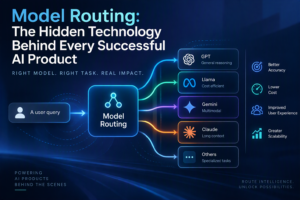
Every time we type a question into an AI assistant, we expect three things at once: a fast reply, a correct reply and a service that stays affordable. No single AI model delivers all three for every kind of question. The products that feel effortless are quietly solving this with one piece of hidden technology that most users never see: Model Routing.
When LMSYS researchers placed a learned router in front of GPT-4 and a cheaper open model, the bill on the MT Bench test fell by over 85%, yet answer quality stayed within about 5% of a GPT-4-only setup. In other words, most of what users ask never needed the most expensive model in the first place. In this article, we’ll look at what model routing is, how it works and why it has become the backbone of successful AI products.
What is Model Routing?
Model routing is a decision layer that sits between the user and a group of AI models. For every incoming request, the router looks at what is being asked and sends it to the model best suited to answer it. A simple greeting goes to a small, fast model. A complex financial analysis goes to a large reasoning model. A request containing sensitive data may stay on the device.
A simple way to picture it is a hospital reception desk. Not every patient needs the senior surgeon. The receptionist checks the symptoms and directs each patient to a general physician, a specialist or the emergency room. The hospital serves more people, faster and at lower cost, while the experts stay free for the cases that truly need them. The router plays the same role for AI models.
Why One Model Is Not Enough?
In the early days of generative AI, most products connected to one large model and sent every request to it. That approach works for a prototype, but it breaks down at scale. Every AI product balances three competing factors:
- Cost: Large frontier models can cost many times more per token than smaller models. Sending a “Hi, what’s my balance?” message to the most powerful model is like hiring a chartered accountant to count coins.
- Latency: Bigger models take longer to respond. In a mobile app, users notice every extra second, and slow replies directly hurt engagement.
- Quality: Small models are fast and cheap, but they struggle with multi-step reasoning, long documents and complex code.
- No single model wins on all three. Model routing removes the trade-off by letting each request use the cheapest model that can still answer it well.
How Model Routing Works?
A routing layer follows a simple flow. The request arrives, the router classifies it, the chosen model generates the answer, and the result is logged so the router keeps improving.
The router invokes each request to the default or low-cost model that can answer it well. User request text, voice or image. Model router Checks task complexity, Checks data sensitivity, Checks cost and latency budgetSmall on-device model. Greetings, autofill, sensitive dataFast cloud modelEveryday questions and summariesLarge reasoning model. Complex analysis and long documents, Quality and cost signals tune the router
The router checks each request against complexity, data sensitivity and budget, then picks one of the model tiers. Feedback on quality and cost flows back so future decisions get better.
There are several common strategies to build the router itself:
Rule-based routing: Simple if-else rules based on keywords, message length or feature type. For example, every “summarise this document” request goes to the long-context model. Easy to build and easy to explain to auditors.
Classifier-based routing: A small, fast model is trained to predict how difficult a request is and which model will answer it best. This is the approach used by frameworks such as RouteLLM.
Semantic routing: The request is converted into an embedding and compared with known categories such as “account query”, “complaint” or “investment advice”, and each category is mapped to a model.
Cascading: The request first goes to the cheapest model. If its confidence is low or its answer fails a validation check, the request is escalated to a stronger model.
Fallback routing: If a model provider is slow or down, traffic automatically shifts to a backup model so the product stays available.
Where We Already See Model Routing?
Many AI products we use daily already depend on routing, even if they never mention the word.
ChatGPT with GPT-5: GPT-5 in ChatGPT is really a team of models behind one name. A quick model handles routine chat, a slower “thinking” model takes on tough problems, and a router in the middle decides, message by message, which one should reply. It weighs how difficult the request looks, whether tools are needed and even direct hints in the user’s wording. User behaviour, such as manually switching models, feeds back into the router so its choices improve over time.
Apple Intelligence: Apple’s AI architecture combines a lightweight language model that operates on the device with more powerful cloud-based models available through its Private Cloud Compute environment. Requests are processed locally whenever possible to reduce data movement and improve responsiveness. Only workloads that exceed on-device capabilities are forwarded to the cloud, making privacy and performance equally important factors in the routing decision.
Open-source frameworks: LMSYS introduced RouteLLM as an open-source framework that simplifies experimentation with multi-model deployments. The framework allows developers to direct requests between lower-cost and higher-capability models while adjusting a configurable threshold to balance operational expense against output quality.
Model Routing in Mobile and Enterprise Apps
For mobile and enterprise teams, routing is not only about saving money. It shapes privacy, compliance and user experience.
- On-device first: Modern phones can run small language models locally. Tasks such as smart replies, form auto-fill suggestions and text summarisation can run on the device with no network call, which means instant response and no data leaving the phone.
- Cloud when needed: Questions that need wider knowledge or deeper reasoning are escalated to a cloud model. The app decides this per request instead of hard-coding one path.
- Compliance-aware routing: In regulated industries such as banking, the router can also check what data the request contains. A query with account details or personal identifiers can be kept on-device or sent only to a model hosted in an approved region, while a general product question can use a public cloud model.
- Offline fallback: When the network is weak, the router can fall back to the on-device model so the feature degrades gracefully instead of failing.
Challenges and Best Practices
Routing adds a new moving part to the system, and it brings its own risks.
Silent quality drops: When a difficult question lands on a small model, the reply is poor, yet no error is raised. Tracking answer quality from the very first release, not just the token bill, is the only way to catch this early.
Harder debugging: A wrong answer now has two possible culprits: the routing choice or the model that responded. Recording which model served each request, and why, turns guesswork into a quick lookup.
Router overhead: The router itself takes time. It must be much faster than the models it chooses between, or it eats into the latency it was meant to save.
Inconsistent experience: Different models can answer in different tones and formats. Shared system prompts and output validation help the product feel like one assistant.
A practical way to start is simple: begin with rule-based routing for two models, log every decision, review the misrouted cases weekly, and only then move to a trained router.
Author’s Point of View
Working on mobile banking applications in the Middle East, I see model routing as the piece that will decide which AI features actually reach production. Banks want AI assistants, smart search and document summaries, but they also need strict data residency, predictable cost and response times that feel native on a phone. A single large cloud model cannot satisfy all of these together. A router that keeps sensitive tasks on the device, sends general queries to an approved cloud model and escalates only complex cases to a reasoning model can.
In the coming years, intelligent routing is likely to evolve into a foundational layer of AI platforms, much like load balancers and API gateways in modern software systems. Future routing engines may evaluate a broader set of signals, including operational cost, response quality, geographical location, device health and power consumption. While end users often focus on the model generating the response, the effectiveness of the routing layer will largely determine whether an AI solution remains scalable, reliable and economically viable.
References:
LMSYS Research. Study on cost-aware routing techniques for large language model systems.
LMSYS. Open-source implementation of a multi-model routing framework.
Apple Machine Learning Research. Technical paper describing the language model framework supporting Apple Intelligence.
Constellation Research. Review of Apple’s AI processing framework and cloud integration model. Constellation Research Insights, 2025.
Jisc National Centre for AI. Discussion of adaptive model selection and switching mechanisms in modern AI systems.
MIT Sloan Management Review Middle East. “Assessment of OpenAI’s GPT-5 Release.” https://www.mitsloanme.com/article/openais-gpt-5-is-finally-here/