Abstract
The document emphasizes the critical necessity for enterprises to have AI-ready data layers integrated with existing systems to ensure successful AI platform implementation, highlighting that lack of AI-ready data significantly risks AI projects and that robust data management, pre-integration with enterprise platforms, and seamless interoperability are essential for driving business efficiency and transformation without disrupting legacy systems.

Every enterprise is in a rush to adopt agentic AI solutions/platforms for their businesses to get benefits or cost savings from their implementation. While their goals are highly aspirational, it becomes imperative that their systems/infrastructure/platforms must be ready for AI, to make it more precise, primarily one needs to look at, whether their enterprise systems/infrastructure has data which is AI ready.
Lack of AI data readiness in enterprises – a cause for concern and a critical piece of “food for thought” for leaders driving AI agendas.
A March 2026 pulse survey by Harvard Business Review Analytic Services, sponsored by Cloudera, found that just 7% of enterprises consider their Data is Completely Ready for AI and 73% of respondents indicated that processing and preparing data for AI remains a significant challenge for their organizations.
According to Gartner, a leading analyst firm, Absence of AI ready data places AI projects at Risk – 63% of organizations either do not have or are unsure if they have the right data management practices for AI, according to a survey by Gartner.
In fact, Gartner predicts that in 2026, organizations will abandon 60% of AI projects unsupported by AI-ready data.
When nearly 60% of AI initiatives or projects are abandoned due to lack of AI‑ready data, it signals not a technology failure—but a fundamental gap in enterprise data readiness that demands immediate strategic attention and needs a thoughtful approach.
This implies that without AI ready data fabric in place, there can’t be a successful implementation of AI/agentic platforms.
To make data ready for AI, AI platforms/stack, that clients intend to implement should have AI ready data layer, integrated and operational across enterprise data platforms/infrastructure and pre-integrated with existing ERP platforms.
Without proper data layer/data management practices in place, assuming AI models will address all possible data management challenges/issues once deployed is a flawed assumption. These challenges must be addressed at the design and build stage of the AI applications.
Enterprises to build an AI-ready data layer or knowledge layer between the source systems and the agents. This ensures the data is clean, prepared, integrated, contextualized, and accessible real time with robust data governance and guardrails for consumption by AI applications, enabling AI agents to accurately understand, perceive, reason and respond efficiently and flawlessly.
Robust Augmented data management practices which is a key enabler of AI ready data has to come into play which ensures Data discovery, Data cleansing (fixing errors, duplicates etc), Data classification and tagging, Data integration and Data governance (policies, compliance) are automated.
AI platform/Agentic AI platforms must be capable of plugging into legacy or non-AI-ready systems and help create AI-ready data.
These implementations become very crucial and critical, should be done without compromising on the existing enterprise data and legacy systems landscape whilst modernizing existing systems, balancing innovation with risk, governance, stability and business continuity.
AI-Ready data plays a key role in Brownfield implementations- implementing AI applications with AI-data readiness built in, across enterprise IT landscape enabling modernization and seamless integration of new capabilities into existing systems.

Enterprise-wide IT service delivery should be unified and accelerated by enabling an AI platform that provides a modular, integrated operational stack, covering data infrastructure, models, agents, workflows, and applications.
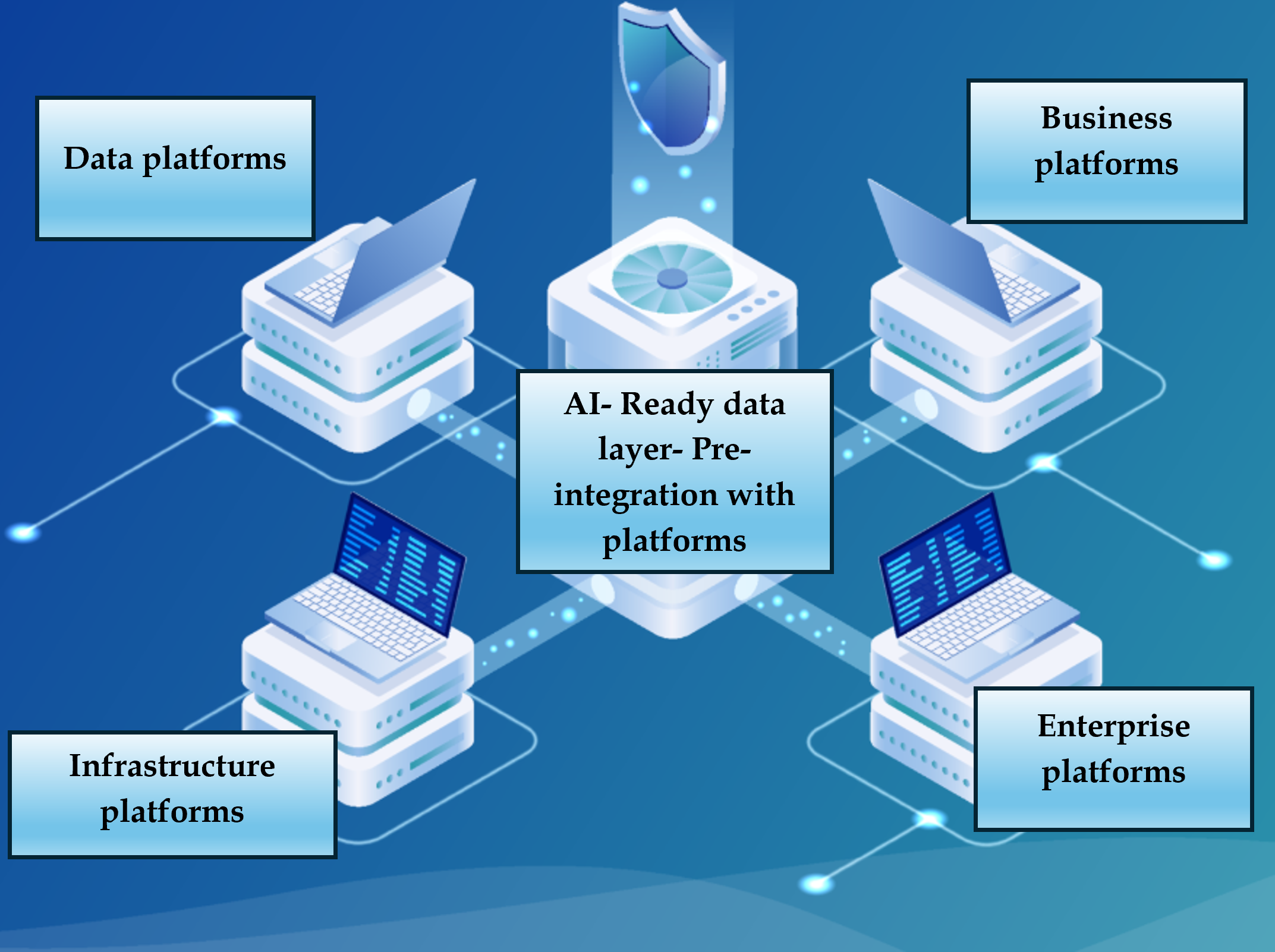
AI platforms with AI-Ready data layer must have pre‑integration with leading enterprise, business, data and Infrastructure platforms ensuring faster deployment and seamless interoperability across client environments.
An enterprise AI platforms/stack must be embedded with all these capabilities but not limited to, for successfully implementing their AI applications that have AI ready data

Conclusion
Overall Enterprise AI platforms readiness relies heavily on the data layers which is ready for AI adoption or implementation.
AI-Ready Data is the critical fuel for running AI applications which enables enterprises run their businesses more efficiently on a day-to-day basis, ultimately driving enterprise transformation and significant business growth /ROI.
This is seamlessly achieved with an AI platform or stack embedding pre-integrated data, enterprise and business platforms with all the crucial data privacy and governance measures in place without disrupting existing applications and systems.
The fact that nearly sixty percent of AI initiatives or projects are abandoned due to non–AI-ready data is not merely an execution gap—it is a strategic blind spot. Enterprises are accelerating investments in AI capabilities while underestimating the foundational role of data readiness, governance, and integration. True competitive advantage will not come from adopting more AI, but from building resilient, AI-ready data ecosystems that can sustain and scale intelligent outcomes.