Introduction
Blockchain technology is being adopted by more enterprises to handle sensitive information, digital assets etc. Blockchain is built on decentralization, distributed ledger and immutability which makes it unique.
APIs play a crucial role in blockchain systems by allowing applications to communicate between blockchain nodes, smart contracts, wallets etc.
What is blockchain API testing ?
Blockchain API testing refers to validating and verifying the APIs interacting with a network works correctly and securely.
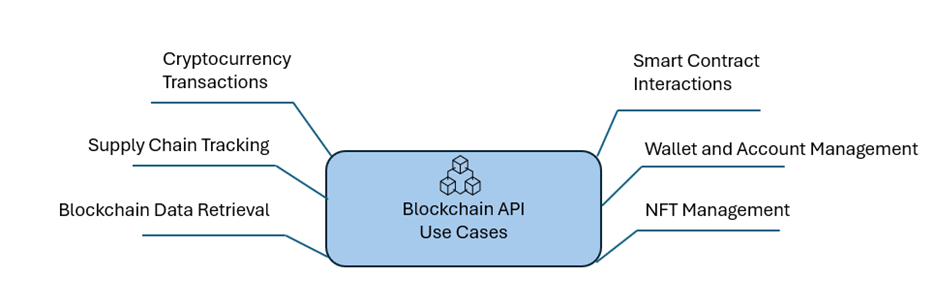
Blockchain API use cases
Factors which make blockchain testing unique
Complexity
Blockchain APIs requires deeper understanding of:
- Cryptographic signing
- Handling asynchronous communication
- Managing private keys and wallets
Immutability
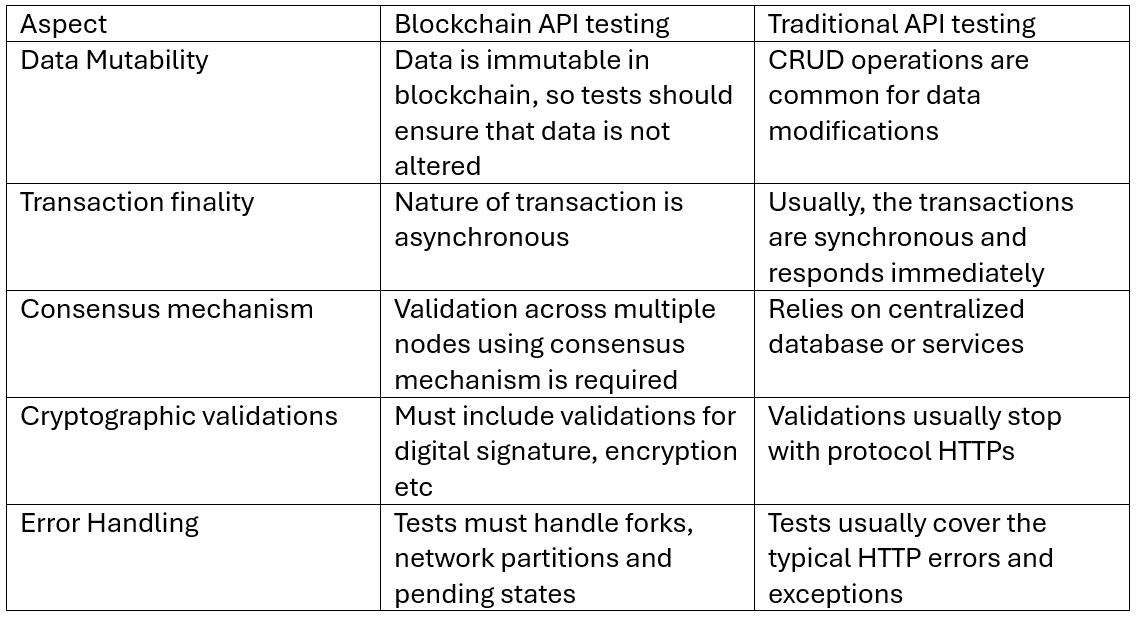
The data once written on the blockchain cannot be altered or erased. This poses a serious challenge in testing and typically involves data manipulation. The mistakes made in the test transactions will be permanent and can disturb the test environment.
Consensus mechanism
Blockchain relies on distributed consensus. Unlike traditional API testing we need to account for transaction confirmation delays and network synchronization.
Asynchronous Transaction
Transactions go through different stages like pending, mined, confirmed etc. Tests should be able to cover the event-driven response and include polling for confirmation.
Distributed Nature
Since the data is distributed across multiple nodes, testing the API consistency across nodes is crucial.
Security, Compliance and Performance
Blockchain APIs deals with sensitive information as it is heavily used in financial transactions. Testing should cover the security aspects like signature validation, compliance checks etc. Simulation of real-time network conditions to check the latency is also crucial.
Blockchain API testing vs Traditional API testing
Types of testing for blockchain APIs
Blockchain API testing refers to testing different aspects of APIs including functional, performance, reliability and security.
Functional Testing
- Verifying the end points performs the expected functionality
- Validate the API response codes and payload for correctness
- Event/log queries – Filtering by topics, block ranges
- Pagination and filtering correctness
This ensures:
- Correct data retrieval
- Proper decoding
- Accurate results for chain state
Security Testing
- Validate the authentication mechanisms for APIs
- Ensure the encryption and signature verification works as expected
- Validate whether secure protocols are used
- Test the APIs for vulnerabilities
Performance testing
- Validate whether the API responds within the stipulated time
- Check the scalability to handle huge transaction volumes
- Verify the timeout and retry mechanisms
Integration testing
- Validate the integration between blockchain nodes and external services
- Validate whether the API is interacting with the nodes and services correctly
Reliability & Resilience testing
Includes test scenarios to see if the API is handling:
- Network timeouts
- Node out-of-sync states
- Pending transactions
- Failover between RPC nodes
Data Integrity testing
Ensures data is correct by checking:
- Transaction status accuracy
- Balance from rest apis vs on-chain balance
- Event log correctness
- Block data reconciliation
Usability & Contract ABI testing
- Ensures REST API responds with human-friendly responses
- ABI decoding correctness
- Data type conversions
Conclusion
Testing blockchain APIs is fundamentally different from testing traditional APIs because block chain system brings in characteristics like immutability, decentralization, asynchronous transaction lifecycle and state changes. Since blockchain transactions are irreversible, error handling and testing negative scenarios are crucial. Event driven data , consensus-driven state changes , signed transactions etc add additional complexities in testing which requires additional testing that account for network delays, fork events and varying RPC implementation. In summary blockchain API testing is unique because it merges the traditional approach with additional validations focused on accuracy, resilience, consistency and security. This makes the testing more complex but robust than the conventional API testing