When Generative AI Meets the Third Dimension

Product names used are fictional and intended solely for illustrative purposes
Generative AI continues to transform how organizations create and interact with digital content. While text, image, and video generation have captured much of the spotlight, a parallel revolution is underway in the world of 3D content creation. Emerging AI platforms can now generate textured 3D models from images or text prompts in minutes, significantly accelerating workflows that traditionally required specialized modeling expertise and substantial development effort.
As part of an internal research initiative focused on AI-driven 3D content creation, conducted in support of emerging technology assessments and future client RFP opportunities, we evaluated several platforms, including Trellis, Hyper3D Rodin, Meshy AI, and 3D AI Studio. Our goal was not only to understand the current state of image-to-3D generation, but also to explore how these technologies may reshape enterprise workflows across digital twins, immersive experiences, simulation, visualization, and product development. The exercise provided valuable insight into both the opportunities and challenges organizations may face as AI becomes increasingly integrated into 3D content pipelines.
Although the technology has advanced significantly, our findings show that the future of enterprise 3D creation is not just about generating assets faster. The larger opportunity is to build intelligent workflows that can reason about geometry, evaluate quality, communicate uncertainty, and work effectively with human creators.
Adapting to the Next Creative Revolution
Technological disruption is not new. Every major advancement in digital content creation has reshaped roles, workflows, and expectations. The challenge is not whether AI will influence the industry, but how creators evolve alongside it. Those who embrace new tools and adapt their skills will be best positioned to create value in the next era of content creation.
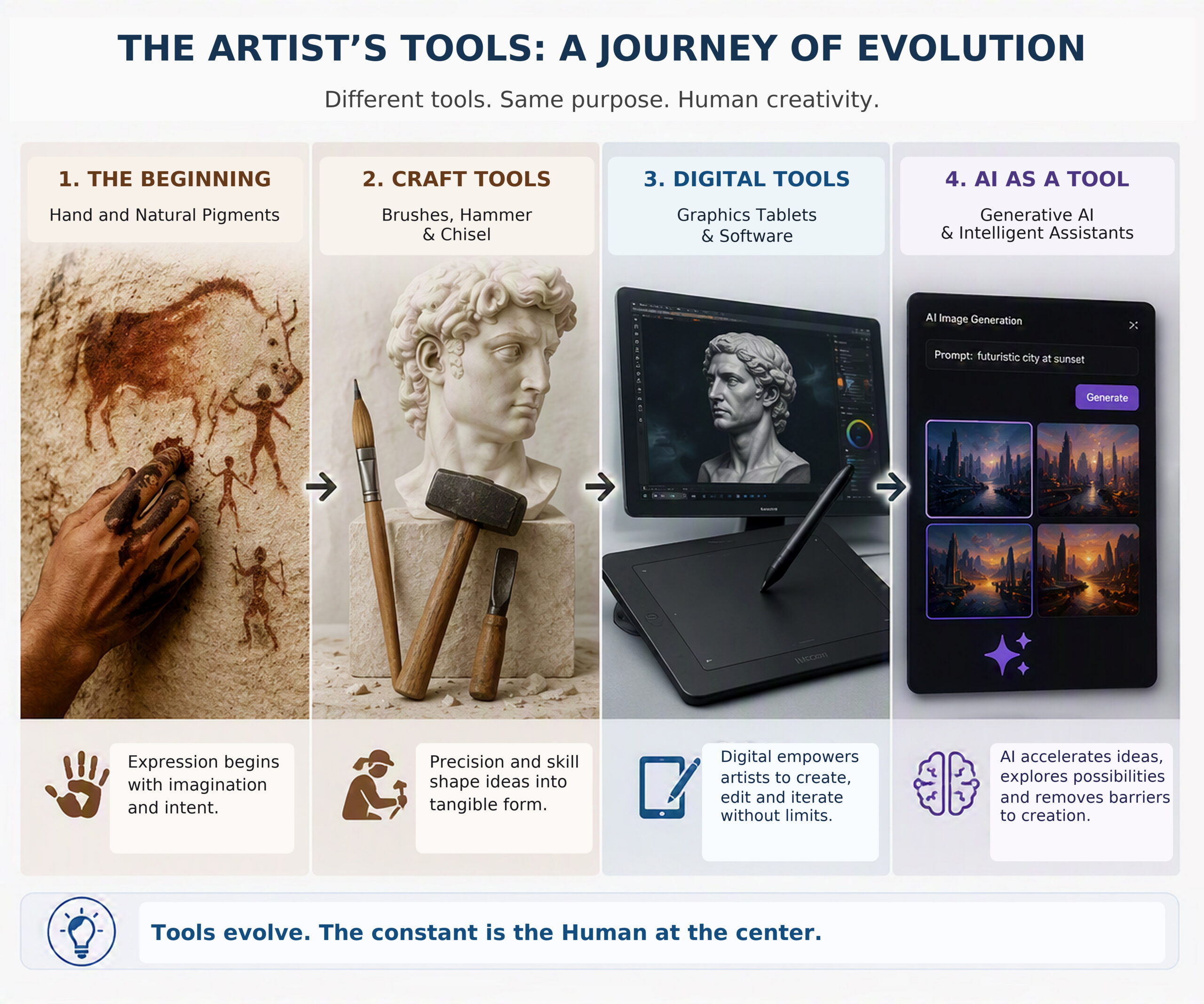
One realization from this exploration is that Generative AI is simply another tool in the hands of an artist. Like the technologies that came before it, AI can accelerate workflows and lower barriers to creation, but it cannot replace creativity, artistic judgment, domain expertise, or human intent. The value has never been in the tool itself, but in how it is used.
As routine production tasks become increasingly automated, uniquely human strengths such as creativity, critical thinking, storytelling, and problem-solving become even more important. The opportunity is not just to generate 3D assets faster, but to combine human ingenuity with AI-powered capabilities to create richer and more meaningful digital experiences.
The Creator’s Dilemma
Years of Learning, Minutes to Generate
As someone who once performed these tasks manually and now helps automate them through AI-driven workflows, I am both excited by their potential and reflective about their implications. The technology was impressive, but the questions it raised may be even more important.
As our team explored these emerging capabilities, I found myself returning to a series of difficult questions:
- If these tools had existed when I entered the work force, would some of the skills that shaped my career still have been necessary?
- If AI can perform many of the tasks that once taught us the fundamentals, how will future professionals develop the judgment that comes from years of practice?
- If execution becomes effortless, will the ability to recognize quality become more important than the ability to create it?
Across many industries, AI is rapidly transforming the types of tasks traditionally performed by junior professionals. In the 3D domain, activities such as modeling, texturing, visualization, and rapid prototyping can now be completed in minutes rather than days. Yet those technical tasks were only one part of the learning journey. My foundation was built through years of studying design, composition, color theory, perspective, storytelling, and visual communication, beginning in fine arts programs and continuing through higher education and professional practice. Those experiences shaped not only how I created content, but how I evaluated quality, solved problems, and transformed ideas into meaningful visual experiences.
The question is no longer whether AI will change creative and technical professions. It already has. The more important question is how the next generation of artists, designers, and engineers will build the judgment, expertise, and critical thinking that earlier generations developed through education, mentorship, experimentation, and hands-on practice.
AI Is Lowering the Barrier to 3D Content Creation
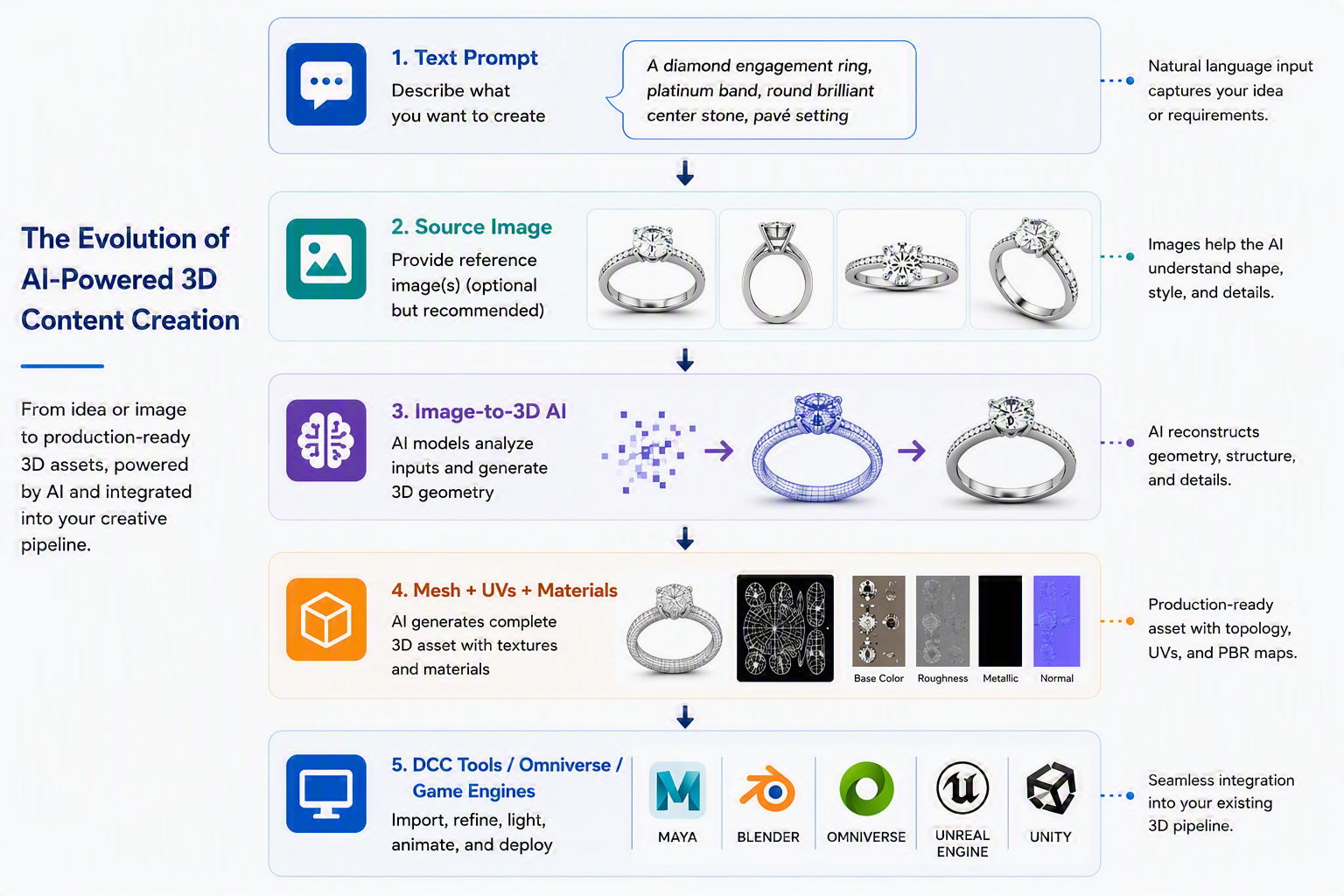
Recent advances in generative AI have dramatically simplified the creation of 3D assets. Modern platforms can automatically generate geometry, textures, UV layouts, and materials while supporting common enterprise formats such as FBX, OBJ, GLB, USD, and STL.
These capabilities are helping organizations accelerate concept development, virtual prototyping, digital twin creation, and immersive experience design. Tasks that once required hours or days of manual effort can increasingly be completed within minutes, enabling teams to evaluate more ideas and iterate more rapidly.
Perhaps most importantly, AI is democratizing access to 3D creation by allowing non-specialists to participate in workflows that previously required extensive technical expertise.
The Real Enterprise Opportunity: Faster Ideation, Not Full Automation
Our evaluation showed that AI delivers the greatest value during the early stages of content creation. Organizations can rapidly generate and compare design alternatives, explore product concepts, and visualize environments long before committing resources to detailed production workflows.
This acceleration has significant implications for innovation programs, product development, customer experience design, and digital twin initiatives. By reducing the time required to move from concept to visualization, AI can help organizations explore a broader range of possibilities while shortening development cycles.
However, despite these advances, consistently producing enterprise-ready assets remains challenging.
Illustrative Time and Cost Considerations
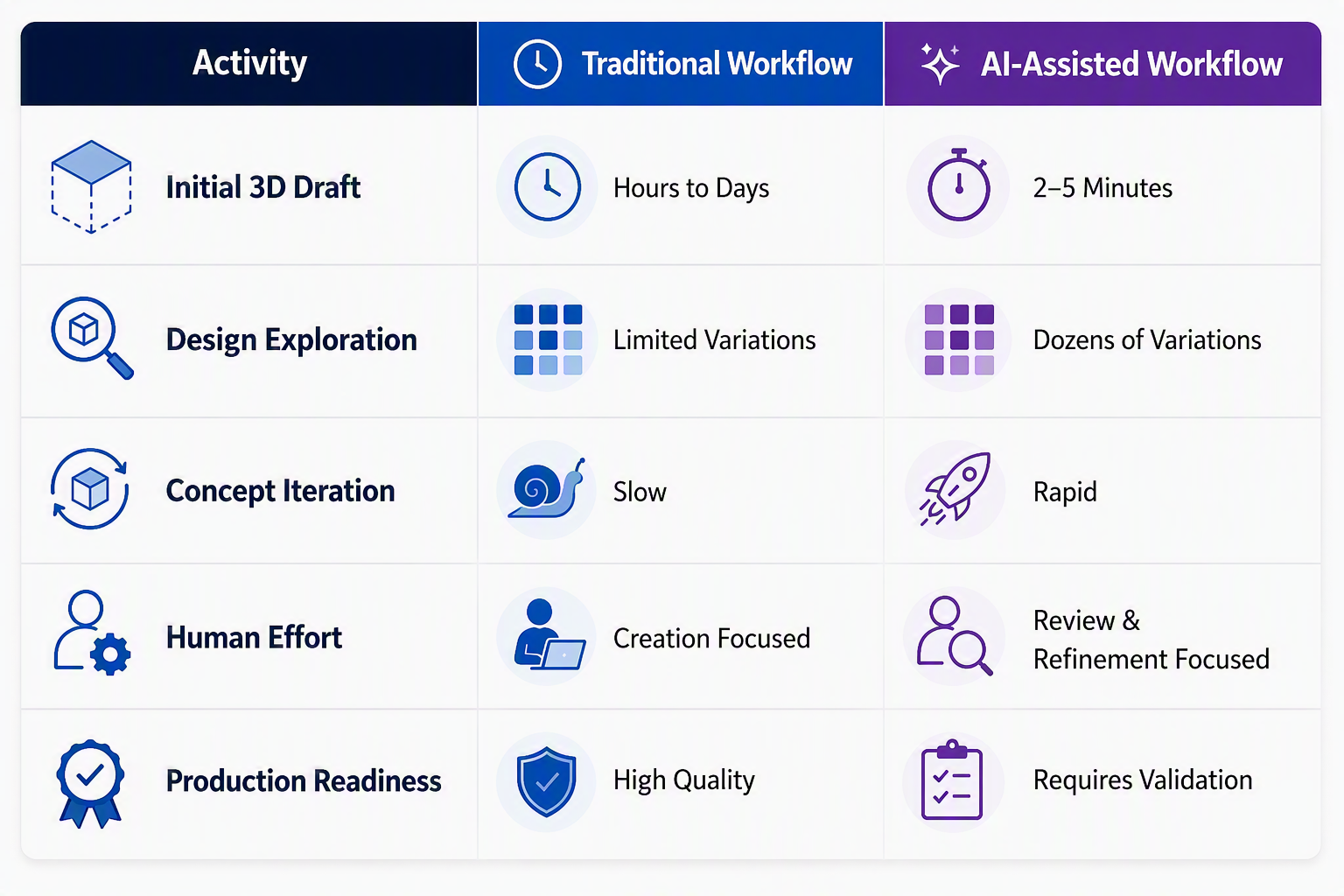
At current pricing levels, an initial AI-generated 3D draft can often be produced in 2–5 minutes (depending on complexity) for ~30–40 cents per generation (excluding retries, geometry / material refinements, and post-processing activities), enabling rapid exploration of design alternatives at a fraction of the time required for traditional modeling workflows.
From Generation to Intelligence: Challenges That Remain
Although current platforms generate impressive results, several common challenges continue to limit first-pass success rates and production readiness.
Understanding Context, Orientation, and Multi-View Ambiguity
Many systems still rely on users to manually identify image viewpoints such as front, side, rear, or perspective views. Real-world imagery frequently contains occlusions, partial visibility, inconsistent framing, and ambiguous angles, increasing the likelihood of interpretation errors that propagate throughout the generation process. Surprisingly, our testing also revealed that providing more reference images does not always improve results. In several cases, supplying multiple viewpoints of the same object introduced additional ambiguity as the model attempted to reconcile conflicting visual information across images. For example, simple cylindrical forms that appeared accurate in a single reference image were sometimes reconstructed as skewed, asymmetrical, or improperly tapered when multiple angles were provided. These findings suggest that current models still struggle with contextual understanding and spatial consistency, and that additional visual inputs can sometimes amplify interpretation errors rather than reduce them.
Separating Geometry from Lighting and Materials
Reflective, metallic, transparent, and translucent materials remain particularly challenging for many reconstruction systems. During testing, harsh shadows, specular highlights, reflections, and light refraction were occasionally misinterpreted as actual surface features rather than lighting effects. This was especially noticeable with luxury product packaging, jewelry, polished metals, gemstones, glass surfaces, and semi-transparent materials.
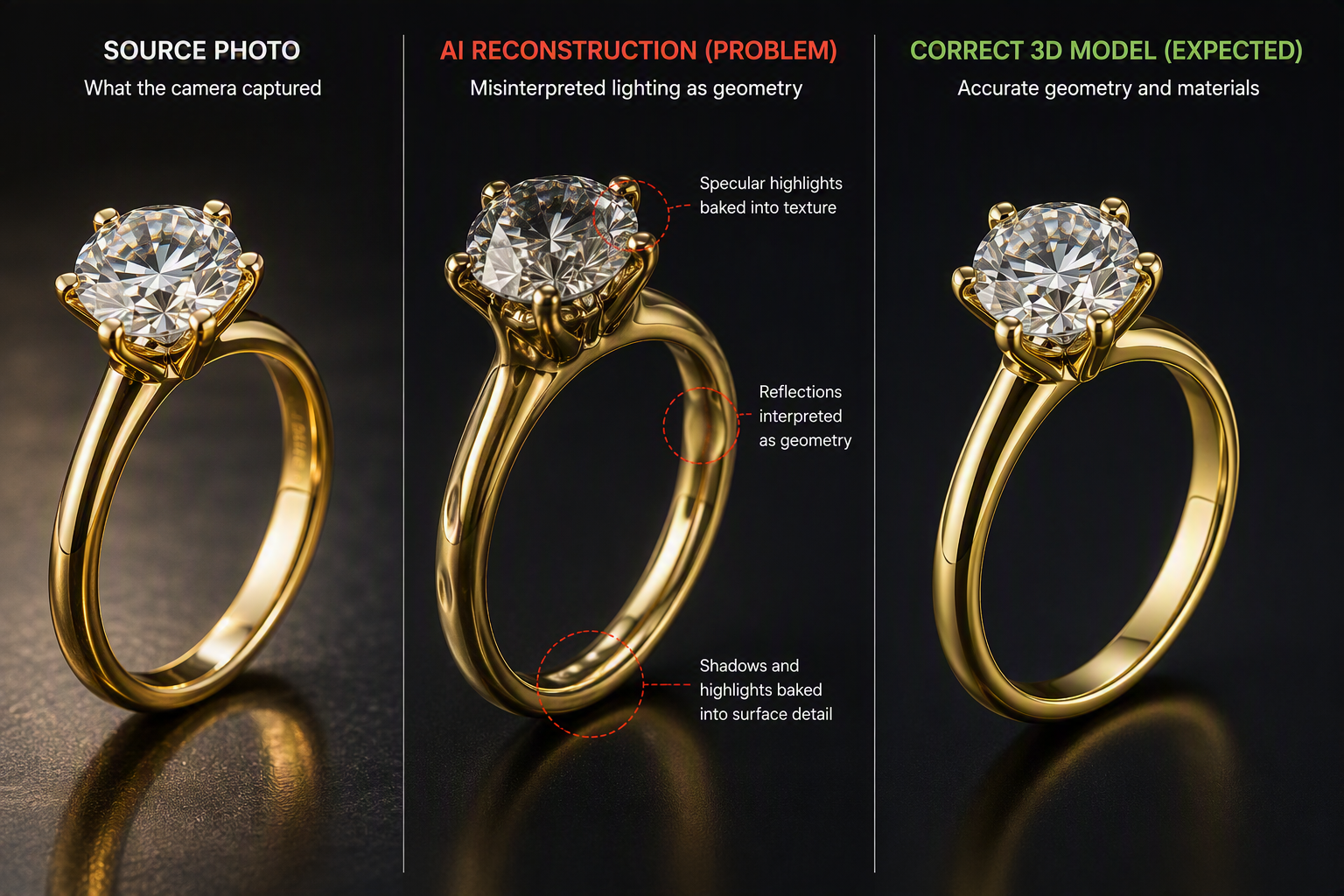
In some cases, reflections, internal highlights, or subsurface light scattering became embedded in the reconstructed textures or were incorrectly interpreted as geometric detail. Reflections that should dynamically change with viewing angle could become permanently baked into the asset, while transparent and translucent regions sometimes obscured an object’s true form, making accurate reconstruction more difficult. These limitations highlight the ongoing challenge of separating an object’s true shape from the lighting, material, and optical properties captured in the source imagery.
Limited Quality Awareness
Many failed generations can often be traced back to issues in the source imagery itself, including viewpoint ambiguity, reflective materials, occlusions, inconsistent lighting, or missing reference angles. This highlights an opportunity for pre-generation Human-in-the-Loop (HITL) validation to identify likely reconstruction risks before tokens are consumed, helping reduce unnecessary retries, improve first-pass success rates, and increase overall cost efficiency.
Even when a generation succeeds, proactive quality assessment remains limited. Structural issues such as distorted proportions, symmetry errors, misaligned components, and incomplete geometry are often discovered only after the model has been created. Because there is frequently limited direct control over the underlying geometry, refinement can become a process of trial and error rather than targeted correction, requiring multiple iterations before acceptable results are achieved.
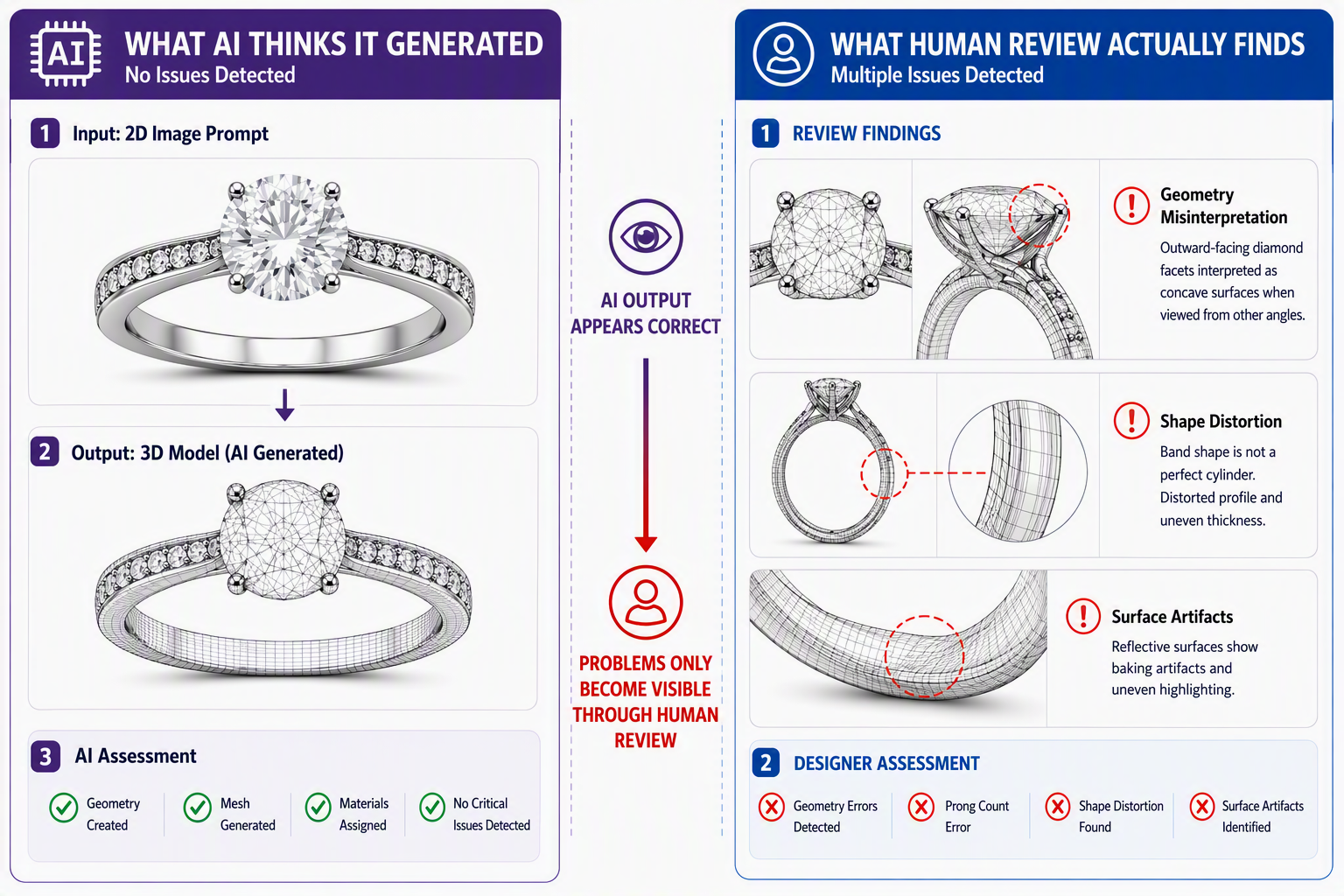
In many cases, an asset may appear convincing from the original viewing angle while concealing issues that become apparent only during closer inspection. Rotating the model, changing the lighting, or viewing it from alternate perspectives can reveal geometry distortions, asymmetry, texture artifacts, material inconsistencies, or missing details that were not immediately obvious during generation. For example, a jewelry model may look correct in a rendered image but reveal uneven prongs, distorted reflections, or inaccurate gemstone geometry when examined from other angles.
These discrepancies may be acceptable for proof-of-concepts, rapid prototyping, and early-stage ideation where speed is prioritized over perfection. However, client-facing deliverables, luxury products, and production-grade assets require a much higher level of accuracy and polish. In these scenarios, the fine details matter, and human review remains essential to ensure the asset can withstand scrutiny from every angle rather than just the one used to generate it.
Minimal Transparency Around AI Confidence
Current platforms rarely communicate uncertainty regarding missing viewpoints, hidden surfaces, orientation assumptions, or inferred geometric details. As a result, users may assume the AI fully understood the source imagery when it may have relied heavily on prediction and approximation.
Collectively, these limitations highlight a broader challenge: today’s systems excel at generating content but provide limited assistance in validating it.
Why Human-in-the-Loop Workflows Still Matter
A key finding from this research is that AI-generated assets should be viewed as an acceleration mechanism rather than a replacement for existing production processes. While generated models often provide a strong starting point, additional refinement is typically required to optimize mesh quality, improve UV layouts, fine-tune materials, and ensure compatibility with downstream visualization or simulation environments. Traditional computer graphics expertise remains essential to achieving the level of accuracy, realism, and performance required by enterprise applications.
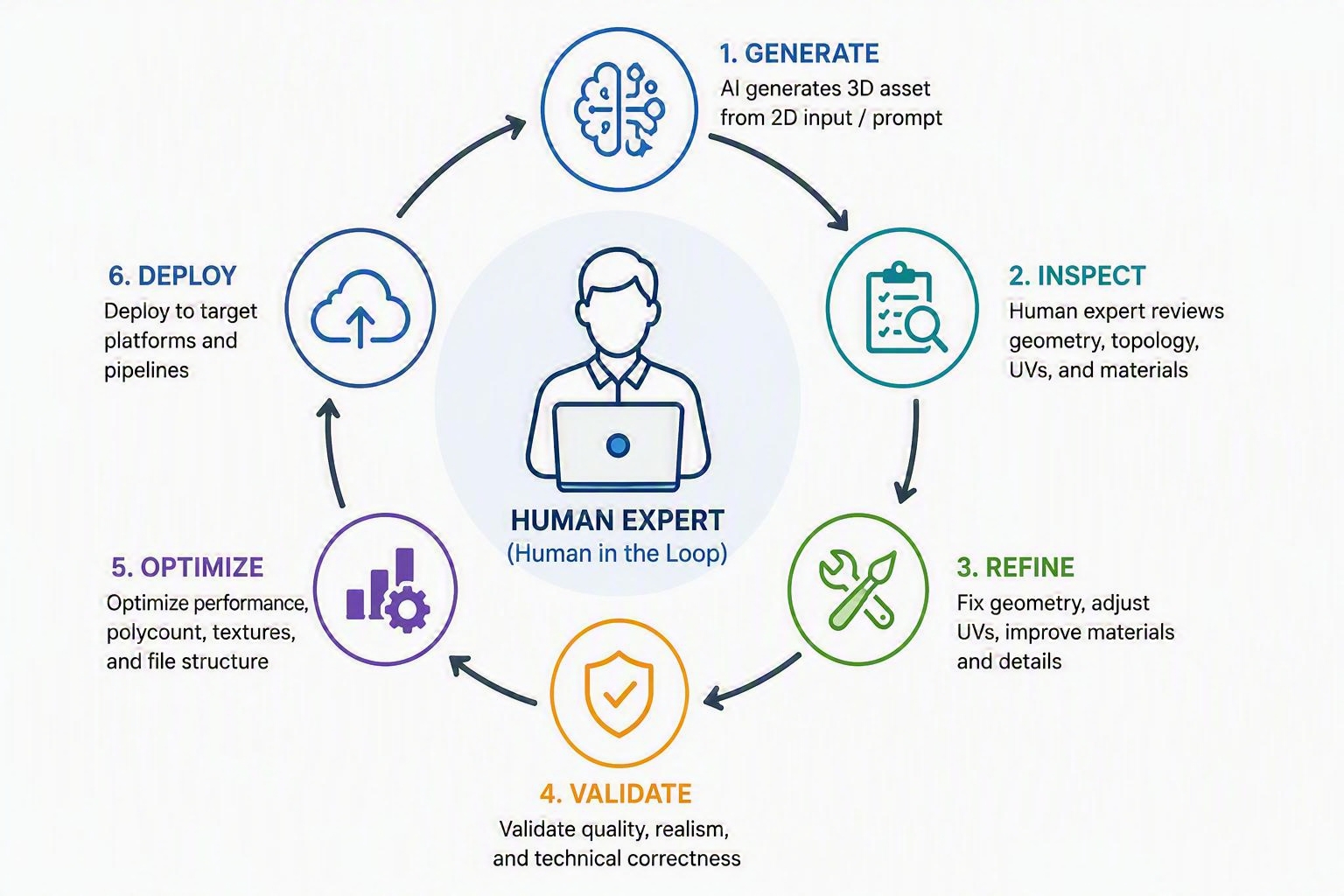
For organizations adopting AI-powered 3D creation, Human-in-the-Loop (HITL) workflows will continue to play a critical role in validating outputs, maintaining quality standards, and ensuring trust in production environments.
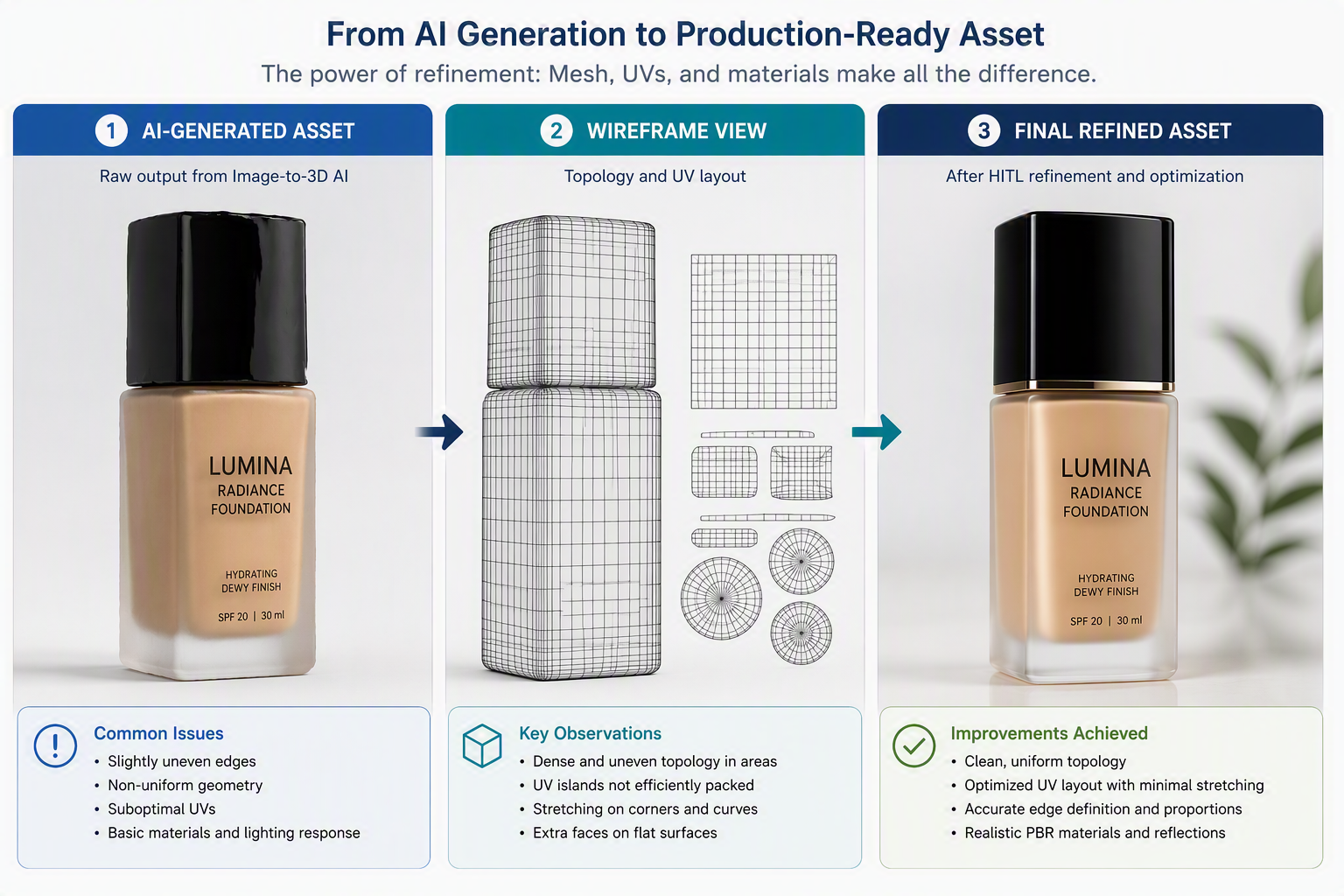
Product names used are fictional and intended solely for illustrative purposes
The Next Frontier: AI-Assisted 3D Content Creation
The most exciting insight from this exploration is that the future of AI-powered 3D creation extends far beyond mesh generation.
Next-generation platforms will likely combine generative AI, computer vision, geometric reasoning, large language models, and automated validation to create systems capable of understanding structure before generation occurs.
Future workflows may automatically identify image orientation, detect symmetry issues, evaluate geometric confidence, validate assets in real time, and proactively recommend corrective actions before the user receives the final model.
This represents a transition from AI-generated 3D assets to AI-assisted 3D engineering workflows, where AI not only creates content but also helps ensure its quality, accuracy, and readiness for enterprise use.
Looking Ahead: From 3D Generation to 3D Intelligence
AI-powered 3D content creation has reached an important inflection point. Platforms such as Hyper3D Rodin, Meshy AI, TRELLIS, and 3D AI Studio demonstrate how generative AI can dramatically accelerate visualization, prototyping, digital twin development, and immersive experience creation.
However, the greatest opportunity lies beyond image-to-3D generation itself. The next wave of innovation will focus on enabling AI systems to reason about structure, assess quality, communicate uncertainty, and collaborate with human experts throughout the content lifecycle.
Generative AI may create the first draft of a 3D asset, but the future belongs to intelligent workflows that transform that draft into a trusted, production-ready digital experience. Through our applied research efforts, we have been exploring these challenges firsthand, evaluating emerging technologies and identifying new approaches to content validation, optimization, and AI-assisted 3D engineering. These insights are not only shaping future enterprise workflows but are also informing a growing portfolio of patent and intellectual property initiatives focused on advancing the next generation of spatial computing and digital content creation.
Acknowledgements
Special thanks to Vishwa Ranjan and Sameer Singh Choudhary for their leadership and support; and the Infosys ICETS team: Abhishek Kumar Tank, Daniel Colon, Sean Marr, Sunil Mukherjee, and Felix Wang for their valuable contributions and collaboration.