Knowing what AI is will not create enterprise value. Capability becomes real when people can apply it safely and repeatedly to the work they are accountable for.
Key takeaways
· AI literacy is necessary but insufficient; capability becomes valuable when it is embedded in real roles and workflows.
· Role-based practice should combine tool fluency, business judgement, risk awareness and human-agent orchestration.
· Learning needs to move closer to work through practice, coaching, communities and performance support.
· Capability should be viewed as an integrated ecosystem that connects employees, the work they do; and the skills, learning and support needed to deliver business value.
AI literacy has become the default answer to an uncomfortable question: is the workforce ready? It is a useful answer, but it is incomplete. Knowing what AI is, how to prompt it and what risks to avoid does not tell an employee how to change the work of finance, engineering, procurement or customer service.
Enterprise capability begins when people can apply AI safely to the decisions and workflows that matter in their role. That requires a different learning architecture.
The starting point is the business value being sought and the work that must change to achieve it- not a list of courses. From there, organizations can identify priority use cases, affected roles, future skill requirements and current capability gaps, then design the right blend of learning and support in the flow of work to achieve the greatest impact.
Literacy is necessary and insufficient
Most organizations begin with broad awareness: what generative AI can do, how to prompt, how to protect confidential information. That is a sensible first step. The problem appears when the same learning offer is expected to change performance across very different roles. A procurement lead, contact-centre manager, engineer and finance analyst do not need the same depth, examples or risk controls.
Capability at scale therefore needs architecture rather than a course catalogue.
Building capability around a shared foundation
Foundation capability covers shared enterprise fluency in responsible use, basic prompting and verification. Role capability applies AI to recurring workflows inside a profession or function. Builder capability enables employees to create reusable assistants, automations or agentic solutions within governed boundaries. Leader capability equips managers and executives to redesign work, make investment decisions and manage risk.
These capabilities build on shared foundation, but they do not form a single ladder everyone must climb. Role, builder and leader capabilities require different depths of practice, matched to the work each person supports. The purpose is to match capability investment to the work people are expected to perform.
Translate capability needs into role-based pathways
A practical model starts with common fluency, then adds role-specific pathway. Each pathway should connect the skills a role needs with relevant use cases, approved tools, a blend of learning and supported practice, and evidence of application. The blend can include concise instruction, practice in a test environment, realistic challenges, coaching, peer feedback and performance support in the flow of work. People should learn with examples from their own function rather than generic demonstrations.
The learning architecture connects skills information, pathway design, content, practice environments and feedback. Learning platforms and approved AI tools enable delivery and reuse at scale; assessments and feedback help tailor support to role, existing capability and working context. Communities, champions and reusable assets allow methods demonstrated in one team to be adapted and governed elsewhere.
From business value to capability at scale
An integrated learning ecosystem – not a course catalogue
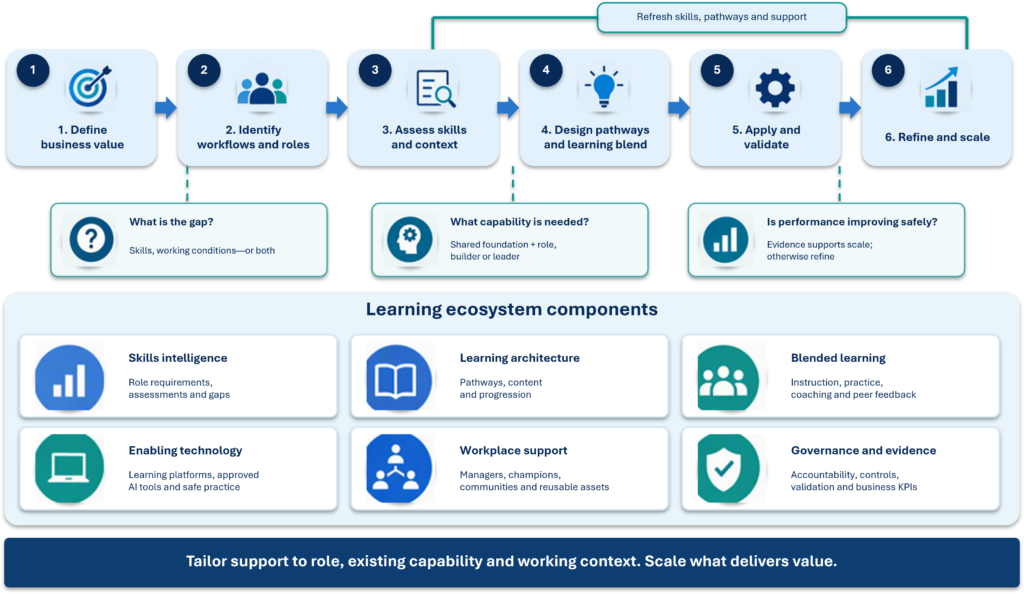
The framework connects business priorities to capability decisions, supported application and a learning ecosystem that enables personalization, reuse and continuous improvement.
Responsible use is more memorable when it is attached to a real workflow. Employees need to understand which data can be used, when human review is mandatory, how to validate outputs and when an AI-generated answer is inappropriate. Human-agent orchestration means deciding what to delegate, where human judgement remains essential, and how outputs are checked and escalated. These decisions belong inside role learning, alongside enterprise governance requirements
Measure capability through performance
Completion rates tell you whether learning was delivered. They do not tell you whether capability exists. Establish a baseline before pilots so that later results can be compared with the starting point. Better measures include quality of outputs, successful use-case application, time to competence, manager observation, reusable assets created and business outcomes achieved. Track these alongside adoption, confidence and use-case maturity, and review progress against the intended business value. The aim is not a workforce that knows about AI. It is a workforce that can use AI to perform better.
Two employees can attend the same AI course and leave with very different ability to create value. The difference is often context: access to good data, permission to redesign work, manager support and repeated opportunities to practice. Capability programs that ignore these conditions risk blaming the learner for an organizational problem.
That is why learning should be connected to a portfolio of real use cases. Employees need safe environments to test examples from their own function, coaching when judgement is difficult and a route for good practices to become reusable. The academy, community and transformation portfolio should reinforce one another rather than operate as separate initiatives.
The easiest AI learning metric is completion. It is also one of the weakest. Enterprise capability needs evidence that learning has transferred into work.
That suggests a different learning architecture: short foundations, role-specific practice, supported application to real work, manager validation and communities that share reusable methods.
The learning model has to move from consumption to application and eventually a shared ecosystem
A repeatable delivery cycle turns learning into application: learn a concept, apply it to a domain problem, review the result with a coach, learning champion or peer, then reuse what works. Employees compare the outcome with the previous way of working and receive feedback on judgement as well as tool use. Concise instruction, examples and repeated practice make this an ongoing capability-building process rather than a one-off course.
The organization can accelerate this by creating role-based challenges, reusable examples, peer coaching and manager-supported practice. To sustain the model beyond launch, build a regular cadence for refreshing content, governance and community support, with knowledge transfer that enables the business to maintain and adapt the approach. In that model, the learning platform is only one component. The real infrastructure is the combination of work, feedback, community and standards that makes better AI-enabled performance repeatable.
Training completion is an input. The stronger measures are whether people can perform target tasks differently, whether quality improves, whether safe usage increases and whether teams reuse proven patterns.
Capability at scale therefore sits between learning and operating model. Business leaders need to own the target outcomes and opportunities to practice; learning teams need to maintain the pathways and supporting assets; technology and governance teams need to sustain approved access and responsible-use boundaries. Together, these responsibilities form the infrastructure that allows redesigned work to become normal work.