AI has moved from buzzword to business priority many firms are realizing that AI is only as good as the data that supports it. Businesses are producing and gathering more data than ever before, but AI initiatives are being hampered by inadequate governance and poor data quality. For example, an industry survey found 39% of data leaders cite data cleaning, integration, and storage challenges as barriers to using generative AI aws.amazon.com.
Similarly, according to Gartner, problems including inadequate controls and poor data quality will cause at least 30% of generative AI initiatives to be shelved by 2025. informatica.com.
In fact, while 87% of organizations expect generative AI to impact their business, 60% may fail to realize AI’s value because of incohesive data governance collibra.com. Without high-quality, well-governed data, even the most advanced AI tools produce biased,
misleading, or risky results. Data governance, not AI, is the foundation.
The Data Challenges Undermining AI Success
Many AI initiatives fail owing to fundamental data issues rather than algorithmic flaws:
• Low Trust in Data: Business leaders frequently report a lack of confidence in the accuracy and consistency of their enterprise data, leading to unreliable AI predictions—the infamous “garbage in, garbage out” dilemma.
• Hard-to-find and siloed data: Without centralized catalogues data is dispersed throughout numerous departments and systems. Due to disparate data sources and inconsistent standards, more than 59% of data officers stated that it is challenging to prepare data for AI use cases.
• Missing Metadata and Lineage: Without comprehensive metadata describing what data exists, its origin, usage, and quality data scientists invest excessive time hunting for data and verifying its trustworthiness.
• Duplicated and Inconsistent Data: When different silos have different versions of the “truth,” discrepancies arise that reduce the accuracy of AI models and lead to misaligned business outputs. Key metrics might have different definitions, which makes AI interpretation difficult.
• Insufficient Governance Skills and Tools: IT & compliance departments may isolate governance from business processes. As a result, there are weak foundations because data policies that protect quality, privacy, and compliance cannot be enforced. The result? AI that makes mistakes, violates compliance, or erodes trust. Regulatory frameworks like GDPR and the upcoming EU AI Act only raise the stakes.
Data Governance: The Basis for Trustworthy AI
Data governance encompasses the processes, roles, tools, and regulations that ensure data is
trustworthy, secure, and usable.
Here’s how data governance unlocks successful AI:
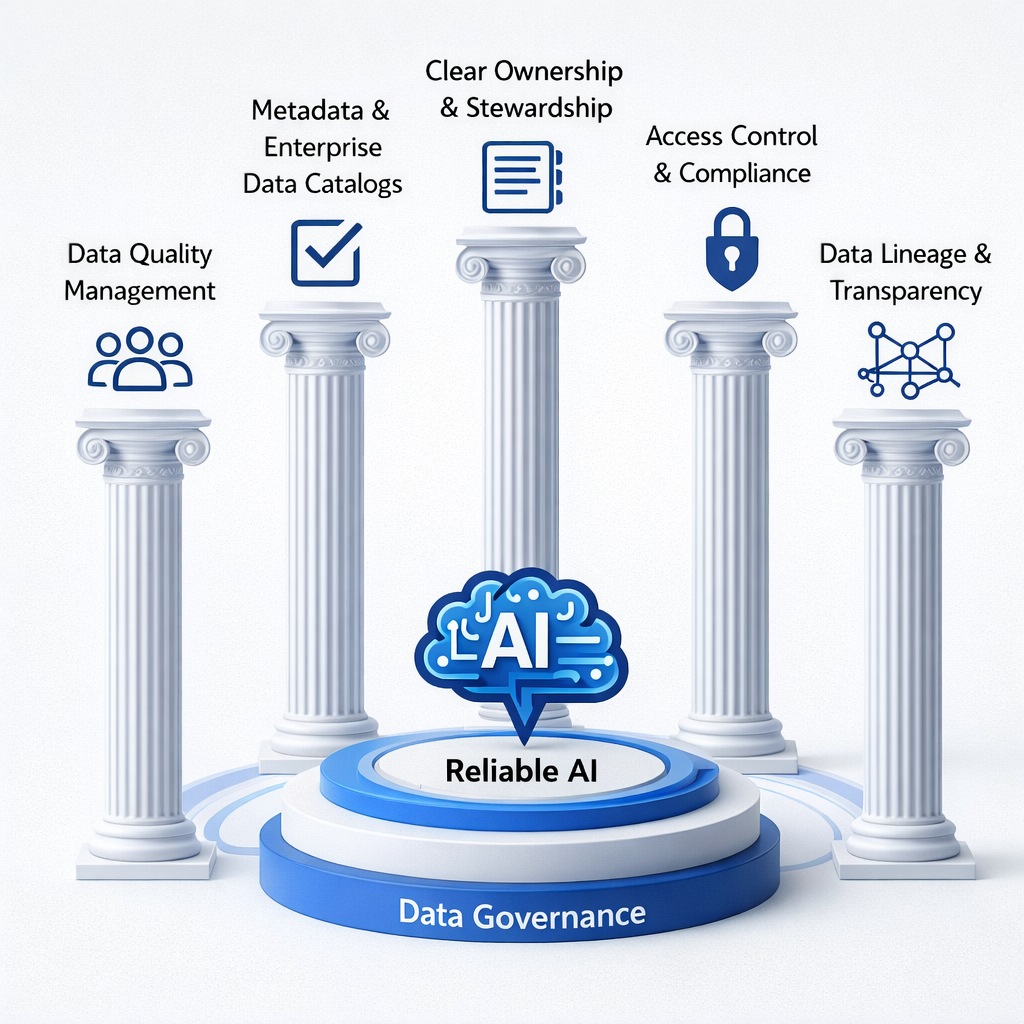
• Data Quality Management: AI models receive consistent, accurate inputs by implementing automated data quality checks, validation, and cleansing, which reduce bias and errors.
• Enterprise data and metadata catalogs: AI-powered enterprise data and metadata catalogs that automatically categorize, index, and monitor data assets. This can be done by documenting centralized definitions, ownership, and usage guidelines, this promotes
discoverability and governance while boosting data literacy and team reuse.
• Clear Ownership and Stewardship: By outlining accountability for each data domain, data custodians are assured to maintain quality and compliance. With leadership support, governance shifts from gatekeeping to business enablement, usually through chief data officers or data governance councils.
• Access Control and Compliance: By preventing leaks and unauthorized use, which are critical in regulated businesses, strong compliance frameworks foster trust with regulators and consumers.
• Transparency and Data Lineage: Understanding the sources and changes of data promotes audit readiness and AI explainability. Lineage reinforces Responsible AI standards by allowing stakeholders to track AI decisions back to validated input data.
Real-World Enabler: Alation as a Governance Accelerator
To illustrate how governance is evolving, take Alation as an example. It is a leading platform in active data intelligence. Apart from the Regular Data Governance features, Alation features include:
• ALLIE AI: By automatically generating metadata and implementing governance rules, it enables rapid, scalable onboarding for new data and AI projects.
• Active AI Governance: Provides a list of all AI/ML resources, enforces rules, and makes it easier to audit and document model data for public oversight.
• Alation Agent Builder: Alation’s latest offering that provides No-Code Customization. Users can use natural language prompts to design metadata-aware agents and tailor them to their use case. Customize with building blocks like model selection, prebuilt agents, and tools from a robust toolkit. Connect to 100+ data sources.
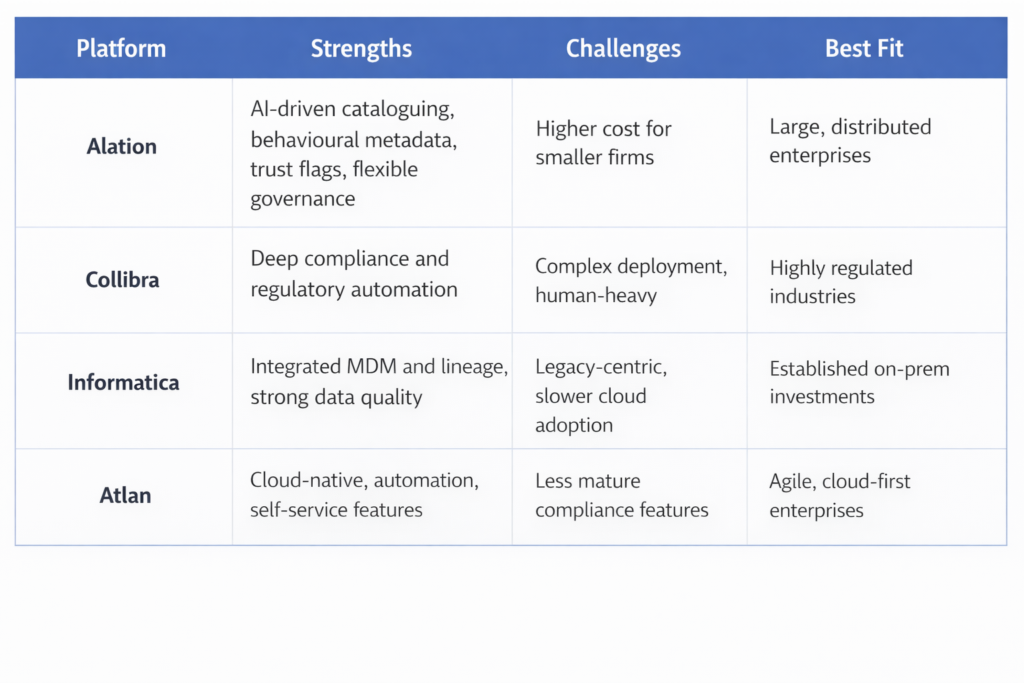
At a glance – How Alation compares:
Now, What Can Organizations Do?
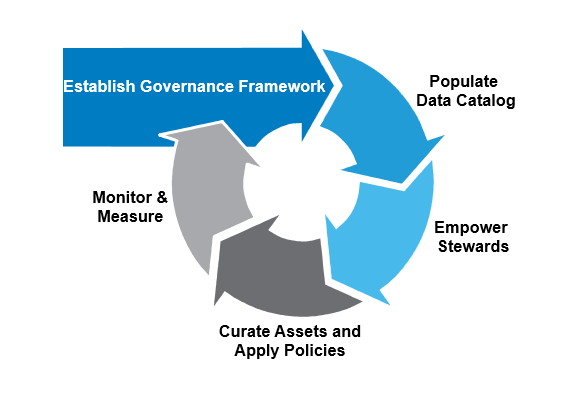
Referencing the cycle in the image above, organizations can embed continuous improvement into their data governance by starting with a clear framework, empowering stewards, curating assets, and driving community collaboration—all reinforced by measurable outcomes.
Conclusion: Governing Intelligence for Confident AI
Data governance is becoming strategic rather than optional as a result of the drive for an AI-driven advantage. By guaranteeing that data is reliable, compliant, and of the highest caliber, governance creates the room for innovation. Businesses can turn governance from a perceived barrier into a scalable engine of intelligent transformation by integrating AI into governance tools, hiring business stewards, and matching governance with practical use cases. The best illustration of this change in governance from static documentation to active intelligence can be found on platforms such as Alation. By doing this, they assist companies in managing their
data and the AI-driven decisions that are derived from it. Manage your data if you want to succeed with AI. It will benefit your business and your algorithms.