For decades, software engineering has followed a fundamental principle: predictable inputs produce predictable outputs. Traditional Quality Assurance (QA) has relied on this determinism to ensure compliant system behavior. However, the rise of AI has significantly changed this paradigm. AI systems are dynamic and probabilistic, requiring new approaches to validation and supervision.
On the ServiceNow AI Platform, capabilities such as ServiceNow Otto, AI Search, Virtual Agent, generative AI (GenAI) skills, and autonomous AI agents far exceed traditional automation. These capabilities can understand context, retrieve information, and generate dynamic responses. Because AI-driven outcomes are inherently probabilistic, quality controls must be embedded throughout the software lifecycle. Quality engineering (QE) for AI ensures that these capabilities are accurate, secure, reliable, compliant, and fit for enterprise use. QE for AI assesses whether the AI systems function as intended and whether their outcomes meet quality and trust standards.
Building confidence in AI outcomes
With AI responses being probabilistic, QE for AI assesses task completion as well as the quality of outcomes against defined standards, such as reusability and alignment with requirements. Unlike traditional QA, where the focus is on accurate execution of workflows, QE for AI evaluates AI-generated responses for accuracy, stability, safety, reliability, and governance. ServiceNow Otto continuously monitors AI interactions and helps identify risks often overlooked in traditional testing.
The six pillars of AI quality
A mature QE practice pressure-tests every AI capability across six dimensions, supported by continuous guardrails. Overlooking any single dimension could undermine the overall quality, reliability, and trustworthiness of AI-generated output. (Refer figure 1: Six pillar of AI QE)
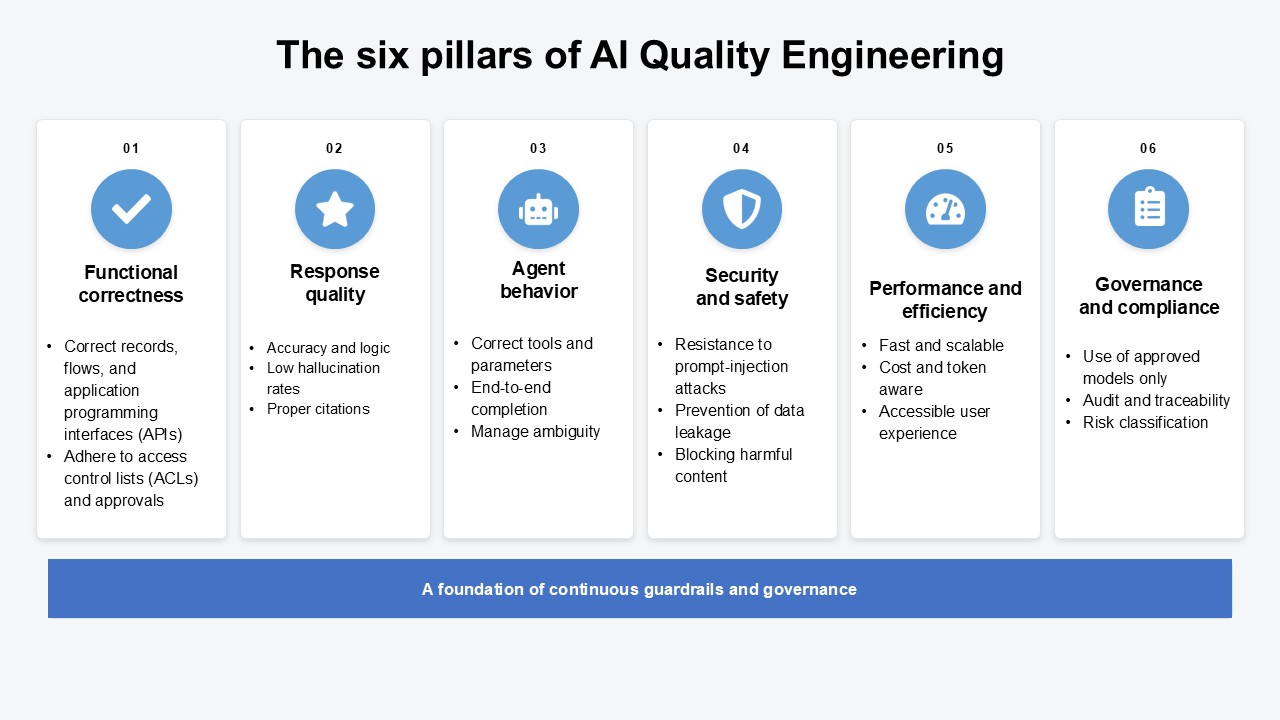
Figure 1: The six pillars of AI QE
AI outcomes you can trust
Golden data flows into the pipeline and a governed, trustworthy outcome flows out. At the center of the system is an AI evaluator that continuously monitors and feeds every insight back into the system to drive improvement. In simple terms, each stage of the pipeline validates and improves the output of the previous stage, while the AI evaluator continuously measures quality, identifies issues, and enables corrective action. This feedback-driven approach helps ensure AI systems remain accurate, reliable, secure, and aligned with business objectives over time. (Refer figure 2: QE validation of AI in ServiceNow)
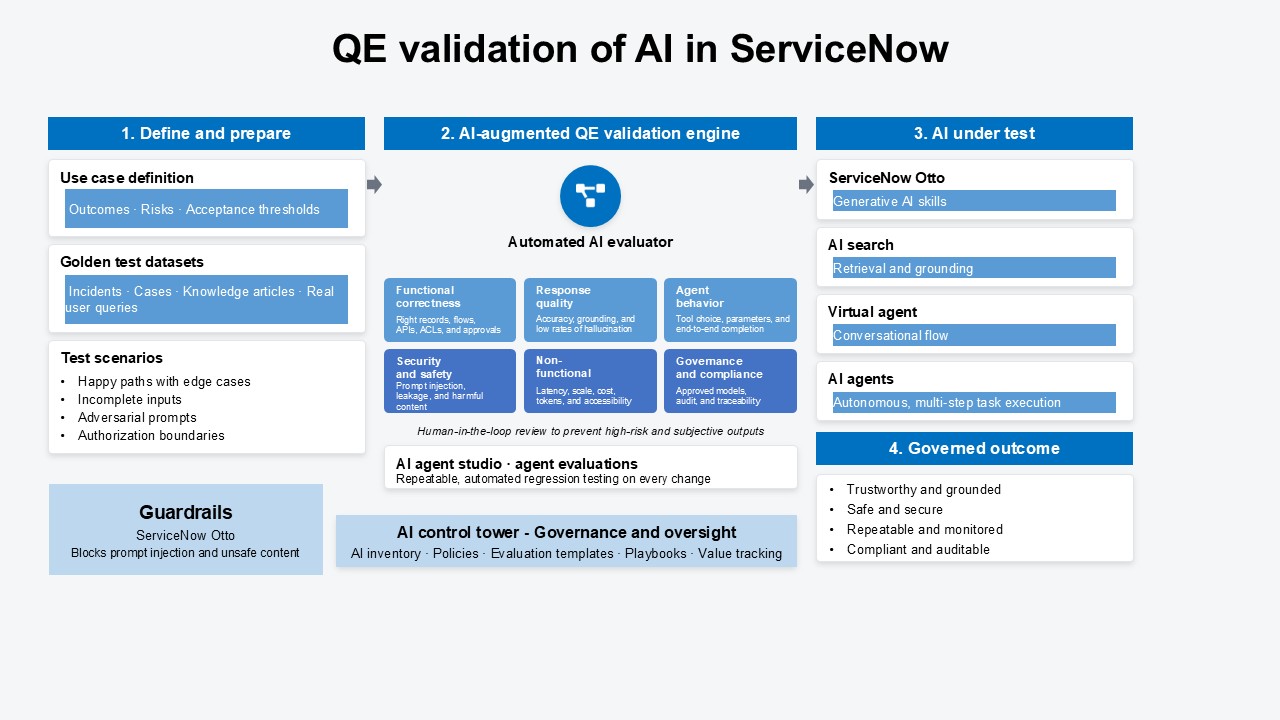
Figure 2: QE validation of AI in ServiceNow
The QE lifecycle
QE for AI is never a case of ‘one and done’. Models drift, prompts evolve, and knowledge sources constantly change. Treating QE as a continuous feedback loop has several advantages:
- Sustained trust over time: AI continues to meet validation and governance expectations, even as models and prompts change
- Early drift detection: Automated regression evaluations identify changes immediately, not after receiving user complaints
- Lower risk exposure: Adversarial and authorization testing help detect safety and governance issues before they reach production
- Faster, better releases: Repeatable evaluations replace slow manual sign-offs, so that teams can ship releases quickly and confidently
- Compounding improvements: Every defect and production signal feeds back into creating better prompts, guardrails, and tests, improving quality with each cycle
The bottom line
AI has made software both more powerful and less predictable. The trade-off is justified only if quality can scale with capability. That is what QE for AI delivers on the ServiceNow AI Platform: an iterative process that makes an agent high-performing while also being dependable.
The organizations that succeed with enterprise AI will be those that can assure regulators, customers, and frontline human agents that their AI is grounded, safe, governed, and reliable. At a time when enterprises are racing to put AI to work, QE for AI can build this trust in the short and long term.