Digital discoverability is shifting from ranked links to synthesized answers. In traditional search, success was measured through rankings, organic clicks and page traffic. In AI-mediated discovery, users increasingly receive answers from generative search, answer engines and assistants that select, synthesize and cite sources. The enterprise or brand visibility therefore depends not only on whether content is discoverable, but whether it is interpretable, extractable, factual, trustworthy and citable. Treating GEO or AEO as a bolt-on marketing tactic will produce short-lived tricks; treating it as a durable capability requires the brand to architect content for machine consumption, not only human consumption. The shift is structural. Analysts expect generative-engine-oriented spend to take an increasing share of enterprise search budgets over the next several years as AI Overviews, chat assistants, and agentic browsing normalize zero-click discovery.
Why This Matters Now
In current world, users ask an assistant for recommendations, but sooner, autonomous agents may evaluate vendors, compare products, gather information, complete forms, make purchasing recommendations, or execute transactions on behalf of users. Generative AI assistants and AI-enhanced search have moved from novelty to default behavior for a large and growing population of consumers.
- Zero-click discovery is becoming the norm. When a generative engine synthesizes an answer directly in the chat window or search results page, users increasingly never visit the underlying website at all. Traditional web-analytics-driven marketing funnels undercount this activity entirely.
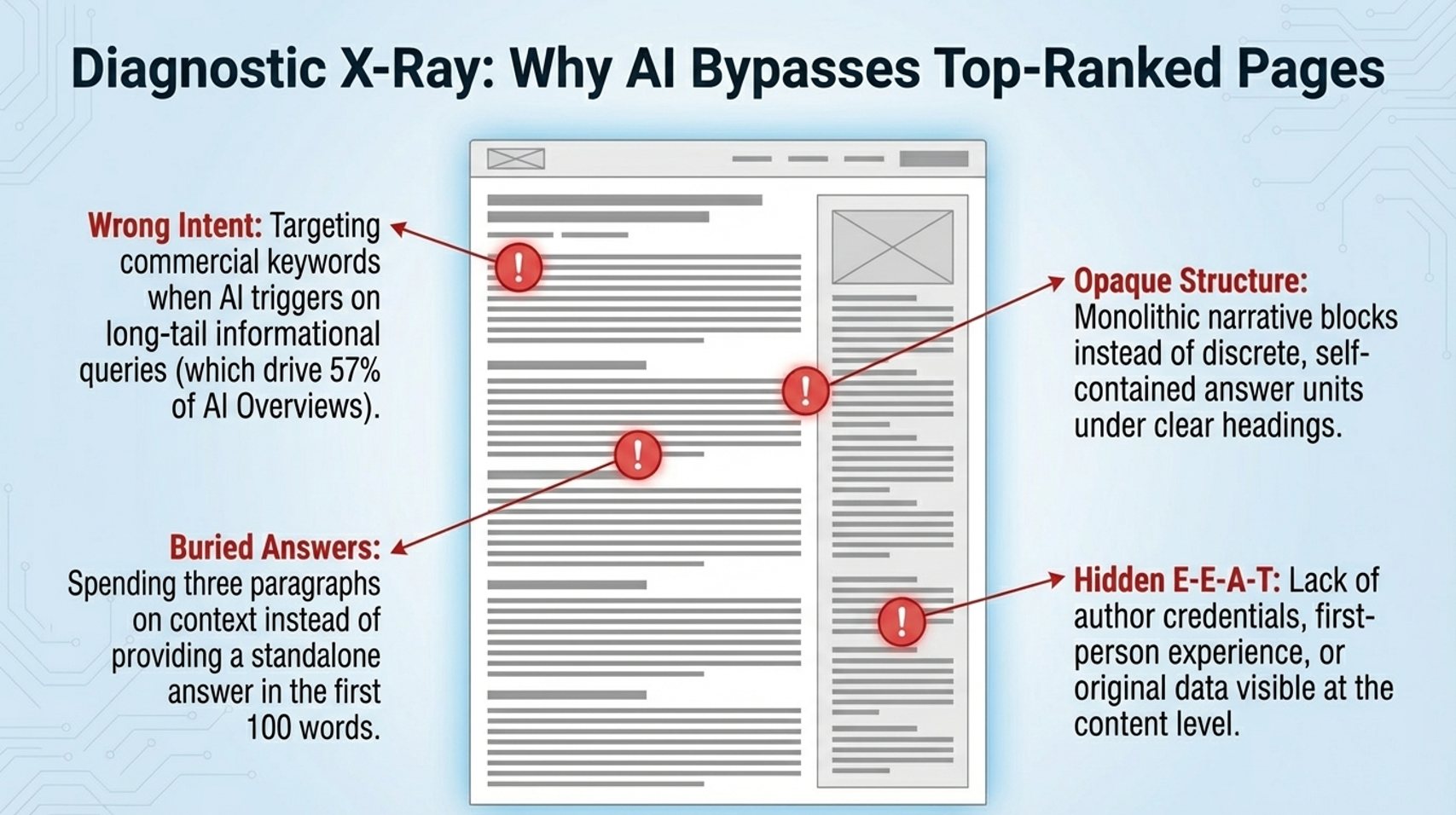
- The competitive set is now the model’s synthesis, not the search results page. An enterprise can rank #1 organically and still be entirely absent from, or misrepresented in, an AI-generated answer, because the model is drawing on a different (and less transparent) set of signals. Only 54.5% of AI Overview citations overlap with organic rankings. Google’s synthesis bypasses nearly half of all top-ranked pages when it builds an answer. Ask ChatGPT, Perplexity, or Gemini the same question a prospect would type, and the brand may simply not appear; no ranking, no visibility, no signal that anything is wrong until pipeline quietly dries up.
- The content and data supply chain feeding these engines is fragmented and largely unmanaged. Product facts, pricing, policies, and positioning live across the corporate website, partner sites, review platforms, documentation, and social channels often inconsistently and models synthesize across all of it.
- The cost of staying invisible is now measurable, and it’s steep.26% of searches that trigger an AI Overview result in zero clicks to any traditional search result at all (Pew Research Center, March 2025). Where an AI Overview appears, organic click-through rates for informational queries drop by 61%. The inverse is just as stark: brands that do get cited in AI Overviews see 35% higher organic CTR and 91% higher paid CTR than their non-cited peers. The queries most likely to trigger an AI Overview in the first place 57% of them are long-tail, informational searches, not the commercial keywords which most SEO programs are still built around.
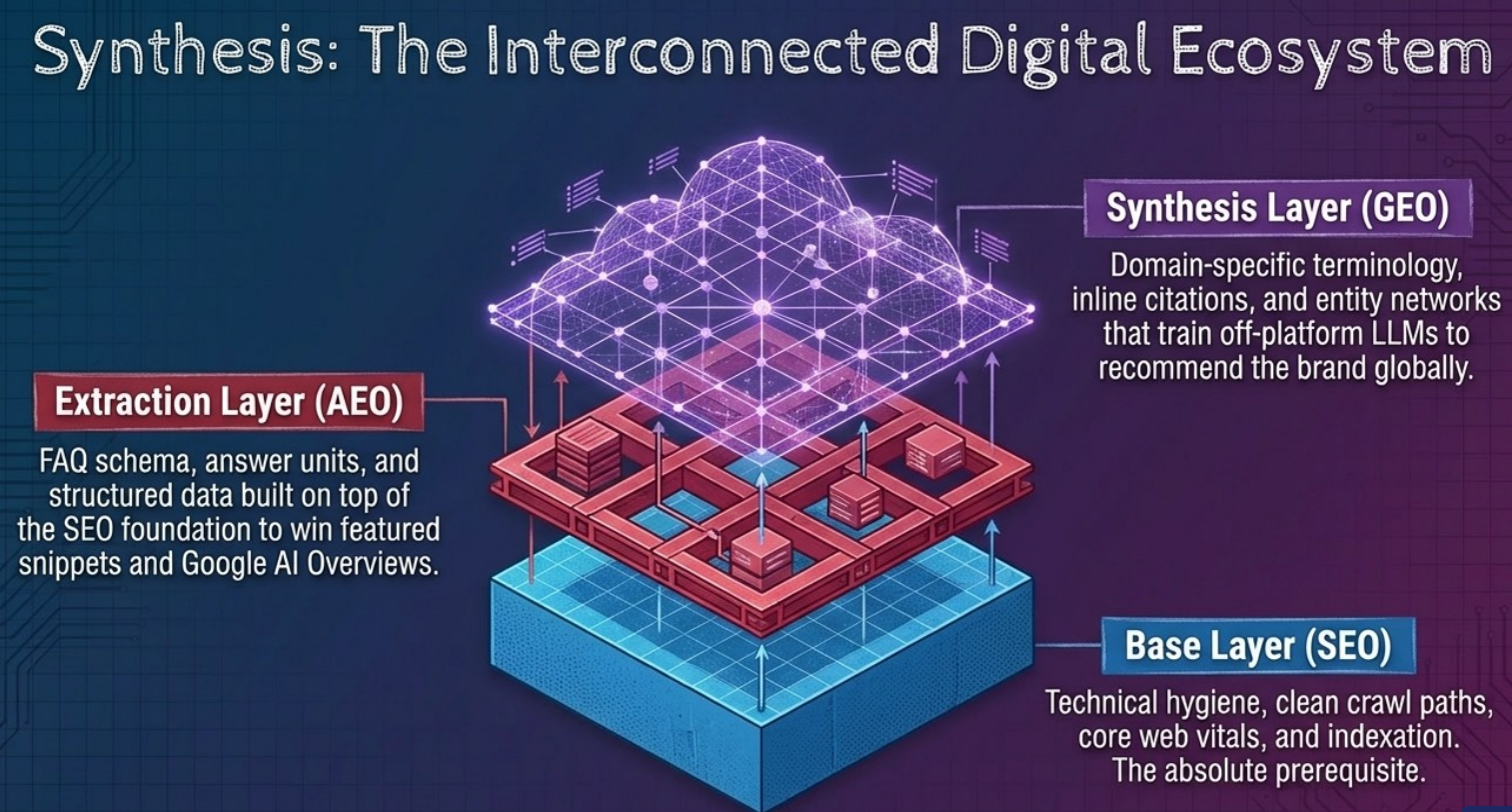
Defining the Terms: SEO, AEO, and GEO
| Dimension | SEO | AEO | GEO |
|---|---|---|---|
| Objective | To improve a brands organizations website’s visibility and ranking in search engine results so that it attracts more relevant organic (non-paid) traffic and ultimately drives business outcomes such as leads, conversions, revenue, or brand awareness. To state it simply for the brands, it would be “Can users find my page?“ | To structure and optimize content so that answer engines and search assistants can easily extract it as the most relevant, authoritative, and direct response to a user’s question. To state it simply for brands, it would be “Can an answer engine extract my content?“ | To make content trustworthy, entity-rich, evidence-backed, and machine-consumable so that generative AI systems cite, quote, recommend, or incorporate it when synthesizing responses. To state it simply for brands, it would be “Will an AI system cite or recommend my content?“ |
| Surface | Google / Bing organic results | Direct-answer surfaces where engines present extracted answers viz. Featured snippets, Google Knowledge Panels, Bing Answer Boxes, Direct-answer cards and rich results, Voice Assistant Responses (Google Assistant, Siri, Alexa) | ChatGPT, Gemini, Perplexity, Copilot, Claude, AI Overviews |
| Primary signals | Backlinks, Core Web Vitals, on-page keywords, authority | Concise, extractable answers; clean structure; schema markup | Entity clarity, corroborated facts, citations, cross-source consistency, freshness |
| Unit of competition | A ranked page | A single extracted passage | A share of the model’s synthesized narrative |
| EA discipline most engaged | Web/CMS architecture, technical SEO, metadata, canonicalization, performance, accessibility | Information architecture, structured data, reusable knowledge blocks, schema, content templates | Knowledge graph, entity governance, provenance, citations, cross-web consistency, API and content-distribution architecture |
In brief, SEO ranks the brands, AEO gets the brand selected as the answer, GEO gets brand/s cited and recommended within synthesized answer. Brands/Organizations need a foundation that serves all three, because the underlying signals authoritative, well-structured, accurate, entity-clear content substantially overlap.
GEO or AEO is often initiated inside marketing or digital experience teams, and tactically it should stay close to them. But the durable capability requires architecture decisions that sit outside marketing’s traditional remit.
- Entity and master data management: Models increasingly reason over entities (organizations, products, people) rather than keywords. If product names, pricing, and organizational facts are inconsistent across systems and public sources, the model inherits that inconsistency.
- Content and knowledge architecture: A single-sourced, versioned repository of authoritative facts (product specs, policies, pricing, claims) reduces the risk of models citing stale or contradictory information scraped from disparate pages.
- Distribution and access architecture: Brands or Enterprises need an explicit, governed policy for what AI crawlers and agents may access extending robots.txt-era thinking to newer conventions such as llms.txt, agent-facing content APIs, and CDN-layer content variants for machine consumers.
- Identity, licensing, and IP: Brands or Enterprises must decide what content they are comfortable having ingested and re-served by third-party models, including licensing implications for premium or proprietary content.
- Measurement and observability: Unlike web analytics, AI-answer visibility is not natively instrumented; enterprises need a monitoring layer purpose-built to sample prompts and track citations across multiple engines.
- Governance and risk: Misattribution, outdated facts, and hallucinated claims about the enterprise carry brand, legal, and compliance risk that existing content-governance processes were not designed to catch.
AI Search Engine Specific Implications
Each major AI search engine weighs signals differently. A single generic content strategy will underperform; hence engine-aware variants and monitoring should be implemented. However, because AI search engine behavior and market share shift quickly, the monitoring layer should be treated as a living capability, re-baselined at least quarterly rather than configured once and left static.
| Surface | Architectural Implication |
|---|---|
| Perplexity | Rewards freshness and multi-source corroboration; benefits from a reliable content-freshness and republishing cadence, plus presence across third-party review and comparison sites. |
| ChatGPT / OpenAI Search | Blends live retrieval with model training exposure; long-form, well-structured, entity-rich pages and consistent brand facts across the web both matters. |
| Microsoft Copilot | Leans on Bing’s index and on professional/social sources; enterprise B2B presence (e.g., company and analyst-style content) carries disproportionate weight. |
| Gemini | Multimodal-aware; incorporates images, video, and structured data more heavily than text-only engines. |
| Claude and Other Assistants | Prioritizes comprehensive, well-organized long-form material and clear sourcing over short marketing copy. |
GEO /AEO sit at the intersection of marketing, content, legal/compliance, and technology. A workable operating model assigns clear ownership across four roles:
- Marketing / Content Strategy: owns messaging, positioning, and the editorial calendar for citation-worthy content.
- Enterprise Architecture: owns the architecture elements on entity model, structured data standards, distribution and access policy, and integration with the enterprise data and API landscape.
- Legal / Compliance / Risk: reviews claims for accuracy and regulatory exposure before they are exposed as machine-readable, highly citable facts, and monitors for misrepresentation once published.
- Data & Analytics: operates the monitoring layer, integrates AI-visibility metrics into existing marketing and digital dashboards, and validates data quality of the entity graph.
A recurring governance forum (monthly during build-out, quarterly once mature) should review the emerging engine behavior changes, accuracy of AI-surfaced claims about the enterprise, structured-data coverage and drift, and any misinformation or IP concerns surfaced by monitoring.
Principles for AI-Mediated Discovery
- Treat agents as a first-class digital channel.
- Design content for humans and machines simultaneously.
- Publish facts once; reuse everywhere.
- Manage entities centrally.
- Treat provenance as a first-class architectural concern.
- Measure representation, not simply traffic.
- Continuously monitor AI visibility.
- Build discoverability into enterprise architecture, not marketing campaigns.
Implementation Roadmap
| Phase | Focus | Exit Criteria |
|---|---|---|
| Assess | Baseline current visibility across major AI engines; inventory content, schema, and entity data; identify quick technical fixes. | Documented baseline share-of-model score; prioritized gap list. |
| Foundation | Establish entity and structured-data layer; fix crawlability and llms.txt / robots policy; consolidate authoritative content sources. | Clean schema coverage on priority pages; consistent entity facts across owned properties. |
| Activate | Publish and refresh high-authority, citation-worthy content; expand presence on third-party review/comparison sources; stand up monitoring. | Measurable increase in citations/mentions across target engines. |
| Scale & Govern | Automate monitoring and content refresh; formalize governance, accuracy review, and risk controls; integrate GEO/AEO KPIs into standard marketing and EA reporting. | GEO/AEO embedded in BAU governance with recurring executive reporting. |
AI Discoverability Diagnostic Framework
Measurement principle should move beyond rankings and clicks. Citation presence tracking, response position, semantic compatibility, representation quality, evidence readiness, extractability and content freshness as directional indicators of AI discoverability maturity.
| Diagnostic Dimension | Assessment Question | Example Remediation |
|---|---|---|
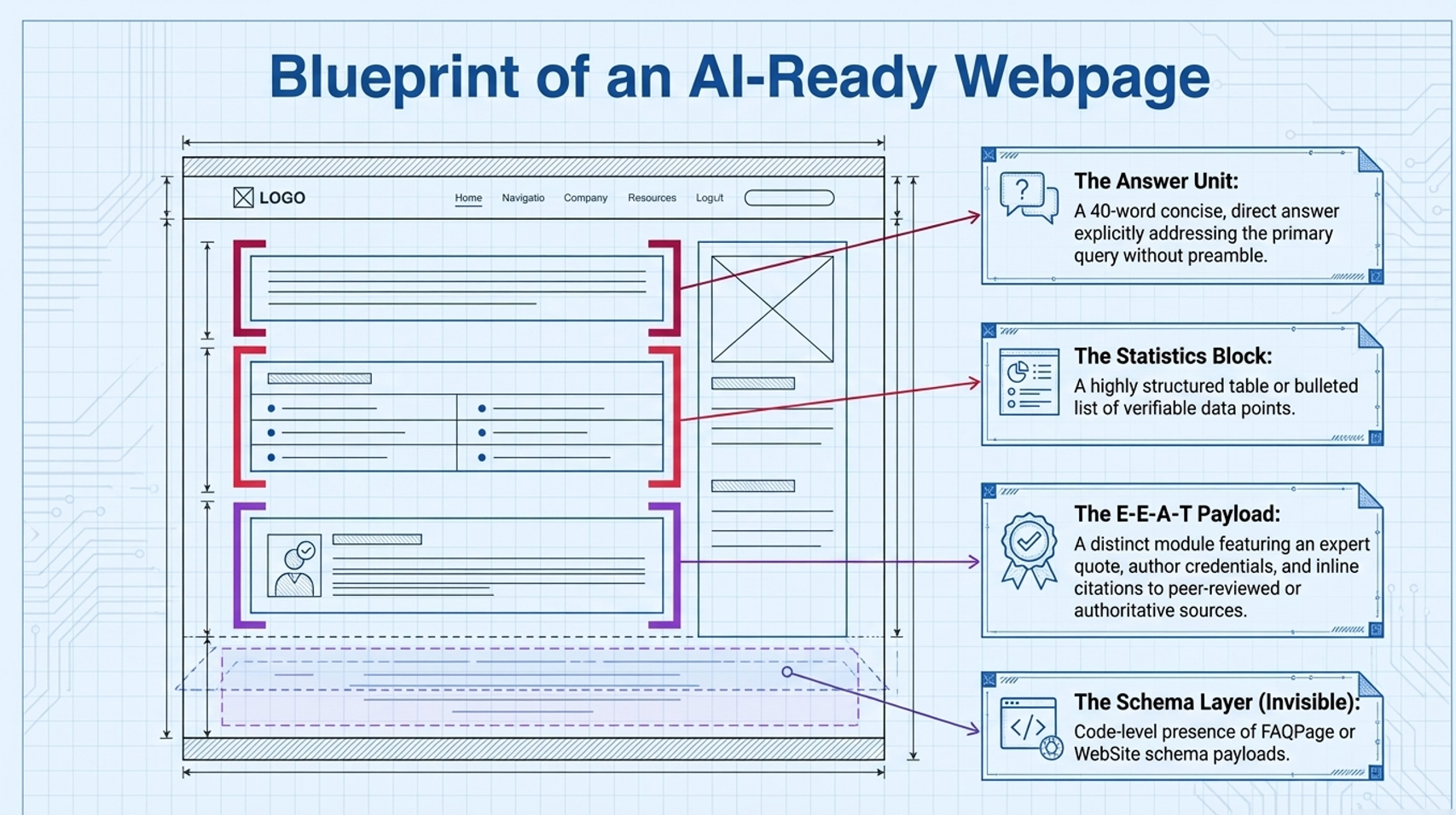
| Extractability | Can the page provide clean, concise answer units? | Add answer-first summaries, FAQs and scannable sections. |
| Factual Density | Does the content include verifiable facts and evidence? | Add statistics, tables, dates, benchmarks and source citations. |
| Citation Readiness | Are important claims backed by credible sources and provenance? | Create a citation policy and claims register. |
| Entity Clarity | Are products, services and terms consistently defined? | Align taxonomy, metadata, schema and canonical descriptions. |
| Governance Scalability | Can the assessment repeat across brands, markets and domains? | Create reusable scoring rubrics, templates and review cadence. |
Watch Outs for GEO
| Watch Out | Control |
|---|---|
| Generative AI systems do not guarantee citation or inclusion of any specific source. | Position GEO as eligibility, interpretability and trust improvement, not output control. |
| AI-generated responses vary by model, prompt, retrieval design and time. | Use periodic monitoring and trend analysis rather than one-time validation. |
| GEO complements SEO and AEO as an evolving discipline. | Maintain foundational SEO and AEO practices while improving evidence, entities and provenance. |
| Third-party metrics may be directional rather than definitive. | Validate tool signals with first-party analytics, official guidance and governance review. |
The brands or enterprises response to GEO and AEO should not be a campaign of optimization hacks. It should be a durable architecture capability for making enterprise knowledge accurate, structured, evidence-backed, governed, measurable and ready for AI-mediated discovery.
The future of discoverability is not fundamentally about search. It is about knowledge. The enterprises that succeed will not simply create better content. They will architect knowledge as a strategic asset: structured, governed, trusted, machine-readable, observable, and consumable by humans, AI assistants, and autonomous agents alike.
In an AI-mediated economy, visibility is no longer a marketing outcome. The organizations that master it will shape not only what users find, but what AI systems know, recommend, and ultimately act upon.
References:
https://developers.google.com/search/docs/fundamentals/ai-optimization-guide
https://arxiv.org/pdf/2311.09735v1
https://www.seerinteractive.com/insights/aio-impact-on-google-ctr-september-2025-update