Global retail e‑commerce sales reached approximately US $6.42 trillion in 2025 and are projected to grow to about $6.88 trillion representing 21.1 percent of global retail in 2026. Despite growing investments in AI, many retailers still face challenges in embedding intelligence across the end-to-end customer journey and struggle to operationalize AI beyond isolated use cases. Search experiences frequently depend on keyword matching, recommendation systems often rely on static business rules, and conversational interfaces remain limited in contextual understanding. Bridging the gap between AI ambition and enterprise-wide deployment requires addressing three persistent constraints: cost, latency, and data governance.
Cost: Running LLM inference at scale for millions of daily sessions can introduce significantly higher infrastructure costs than task-specific AI systems, particularly for high-volume retail workloads such as search, recommendations, and customer service interactions.
Latency: Retail experiences frequently require near real-time responses, making inference latency a critical consideration when deploying large language models in production environments.
Data Governance and Privacy: Processing customer data through external AI services can introduce additional privacy, regulatory, and data residency considerations.
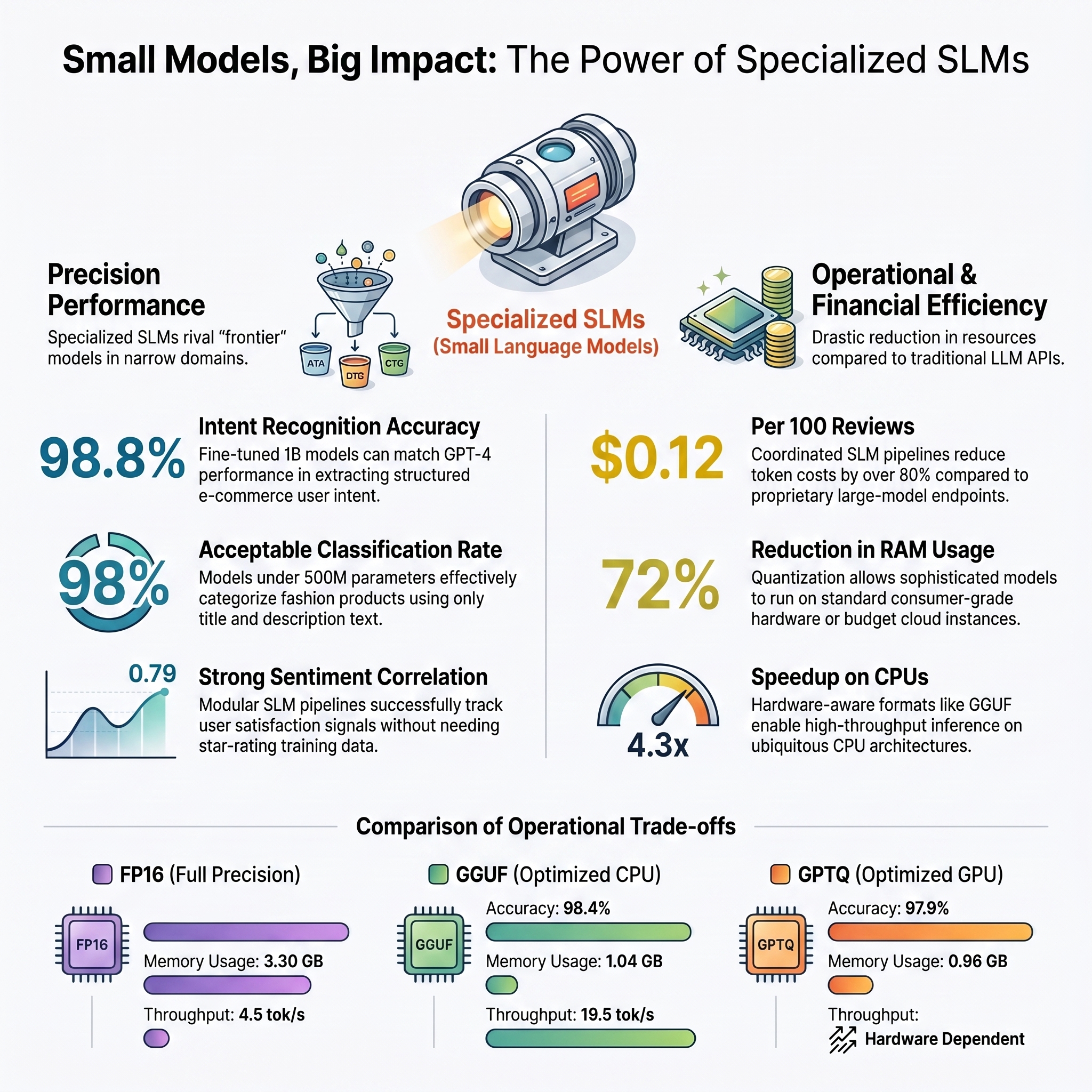
Small Language Models (SLMs) offer a pragmatic alternative while maintaining sufficient performance for many retail use cases making them viable option for organizations seeking to balance intelligence, efficiency, and operational control.
Many of the highest-volume AI workloads in eCommerce are well-defined and domain-specific. Product search must interpret purchase intent within a retailer’s catalog. Returns and service assistants operate within established policies and workflows. Recommendation engines rely on structured product attributes, customer preferences, and behavioral signals to drive relevance.
For these narrowly scoped use cases, Small Language Models (SLMs) can often deliver strong performance when tailored to the retailer’s domain. Unlike general-purpose LLMs, which are designed to address a broad spectrum of tasks and knowledge domains, SLMs can be optimized for specific retail workflows with lower computational requirements. The result is a practical balance of performance, cost efficiency, latency, and deployment flexibility for many enterprise retail applications.
Key Use Cases Across the Storefront Lifecycle
Intelligent Product Search & Discovery
Traditional keyword search fails to capture semantic intent. SLMs power semantic vector search, query rewriting, and intent classification at the sub-100ms latency required for real-time search experiences.
- Query Understanding: Classify search intent (informational, navigational, transactional) and expand queries with semantically related terms
- Catalog Embedding: Generate rich product embeddings capturing style, occasion, material, and use-case relationships
- Conversational Search: Multi-turn product discovery dialogues maintaining context across refinement queries
- Visual + Text Fusion: Lightweight vision-language SLMs enabling image search with text refinement on mobile
Hyper-Personalized Recommendations
SLMs enable a qualitative leap from collaborative filtering to reasoning-based personalization — processing a customer’s stated preferences, purchase history, browsing behavior, and contextual signals (time, device, session context) to generate individualized recommendations with explainable rationale.
- Session-Aware Recommendations: Real-time inference over current session context to surface intent-aligned items
- Outfit & Bundle Building: Reasoning over product attributes to compose coherent ensembles (fashion, lifestyle)
- Personalized Homepage Curation: Dynamic content assembly based on SLM inference over user preference vectors
- CRM Personalization: Individualized subject lines and product selections for email and push campaigns
Conversational Commerce & AI Assistants
- Product Q&A: Grounded answers to specific product questions from structured catalog data via RAG
- Shopping Assistants: Guided selling dialogues that help customers articulate and satisfy needs
- Size & Fit Advisory: Personalized size recommendations from fit data and return pattern analysis
- Gifting Advisor: Contextual gift recommendation based on recipient profile and budget
Customer Support & Post-Purchase
- Automated WISMO (Where Is My Order): Real-time order status with proactive issue detection
- Returns & Exchange Processing: SLM-guided returns eligibility, instructions, and alternatives
- Complaint Triage: Sentiment-aware routing to the appropriate support tier
- Post-Purchase Engagement: Review solicitation, cross-sell, and loyalty program enrollment
Catalog Intelligence & Merchandising Operations
- Automated Product Descriptions: SEO-optimized, brand-voice-consistent copy generation from structured attributes
- Category Taxonomy Classification: Automatic hierarchical classification of products
- Attribute Extraction: Structured attribute extraction (color, material, dimensions) from unstructured supplier content
- Content Moderation: Automated review of user-generated content against community guidelines
Enterprise Reference Architecture
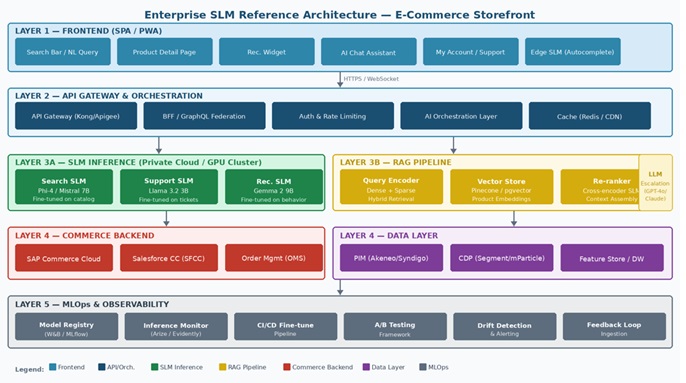
The diagram below illustrates a production-grade enterprise SLM deployment spanning six architectural layers — from the customer-facing frontend through API orchestration, SLM inference, RAG pipeline, commerce backend systems, data platforms, and MLOps infrastructure.
SLM vs. LLM: A Practical Decision Framework
The choice between SLMs and LLMs for a given retail use case should be driven by task requirements, latency needs, data governance constraints, and cost targets and not general AI prestige. The following framework enables systematic task routing.
| Use Case | SLM Preferred | LLM Preferred | Hybrid Pattern |
|---|---|---|---|
| Product search & semantic retrieval | ✓ | ||
| Simple FAQ & tier-1 support | ✓ | ||
| Complex multi-step customer journey | ✓ | ||
| Product description generation (catalog) | ✓ | ||
| Long-form editorial / campaign content | ✓ | ||
| Real-time session personalization | ✓ | ||
| Agentic shopping assistant | ✓ | ||
| Catalog attribute extraction (batch) | ✓ | ||
| Novel complaint handling / escalation | ✓ | ||
| High-volume batch inference (catalog ops) | ✓ | ||
| Creative gifting advisor | ✓ | ||
| Size & fit recommendation | ✓ |
SLMs are the recommended default for structured, high-volume, latency-sensitive, and data-sensitive tasks. LLMs add value where creative reasoning, broad world knowledge, or complex multi-step agentic behavior is required. Hybrid architectures where an SLM handles first-tier processing with structured LLM escalation offer the optimal cost-performance profile for most enterprise retailers.
Non-Functional Requirements: Latency, HA & Scale
Not all SLM-powered interactions have equivalent latency requirements. Enterprise SLM deployments should define explicit SLA tiers by interaction type and enforce them through architecture:
Latency SLAs must be defined in terms of end-to-end time experienced by the customer, not inference-only time. Network transit, retrieval latency, and orchestration overhead must be included in SLA measurement.
High Availability Architecture
Production SLM deployments supporting mission-critical e-commerce storefronts must be architected for HA from day one.
- Multi-zone GPU cluster deployment: minimum 2 availability zones with active-active load balancing via vLLM serving
- Semantic cache as circuit breaker: Redis cache layer absorbs traffic surges and provides degraded-mode serving if inference cluster is unavailable
- Graceful degradation path: If SLM inference fails, fall back to keyword search / rules-based recommendations with silent alerting
- Health check cadence: 10-second liveness probes; 30-second readiness probes on all inference pods
- Blue/green model deployments: Zero-downtime model version rollouts with automated rollback on error rate threshold breach
Scale Strategy: Peak Commerce Events
Black Friday, Cyber Monday, major sale events, and product launches represent 10–50x normal traffic. SLM infrastructure must be pre-provisioned and validated for these events.
- Pre-warm strategy: Scale GPU cluster to peak capacity 24 hours before expected event start; do not rely on auto-scaling alone during rapid ramp.
- Semantic cache pre-population: Pre-compute and cache embeddings for top 10K anticipated search queries (Black Friday gift guides, category pages) before the event.
- Request shedding: Configure rate limits at the API gateway layer to protect inference cluster during unexpected traffic spikes; return cached results rather than queuing.
- LLM escalation suppression: During peak periods, raise SLM confidence threshold for LLM escalation to reduce cloud LLM costs and eliminate LLM API latency from the critical path.
- Load testing protocol: Conduct full-scale load test (using production traffic replay) minimum 4 weeks before each major peak event.
- Incident response: Dedicated on-call rotation for AI infrastructure during peak events; 15-minute SLA for P1 incidents.
MLOps Architecture & Continuous Training
Model Lifecycle Management
Enterprise SLM deployments require a structured model lifecycle from initial training and evaluation through production deployment, monitoring, and controlled retirement. Ad hoc model management creates operational risk and degrades model quality over time as catalog and customer behavior evolve.
| Lifecycle Stage | Key Activities | Tools | Gate Criteria |
|---|---|---|---|
| Data Preparation | Catalog ingestion, interaction log curation, PII redaction, train/eval splits | dbt, Apache Spark, Presidio | Data quality score >95%; eval set representativeness validated |
| Base Model Selection | Benchmark candidate SLMs on retail task suite; assess compute profile | Hugging Face, LM-Eval Harness | Task accuracy, latency, and cost within defined thresholds |
| Fine-Tuning | LoRA/QLoRA fine-tuning on curated retail dataset; hyperparameter sweep | HF Trainer, Modal, W&B Sweeps | Eval set improvement >5% over base model baseline |
| Evaluation & Red-Teaming | Offline evaluation on held-out set; hallucination rate audit; bias audit | Promptfoo, custom eval harness | Hallucination rate <1%; fairness metrics within bounds |
| Staging Deployment | Deploy to staging; shadow traffic testing against production model | vLLM, Kubernetes, Argo CD | Latency SLAs met; no regression vs. current production |
| Production Rollout | Blue/green or canary deployment; A/B test vs. incumbent | Argo Rollouts, LaunchDarkly | Business metric improvement or equivalence; error rate <0.1% |
| Monitoring & Maintenance | Drift detection, performance tracking, feedback loop | Arize AI, Evidently, Grafana | Ongoing — trigger retraining if drift score exceeds threshold |
Monitoring & Feedback Loop
A production SLM without monitoring is a liability. Three categories of signals must be instrumented:
Technical Monitoring
- Inference latency (P50, P95, P99) by model and endpoint alerting on SLA breach
- Token throughput and GPU utilization signals for capacity planning
- Error rates: model timeout, output parsing failure, RAG retrieval failure
- Cache hit rate: low hit rate signals need for cache pre-population or TTL adjustment
Model Quality Monitoring
- Output distribution drift: statistical comparison of model output distributions over rolling windows
- Embedding drift: cosine similarity degradation in product embedding space as catalog evolves
- Hallucination rate: automated fact checking of generated product claims against PIM source of truth
- Human evaluation sampling: weekly 200-sample human review of model outputs across use cases
Business Signal Feedback Loop
- Search-to-click and search-to-cart rates as implicit relevance signals
- Recommendation click-through, add-to-cart, and purchase rates
- Support ticket deflection rate and escalation-to-human rate
- Customer satisfaction (CSAT) scores on AI-assisted interactions
Feedback signals from business metrics must be ingested into the training data pipeline on a weekly cadence to drive continuous fine-tuning. This closes the loop between model behavior and business outcomes, preventing model quality decay as catalog and customer behavior evolve.
Continuous Fine-Tuning Pipeline
A production continuous fine-tuning pipeline should operate on a structured cadence
- Weekly incremental fine-tuning: Incorporate prior week’s interaction logs (search queries, support conversations, recommendation interactions) into training data; run LoRA adapter update on top of current production base
- Catalog change triggers: Automated re-embedding of new or modified products within 4 hours of PIM update; asynchronous vector store refresh
- Scheduled full retraining: Full model retraining quarterly to incorporate accumulated behavioral data and catalog changes; base model version review annually
- Automated evaluation gate: Every candidate model must pass offline evaluation harness (task accuracy, hallucination rate, latency benchmark) before staging deployment
- Rollback automation: Automated rollback to previous production model version if error rate exceeds 0.5% or business metric degradation exceeds 3% within 24 hours of rollout
- Data flywheel: Human-reviewed corrections from support escalations and user feedback are highest-quality training signal; prioritize in fine-tuning data mix
Model Governance Strategy
As SLM deployments grow from a single search model to a portfolio of domain-specific models, the risk of model sprawl uncoordinated versioning, inconsistent behavior, and compounding operational overhead becomes a material organizational risk. A formal model governance strategy prevents this.
Two architectural philosophies govern how organizations structure their SLM portfolio. The choice between them has significant implications for operational cost and model consistency:
| Approach | Description | Advantages | Disadvantages | Recommended For |
|---|---|---|---|---|
| Horizontal Shared Base | Single fine-tuned SLM base shared across all retail tasks; task-specific behavior via prompt engineering and LoRA adapters | Lower infrastructure cost; consistent base behavior; single base model to maintain | Task-specific performance below vertical specialist; adapter management overhead | Retailers with less than 5 AI use cases; organizations with limited ML engineering capacity |
| Vertical Specialization | Separate fine-tuned model per functional domain (search, support, recommendations) | Best per-task performance; independent deployment and update cadence | Higher infrastructure cost; model consistency risk; operational overhead multiplies with model count | Large retailers with high traffic per domain; organizations with dedicated ML teams per domain |
| Hybrid (Recommended) | Shared base model with domain-specific LoRA adapters for low-to-medium volume tasks; dedicated models only for highest-traffic domains | Balances cost and performance; reduces model count while preserving domain specialization | Requires adapter management discipline; more complex serving infrastructure | Most enterprise retailers with 3–10 AI use cases |
Model Versioning Policy
Every model in production must carry a formal version identity. The following versioning policy provides the minimum governance required to operate multiple SLM models safely
- Version registry: Every model version registered in the Model Registry (W&B or MLflow) with: base model identifier, training dataset hash, evaluation metrics, deployment timestamp, and deprecation date.
- Minimum support window: Each production model version must be supported for a minimum of 90 days to allow dependent system owners to plan upgrades.
- Deprecation protocol: Model versions are deprecated with 30-day notice. Deprecation triggers automated alerts to all downstream consumers (API clients, monitoring dashboards, evaluation pipelines).
- Rollback guarantee: The previous model version must remain deployed and routable for 14 days after any new version promotion to production, to enable emergency rollback without re-deployment
Cross-Model Consistency
When multiple SLMs operate across the storefront, inconsistent outputs create a fragmented customer experience for example, search returning products the recommendation SLM would not surface, or the support SLM citing product specs that differ from the search SLM’s catalog view. Cross-model consistency must be governed explicitly.
- Shared embedding space: Search SLM and recommendation SLM must use the same or compatible product embedding space. Encoder version divergence must trigger a coordinated update.
- Unified catalog view: All SLMs must retrieve product data from the same PIM version via the same RAG pipeline. Parallel catalog access patterns create consistency risk.
- Tone and brand voice alignment: Fine-tuning datasets for all customer-facing SLMs (search, recommendations, support) must include shared brand voice guidelines to ensure consistent language register.
- Conflict detection: Implement automated cross-model consistency tests in the CI/CD pipeline for example, verify that the top-5 search results for representative queries are retrievable by the recommendation SLM.
Security Architecture for SLM Systems
Security architecture for SLM deployments in enterprise e-commerce is not optional , it is a mandatory engineering discipline that must be designed in from day one. The attack surface introduced by SLM systems includes prompt injection, API abuse, model supply chain risk, and token leakage, all of which have direct business impact in retail contexts.
Zero-Trust API Design
All SLM inference endpoints must be designed under a zero-trust model: no request is implicitly trusted regardless of network origin.
Prompt Injection Protection
Prompt injection is the primary adversarial attack vector for LLM and SLM systems. In retail, attackers may attempt to manipulate the SLM into revealing system prompts, bypassing policy guardrails, or generating fraudulent content (fake discount codes, fabricated return policies.
Model Supply Chain Security
Open-weight SLMs downloaded from public model hubs (Hugging Face) introduce supply chain risk ,model weights can be poisoned, backdoored, or replaced after publication
Token Leakage & Data Privacy Controls
SLM inference endpoints can inadvertently leak sensitive data through verbose model outputs, debug logging, or improperly scoped RAG retrieval.
- PII exclusion from inference context: Customer PII (name, email, address, payment information) must never be included in SLM inference requests. Only anonymized behavioral embeddings and session identifiers are passed to the model.
- Output PII scanning: SLM outputs are scanned for PII patterns (email addresses, phone numbers, credit card patterns) by an automated filter before delivery to the frontend. Detected PII triggers output redaction and a security alert.
- RAG scope restriction: Vector retrieval must be scoped to the authenticated customer’s authorized data view. Cross-customer data leakage via RAG retrieval is a critical risk in multi-tenant deployments.
- Inference log redaction: System prompt contents and full input/output token streams are not logged in plaintext. Only metadata (token count, latency, model version, error codes) is retained in operational logs.
Total Cost of Ownership Framework
Inference cost comparisons (cloud LLM vs. SLM) are necessary but insufficient for enterprise investment decisions. A complete Total Cost of Ownership (TCO) model must account for all cost categories including infrastructure, model training, platform tooling, and people across the full deployment lifecycle. TCO must be evaluated against quantifiable revenue and cost impact.
Indicative Industry Benchmarks
The following data points are drawn from publicly available case studies and industry research (2025–2026). They are presented as directional evidence of SLM impact in retail contexts, subject to the guardrails above. Below benchmarks are based on publicly available external sources and is only directional hypotheses. Reported outcomes vary by retailer baseline, catalog quality, traffic mix, model maturity, UX integration, and measurement design. Each use case should be validated through a controlled A/B test with pre-defined KPIs, representative traffic, and statistical confidence reporting. The appropriate process will be to define success metrics before deployment, run a controlled A/B test with a representative traffic sample, and measure impact against respective specific baseline.
| Retailer Profile | AI / GenAI Application | Metric | Observed Direction (Externally Referenced) | Context Note |
|---|---|---|---|---|
| Fashion | Semantic Search / AI Commerce Search (Solr replacement or augmentation) | Search CTR, Zero-Result Rate, Search-to-Cart Conversion, Product Views from Search | TOUS reported 87% reduction in zero-result pages, 27% increase in CTR, and 11% increase in products viewed from search after adopting semantic search. | Use conversion uplift as a hypothesis rather than assuming a fixed improvement percentage. Validate add-to-cart and purchase rates through A/B testing. Google Commerce Search explicitly supports measuring add-to-cart, purchase rate, revenue rate, and AOV in experiments. |
| Electronics (Large) | Product Q&A via RAG / AI Support Assistant | Resolution Rate, Containment Rate, Escalation Rate | Mature AI support implementations have reported 70–90% containment ranges; Intercom/Claude reports 51% average resolution rate and up to 86% resolution rate in production deployments. | Measure containment, resolution, and escalation separately. Track CSAT and re-contact rate to ensure quality. Intercom distinguishes automation, involvement, and resolution metrics. |
| Beauty (DTC) | Personalized Recommendations | Average Order Value (AOV), Revenue per Visitor, Attach Rate | Personalization initiatives have been associated with 5–15% revenue uplift; Shopify reported 14% higher AOV for AI-referred shoppers compared with organic-search shoppers. | Validate by audience segment, category, and recommendation placement. Use A/B testing to isolate impact. |
| Grocery (Regional) | Conversational Shopping / Natural-Language Product Discovery | Search-to-Cart Conversion, Cart Adds, Basket Completion | Grocery AI-search deployments have reported 10–14% improvement in search-to-cart conversion and approximately 14% increase in cart additions. | Evidence is primarily vendor-reported. Require statistical significance testing before scaling. Replace vague “engagement” metrics with measurable KPIs. |
| Home Goods (Enterprise) | Catalog Description Generation | Content Production Cost, Content Turnaround Time | Reported outcomes include approximately high reduction in content production cost and faster turnaround for large-scale product description generation. | Quality validation, SEO review, and brand-governance checks remain necessary. Note that the cited case originated from retail/fashion, not home goods specifically. |
| Apparel (Global) | Size & Fit Advisory | Return Rate on Advised Items, Bracketing Rate, Conversion Rate | Public deployments report approximately 15–25% reduction in returns among advised/recommended-size shoppers; Moosejaw reported 24% reduced returns, and other implementations report similar cohort-level reductions. | Impact typically applies to shoppers using the recommendation tool, not automatically to enterprise-wide returns. Track adoption rates by category. Apparel returns rates remain high due to fit-related issues. |
Risks, Limitations & Mitigation Strategies
- Hallucination & Factual Accuracy: SLMs can generate plausible but incorrect information. In retail: fabricated product specifications, incorrect pricing or availability, policy misrepresentation. Mitigation: Ground all SLM responses in verified catalog data via RAG. Implement output validation layers that check generated claims against PIM. Apply confidence thresholds that escalate low-confidence responses to human review or rules-based fallback.
- Bias & Fairness in Recommendations:Recommendation SLMs trained on historical purchase data can amplify existing biases — surfacing premium products to certain demographics or under-representing accessible price points. Mitigation: Audit recommendation outputs across demographic segments. Implement diversity constraints in recommendation ranking. Include fairness metrics in model evaluation pipelines.
- Operational Complexity & MLOps Immaturity:Managing fine-tuned SLMs at scale introduces MLOps complexity that most retail engineering teams are not equipped for model versioning, drift detection, GPU cluster management, and continuous training pipelines. Mitigation: Start with managed SLM inference services (Together AI, Fireworks, Anyscale) before committing to self-hosted infrastructure. Build MLOps capability incrementally alongside business value.
- Capability Ceiling for Complex Tasks:SLMs genuinely underperform on tasks requiring broad world knowledge, complex multi-step reasoning, or high-quality creative generation. Mitigation: Implement the hybrid escalation architecture (Section 5). Define capability boundaries per use case before deployment. Instrument escalation rates to identify where SLM performance is insufficient.
- Integration Risk with Enterprise Commerce Systems
Deep integration with SAP Commerce, SFCC, OMS, and PIM introduces significant integration complexity and change management risk. Mitigation: Begin with read-only, non-transactional integrations (search, recommendations) before transactional flows (order support, returns initiation). Maintain commerce platform API versioning discipline. Implement circuit breakers on all SLM-to-commerce API calls.
Vendor & Technology Landscape
Foundation Models (Open-Weight, Fine-Tunable)
- Microsoft Phi-4 (3.8B): Compact SLM family recognized for strong reasoning and structured task performance relative to model size; suitable for search, catalog enrichment, and support-oriented retail workloads.
- Meta Llama 3.2 (1B–3B): Instruction-tuned multilingual models optimized for dialogue, summarization, and retrieval use cases, supported by a broad open-source ecosystem and deployment tooling.
- Mistral 7B / Mistral NeMo (12B): Multilingual models with long-context capabilities, function-calling support, and broad language coverage, making them suitable for global commerce environments.
- Google Gemma 2 (2B, 9B): Lightweight open models designed for efficient deployment across cloud, workstation, and edge scenarios, with a strong focus on intelligence-per-parameter efficiency.
- Alibaba Qwen 2.5 (0.5B–7B): Multilingual model family with particularly strong Chinese and English language capability, broad language support, and extensive model-size options suitable for international commerce scenarios.
Inference & Deployment Infrastructure
- vLLM: Industry-standard high-throughput SLM inference server; supports continuous batching and PagedAttention
- Ollama: Simplified local/edge deployment for prototyping and development
- Together AI / Fireworks AI: Managed SLM inference with fine-tuning support; strong cost-performance for sub-self-hosted-scale
- NVIDIA NIM: Enterprise-grade SLM microservices optimized for NVIDIA GPU infrastructure; supports triton serving
- Apple MLX / ONNX Runtime: Edge inference on Apple Silicon and commodity CPU/GPU hardware
Fine-Tuning & MLOps Platforms
- Hugging Face AutoTrain / PEFT: Managed fine-tuning with LoRA/QLoRA support
- Modal / Replicate: Serverless GPU fine-tuning compute; pay-per-job pricing
- Weights & Biases: Experiment tracking, model registry, and production monitoring
- Arize AI / Evidently: ML observability platform with drift detection and LLM-specific monitoring
- LlamaIndex / Haystack: RAG orchestration frameworks with retail data connectors
Build vs. Buy Decision Framework
- Self-host if: you process >500K AI-powered interactions/day; proprietary data (catalog, behavior) is a genuine competitive differentiator; regulatory requirements mandate data residency; ML engineering capability exists or is being built
- Use managed inference if: you are in PoC/early production phases; traffic is below 500K interactions/day; you lack GPU infrastructure management capability
- Use cloud LLM API if: use case requires broad world knowledge or creative capability beyond SLM scope; task volume is low (<10K/day); rapid prototyping before production infrastructure investment
Measurement Framework
Define these metrics before deployment and track them rigorously:
- Business outcomes: Search-to-cart conversion rate, average order value, support ticket deflection rate, return rate (fit/size use cases), content production cost per SKU
- Technical quality: Hallucination rate, relevance score (NDCG@10 for search), CSAT on AI-assisted interactions, escalation-to-human rate
- Operational: Model latency (P50/P95/P99), inference cost per query, fine-tuning cycle time, deployment frequency, mean time to recovery (MTTR)
Conclusion
Small Language Models represent a pragmatic, architecturally sound path to enterprise retail AI, not because they are the most powerful AI systems available, but because they are the most deployable. The combination of domain-specific fine-tuning, edge and private-cloud deployment, sub-100ms latency, and dramatically lower operational cost removes the economic, performance, and governance barriers that have prevented retailers from implementing AI intelligence at storefront scale.
Three principles should guide implementation strategy. First, scope before scaling: define task boundaries clearly, establish evaluation frameworks before deployment, and validate with A/B tests before claiming business impact. Second, invest in MLOps from the start: a model without monitoring, drift detection, and a continuous training pipeline will degrade. Third, architect for the hybrid future: SLMs and LLMs are complementary, not competitive. The winning architecture routes each interaction to the most appropriate model tier.
The SLM era in retail has arrived. The competitive advantage goes to organizations that treat SLM infrastructure as a strategic capability investment not an IT project and build the organizational muscle to fine-tune, deploy, monitor, and continuously improve domain-specific AI.
references:
https://capitaloneshopping.com/research/ecommerce-statistics
https://www.shopify.com/blog/global-ecommerce-sales
https://empathy.co/assets/media/uploads/resources/empathy.co_tous-revolutionising-e-commerce-search-with-semantics.pdf
https://claude.com/customers/intercom
https://fin.ai/
https://www.shopify.com/ca/enterprise/blog/ai-search-insights
https://info.truefit.com/moosejaw-case-study
https://build.nvidia.com/meta/llama-3.2-3b-instruct/modelcard
https://mistral.ai/news/mistral-nemo/
https://lmstudio.ai/models/mistral-nemo
https://deepmind.google/models/gemma/
https://deepmind.google/models/gemma/gemma-4/
https://deepwiki.com/QwenLM/Qwen2.5/5.3-multilingual-support
https://arxiv.org/pdf/2412.15115v2