Geopatriation is emerging as a strategic priority for enterprises navigating rising geopolitical uncertainty and tightening data sovereignty regulations. The term refers to the deliberate shift of data and applications from global public cloud environments to domestic or regionally controlled infrastructure such as sovereign clouds, local cloud providers, or in-house data centers—due to perceived geopolitical risk. At its core, geopatriation is about reclaiming control over where critical digital assets reside and under which legal jurisdiction they operate. Rather than relying solely on hyperscalers with globally distributed architectures, organizations are increasingly aligning sensitive workloads with infrastructure governed by national or regional frameworks to strengthen compliance, resilience, and strategic autonomy.
Geopatriation—the strategic relocation of data and workloads from global to local, sovereign clouds to mitigate geopolitical risk—is surging, with Gartner predicting that over 75% of European and Middle Eastern enterprises will adopt this approach by 2030, up from less than 5% in 2025. This shift is driving a projected rise in sovereign cloud infrastructure spend to $23 billion by 2027. – According to Gartner, one of the leading consulting firms.
1. Transforming Geopatriation Operating Model
Geopatriation isn’t just about moving workloads or data to different regions—it fundamentally reshapes how IT organizations structure, govern, and operate their core business systems and delivery mechanisms to navigate geopolitical complexity, local regulations, and digital sovereignty imperatives.
1.1 From Centralized Mega-Hubs to Distributed Regional Hubs
Traditional IT delivery models relied on centralized global hubs in locations such as India, the Philippines, and Eastern Europe to achieve scale and cost efficiency. However, rising geopolitical risks and data sovereignty regulations are driving a shift toward distributed, multi-regional delivery networks with smaller, locally aligned centers. Organisations are redefining global delivery models to prioritise regulatory compliance, operational resilience, and market proximity over pure cost arbitrage. This transition enables businesses to meet data residency requirements while improving service responsiveness and regional trust.
1.2 Regional Decisions and Accountability
In a geopatriated operating model, decision-making authority is increasingly decentralized to regional hubs, enabling local leadership to manage compliance, partnerships, and service delivery based on market-specific requirements. This shift reflects a broader move from centralized global control to federated governance structures with regional accountability. By empowering local teams while maintaining global standards, organisations improve regulatory responsiveness, operational agility, and market alignment.
1.3 Hybrid Global-Regional Coordination
Geopatriation reshapes — rather than replaces — global coordination by balancing centralized strategy with localized execution. While enterprise-wide standards, security frameworks, and reference architectures remain globally aligned, infrastructure deployment, compliance, and partnerships are increasingly managed at regional levels. This hybrid operating model enables organisations to maintain global consistency while ensuring regulatory compliance, operational flexibility, and faster market responsiveness across jurisdictions.
1.4 Data Sovereignty & Governance Built Into the Operating Model
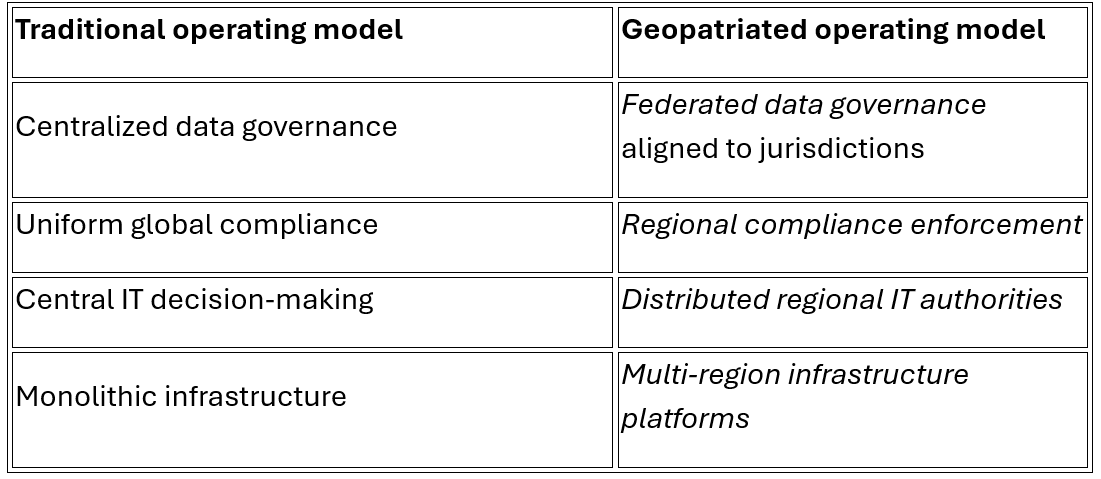
In a geopatriated operating model, data governance and sovereignty become foundational to IT operations, ensuring that data storage, processing, and access comply with jurisdiction-specific regulations such as GDPR and regional localization laws. Initiatives like Gaia-X demonstrate how sovereignty-driven governance frameworks are shaping enterprise architecture and delivery models. By embedding compliance into infrastructure design, organisations reduce cross-border data risks while strengthening regulatory trust and operational resilience.
This changes operating processes in several ways:
1.5 Talent Strategy and Organizational Structure
Geopatriation is transforming talent strategies by shifting from centralized, cost-driven workforce models to distributed regional talent hubs aligned with regulatory, language, and market requirements. IT enterprises are building location-specific expertise centers to support compliance, client proximity, and operational resilience. This diversified talent distribution reduces geopolitical risk while strengthening localized capabilities and long-term service stability.
2. Operational Resilience in a Fragmented World: Geopatriation as a Business Strategy
Geopatriation represents a strategic reset in how organizations design and manage global business operations. Rather than retreating from globalization, enterprises are recalibrating operating models to balance global connectivity with regional resilience, ensuring that critical data, applications, and digital workflows remain anchored within trusted jurisdictions.
As regulatory expectations and geopolitical risks intensify, customers, governments, and regulators increasingly favor organizations that demonstrate strong data sovereignty, transparent governance, and compliance-led operational frameworks. The future of cloud-enabled business operations will therefore depend on combining the scale and innovation of global platforms with the control, trust, and continuity enabled by localized, geopatriated infrastructure—allowing enterprises to operate globally while remaining operationally secure close to home.
3. Key Technology Trends Driving Geopatriation
3.1 Sovereign Cloud Architecture
Organizations are deploying sovereign cloud environments where data, infrastructure operations, and governance remain within national or regional jurisdictions.
Business Relevance expected: Enables enterprises to meet regulatory mandates while maintaining cloud scalability and ensuring operational independence from foreign legal control.
3.2 Confidential Computing & Trusted Execution Environments
Confidential computing secures data during active processing by isolating it within hardware-enforced secure enclaves, preventing unauthorized visibility—including from cloud infrastructure operators.
Business Relevance: It empowers regulated industries to enable cross-border data collaboration and analytics while preserving strict control over sensitive financial, healthcare, and defense information, ensuring compliance with sovereignty and privacy mandates.
3.3 Sovereign & Domain-Specific AI Models (AI Nationalism)
Countries and enterprises are developing locally trained AI and domain-specific language models hosted within domestic infrastructure.
Business Relevance: Prevents intellectual property leakage and ensures enterprise data used for AI training remains under jurisdictional control.
3.4 Regulatory-Driven Resilience Platforms (DORA & NIS2 Compliance)
New regulations require enterprises to demonstrate operational continuity even if disconnected from global cloud providers.
Business Relevance: Drives enterprises to maintain regional backup environments and exit strategies—core principles of geopatriation.
3.5 Multi-Cloud & Distributed Cloud Sovereignty Models
Enterprises are adopting distributed multi-cloud architectures combining global hyperscalers with regional sovereign clouds.
Business Relevance: Balances innovation access with compliance assurance while reducing geopolitical dependency risks.
3.6 Pre-emptive Cybersecurity & Zero-Trust Sovereign Security
Security architectures are shifting toward predictive, AI-driven cybersecurity and zero-trust models embedded within sovereign infrastructure.
Business Relevance: Ensures national and enterprise systems remain protected from cross-border cyber threats and external surveillance risks.
4. Use Cases:
Modern geopatriation is evolving beyond compliance-driven localization into sector-specific digital autonomy—covering AI, mobility, manufacturing ecosystems, and national innovation platforms. Enterprises adopting geopatriation are effectively redesigning operating models around jurisdictional resilience, IP protection, and geopolitical risk insulation.
4.1 Sovereign Mobility & Autonomous Transport Data Platforms
A highly emerging geopatriation use case is the creation of national sovereign mobility clouds, where transportation, vehicle telemetry, HD mapping, and autonomous driving datasets are retained within national infrastructure. Countries are relocating mobility intelligence away from global hyperscaler environments to prevent foreign access to real-time traffic flows, logistics movements, and connected vehicle data. Sovereign mobility platforms enable governments and industry players to safely develop autonomous ecosystems while maintaining jurisdictional control over critical transportation intelligence.
4.2 Federated Industrial Data Spaces for Manufacturing Collaboration
Industrial geopatriation is accelerating through federated sovereign data ecosystems such as Gaia-X, where manufacturers share operational and IoT data without transferring ownership outside regional jurisdiction. Instead of exporting production data to global cloud providers, enterprises retain sovereign control while enabling cross-company analytics, AI training, and supply-chain collaboration. This model allows innovation without surrendering industrial intellectual property or exposing strategic manufacturing capabilities.
4.3 Government Procurement & Public Digital Infrastructure Sovereignty
Public administrations are increasingly geopatriating workloads through sovereign procurement frameworks such as national cloud marketplaces that mandate locally governed hosting environments. Programs like government cloud frameworks ensure citizen records, taxation systems, and administrative platforms operate strictly within national jurisdiction while reducing dependency on foreign technology operators. This enables long-term operational continuity even during geopolitical disruptions or cross-border legal conflicts.
4.4 AI & GPU Sovereignty for National AI Model Development
A newer geopatriation trend involves deploying sovereign GPU and AI compute clouds to ensure that AI model training datasets, algorithms, and inference pipelines never leave national boundaries. Governments and enterprises are relocating AI workloads locally to prevent leakage of proprietary datasets or strategic AI capabilities. Sovereign AI infrastructure also enables compliance with emerging national AI governance frameworks while supporting domestic innovation ecosystems.
4.5 Critical Infrastructure & Utility Operational Isolation
Energy grids, water systems, and defense-linked utilities are geopatriating operational workloads into sovereign environments to prevent external surveillance or remote administrative access. Infrastructure telemetry, predictive maintenance analytics, and operational control systems are increasingly hosted within domestically controlled clouds to reduce cyber-physical risk exposure. Sovereign deployment ensures infrastructure continuity even if international connectivity or foreign providers become unavailable.
4.6 National Healthcare & Genomic Research Protection
Healthcare providers and life-science institutions are relocating medical datasets and genomic research platforms into sovereign clouds to protect sensitive population health data. Geopatriation ensures compliance with national privacy laws while safeguarding biomedical intellectual property used for precision medicine and pharmaceutical innovation. Local hosting also enables trusted collaboration between hospitals and research institutes without cross-border exposure risks.
4.7 Indigenous & Environmental Data Sovereignty Platforms
An emerging and highly unique geopatriation application involves protecting ecological, biodiversity, and indigenous geospatial datasets using sovereign cloud architectures. These platforms allow communities or national agencies to encrypt, control, and selectively share environmental intelligence without transferring ownership to external cloud operators. The approach is increasingly used for land governance, climate monitoring, and biodiversity protection programs.
5. Current Industry updates
Geopatriation refers to the strategic migration of enterprise data and workloads from global public clouds to sovereign or locally governed environments to address geopolitical and regulatory risks. Recognized as a key technology trend for 2026, it reflects rising enterprise demand for operational control, compliance, and digital trust. Increasing regulatory fragmentation is driving organisations to redesign cloud strategies around jurisdictional resilience. Gartner reports that more than 60% of CIOs in Western Europe anticipate geopolitical tensions will drive greater dependence on local cloud providers. By 2030, over 75% of enterprises outside the United States are expected to implement structured data sovereignty strategies, elevating sovereignty from a compliance requirement to a central operational priority.
Recent geopatriation is not about abandoning cloud it is about re-anchoring cloud control locally. The strongest activity today is visible across:
Europe → regulatory & legal sovereignty
Middle East → national AI and digital economy control
Enterprises → crisis resilience & jurisdictional risk mitigation
5.1. AWS European Sovereign Cloud (EU Data Repatriation Initiative)
One of the clearest modern geopatriation examples is Amazon Web Services’ European Sovereign Cloud, launched to allow European enterprises and governments to keep data, operations, and administrative control entirely within the European Union. The infrastructure is physically and logically separated from AWS’s global cloud, operated exclusively by EU-based personnel under EU law. This initiative directly responds to European organizations relocating sensitive workloads away from globally governed environments due to concerns around foreign jurisdiction such as the U.S. CLOUD Act.
5.2 Microsoft–SAP–Delos Cloud Crisis-Resilient EU Infrastructure
Germany’s Delos Cloud, supported by Microsoft and SAP, represents geopatriation focused on business continuity during geopolitical disruption. The partnership ensures European cloud services can continue operating even if non-EU governments attempt to restrict access to hyperscaler platforms. Legal control and operational authority are transferred to EU entities, effectively relocating sovereignty from global providers to regional operators.
5.3 Middle East Government Sovereign Hypercloud Programs (UAE, Saudi Arabia, Qatar)
Multiple Middle Eastern governments are actively geopatriating national digital services—including healthcare, banking, smart city, and public administration systems—into domestically governed sovereign clouds. Countries such as the UAE and Saudi Arabia are building in-country hyperscale environments to ensure citizen and national infrastructure data never leaves national jurisdiction while supporting AI and digital economy initiatives.
5.4 EU Institutional Shift Toward Local Cloud Providers
A growing number of European enterprises are moving workloads from global hyperscalers to regional providers as geopolitics reshapes IT strategy. A recent survey shows 61% of Western European CIOs plan increased reliance on local or regional clouds, signalling large-scale enterprise geopatriation driven by regulatory and geopolitical risk considerations.
5.5 Egypt’s National Government Cloud Migration
Egypt launched a centralized national government cloud designed to host ministry and state-agency data domestically rather than across distributed global platforms. The initiative consolidates public-sector workloads into nationally controlled infrastructure, ensuring jurisdictional ownership while accelerating digital service delivery—an archetypal geopatriation move in emerging economies.
5.6 Europe-Wide Geopatriation Trend Reshaping CIO Strategy (2026)
Recent CIO analyses confirm that geopatriation has become a mainstream enterprise strategy, with organizations actively reclaiming control of data locations and migrating workloads back toward sovereign or regional environments as geopolitical tensions increasingly influence cloud architecture decisions.
6. Key Technology Trends Driving Geopatriation
6.1 Sovereign Cloud Architecture
Organizations are deploying sovereign cloud environments where data, infrastructure operations, and governance remain within national or regional jurisdictions.
Enables enterprises to meet regulatory mandates while maintaining cloud scalability and ensuring operational independence from foreign legal control.
6.2 Confidential Computing & Trusted Execution Environments
Confidential computing safeguards data while it is actively being processed by leveraging hardware-based Trusted Execution Environments (TEEs), ensuring that even cloud providers cannot access enterprise workloads. This enables highly regulated sectors to collaborate across borders while maintaining sovereignty over sensitive financial, healthcare, and defense data.
6.3 Sovereign & Domain-Specific AI Models (AI Nationalism)
Countries and enterprises are developing locally trained AI and domain-specific language models hosted within domestic infrastructure. Prevents intellectual property leakage and ensures enterprise data used for AI training remains under jurisdictional control.
6.4 Regulatory-Driven Resilience Platforms (DORA & NIS2 Compliance)
New regulations require enterprises to demonstrate operational continuity even if disconnected from global cloud providers. Drives enterprises to maintain regional backup environments and exit strategies—core principles of geopatriation.
6.5 Multi-Cloud & Distributed Cloud Sovereignty Models
Enterprises are adopting distributed multi-cloud architectures combining global hyperscalers with regional sovereign clouds. Balances innovation access with compliance assurance while reducing geopolitical dependency risks.
6.6 Pre-emptive Cybersecurity & Zero-Trust Sovereign Security
Security architectures are shifting toward predictive, AI-driven cybersecurity and zero-trust models embedded within sovereign infrastructure. Ensures national and enterprise systems remain protected from cross-border cyber threats and external surveillance risks.
7. Future Roadmap
Geopatriation is evolving from a regulatory response into a core enterprise cloud strategy, with sovereign cloud infrastructure becoming critical to national and business operations across government, telecom, energy, and financial sectors. Gartner projects sovereign cloud spending to reach $80 billion by 2026, while nearly 20% of enterprise workloads are expected to shift from global hyperscalers to regional or sovereign providers, reshaping traditional cloud globalization models. Digital sovereignty is increasingly becoming a board-level priority, with over 75% of enterprises outside the U.S. anticipated to adopt formal sovereignty strategies by 2030. The trend is also expanding beyond data to include AI and compute sovereignty, as nations treat digital capabilities as strategic infrastructure. Moving forward, enterprises will adopt policy-driven, jurisdiction-aware cloud operating models where workload placement is guided by regulatory, risk, and resilience considerations rather than cost alone.
Business Implications: Geopatriation will drive enterprises toward hybrid operating models that combine global innovation platforms with jurisdiction-controlled execution environments to balance scalability and compliance. Cloud strategy decisions will increasingly factor geopolitical exposure alongside cost and performance considerations, reshaping infrastructure planning. Additionally, organisations are expected to train and deploy AI models within national or regional environments to safeguard intellectual property, sensitive data, and strategic digital
By 2030, geopatriation will redefine how organizations design digital operations—shifting from globally centralized cloud models toward distributed, sovereign, and risk-aware digital architectures. Enterprises that proactively embed sovereignty into cloud, AI, and cybersecurity strategies will gain stronger regulatory trust, operational continuity, and geopolitical resilience.
References
- https://aijourn.com/geopatriation-why-the-future-of-cloud-belongs-closer-to-home/
- https://www.gktoday.in/sovereign-mobility-cloud/
- https://www.truefoundry.com/blog/geopatriation
- https://www.techradar.com/pro/aws-brings-sovereign-cloud-to-europe-you-can-pause-your-geopatriation-plans-for-now
- https://www.techradar.com/pro/microsoft-and-sap-sign-deal-to-keep-eu-cloud-running-even-in-times-of-crisis?utm
- https://www.cio.com/article/4131458/geopatriacion-and-sovereign-cloud-how-data-returns-to-its-origin.html
- https://www.cloud4c.com/blogs/sovereign-cloud-transformations-in-middle-east
- https://www.cloud4c.com/blogs/sovereign-cloud-transformations-in-middle-east