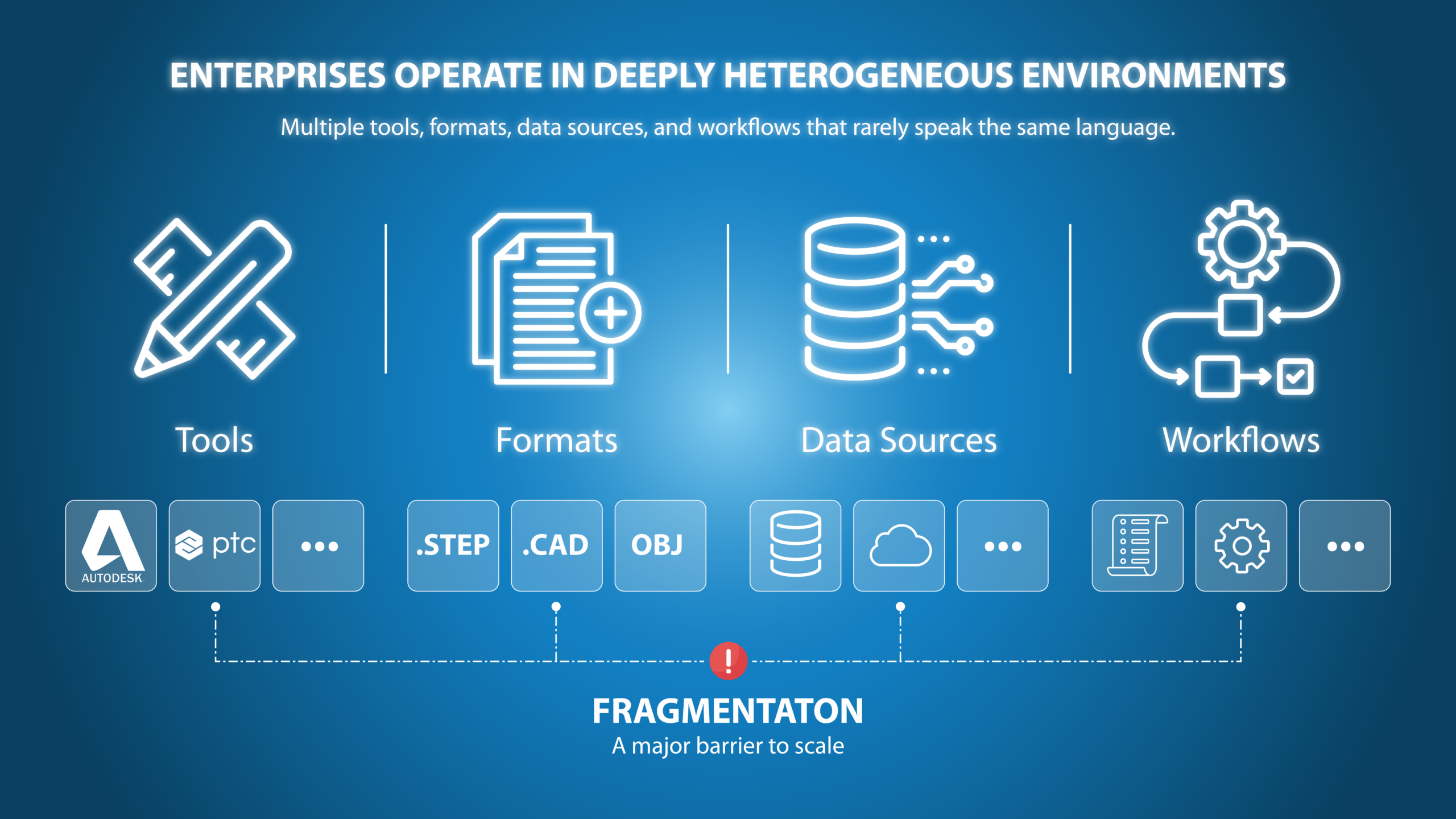
Enterprises today operate in deeply heterogeneous environments—multiple tools, formats, data sources, and workflows that rarely speak the same language. As organizations adopt digital twins, real‑time simulation, robotics, AI‑driven automation, and industrial metaverse platforms, this fragmentation becomes a major barrier to scale.
USD (Universal Scene Description) is emerging as the interoperability foundation that unifies these ecosystems. Originally developed by Pixar and now stewarded by the Alliance for OpenUSD, USD provides a structured, extensible, non‑destructive way to represent complex scenes, assets, and metadata. Its architecture directly aligns with the needs of modern enterprise systems.
For IT services organizations, USD unlocks new opportunities in data integration, simulation pipelines, digital‑twin lifecycle management, and enterprise visualization. It is quickly becoming the backbone of next‑generation spatial computing.
Introduction: The Enterprise Problem USD Actually Solves
Most enterprises don’t struggle with creating 3D content — they struggle with managing it, sharing it, and scaling it across teams, tools, and workflows. Engineering teams work in CAD, design teams rely on DCC tools, simulation teams use physics engines, operations teams depend on IoT and telemetry, and AI teams need structured, consistent data to train and automate systems. All of these groups operate in inherently heterogeneous environments, and traditional file formats were never designed to unify such diverse ecosystems. Export–import workflows break easily, metadata gets lost, teams overwrite each other’s work, and real‑time and offline workflows drift apart. USD was built to solve exactly this class of problem.
What USD Is (and What It Isn’t)
USD is often described as a file format, but that dramatically undersells what it is. At its core, USD is a full scene‑description framework built around a powerful composition engine, a hierarchical scenegraph, and a non‑destructive layering model that lets multiple contributors work on the same asset without conflict. Originally designed for the complexity of film production, its architecture aligns naturally with modern enterprise needs. USD supports both real‑time and offline workflows, preserves metadata and hierarchy, and cleanly separates modeling, materials, physics, and simulation. Because it’s schema‑based and extensible, organizations can define custom data types—robotics metadata, IoT signals, simulation parameters, proprietary attributes—and have them behave as native elements in the ecosystem. This is also where OpenUSD comes in: the industry‑backed effort to ensure USD remains open, interoperable, and ready for broad, cross‑industry adoption.
Why USD Is Becoming Foundational in Enterprise IT
USD is gaining traction across the enterprise because it solves a fundamental problem: modern organizations increasingly rely on spatial data, yet their tools and workflows remain fragmented. Engineering teams produce CAD models, designers work in DCC tools, simulation teams rely on physics engines, and AI systems require structured, consistent data. USD provides a unified way to represent all of this information in a single, coherent scene. It works across heterogeneous tools, supports real‑time collaboration, and scales to the massive complexity found in industrial and engineering environments. USD preserves hierarchy, metadata, and semantic structure in a way that traditional formats simply cannot. And because platforms like NVIDIA Omniverse, Unreal Engine, and others use USD as their backbone, enterprises gain a consistent data model that spans visualization, simulation, AI, and digital‑twin workflows. This makes USD not just useful, but foundational for the next generation of enterprise technology.
Key Benefits of USD in Emerging Technologies
1. Interoperability Across Tools and Pipelines
USD eliminates brittle export/import workflows by providing a common representation for geometry, materials, physics, and metadata. This reduces integration cost and prevents data loss.
2. Non‑Destructive, Layered Collaboration
USD’s composition engine allows multiple teams to contribute “opinions” without overwriting each other. This is essential for digital twins, simulation, and multi‑disciplinary engineering.
3. Scalability for Massive, Complex Scenes
USD was built to handle film‑scale complexity — millions of assets, nested hierarchies, and heavy metadata. Enterprises benefit from this robustness.
4. Extensibility Beyond 3D Graphics
USD schemas can represent robotics data, IoT signals, simulation parameters, or domain‑specific metadata. This makes USD adaptable to any industry.
5. Foundation for AI, Simulation, and Digital Twins
Platforms like NVIDIA Omniverse use USD as their core data model, enabling real‑time physics, AI agents, robotics simulation, and collaborative digital‑twin environments.
How USD Enables New IT Services Opportunities
For IT services organizations, USD represents far more than a technical upgrade—it opens an entirely new category of enterprise offerings. As companies adopt digital twins, simulation workflows, and AI‑driven automation, they need partners who can help them build and manage USD‑based pipelines. This includes CAD‑to‑USD conversion services, simulation‑ready asset preparation, metadata harmonization, and the development of custom schemas that reflect industry‑specific requirements. USD also enables new visualization and collaboration platforms that unify engineering, design, simulation, and operations teams around a single source of truth.
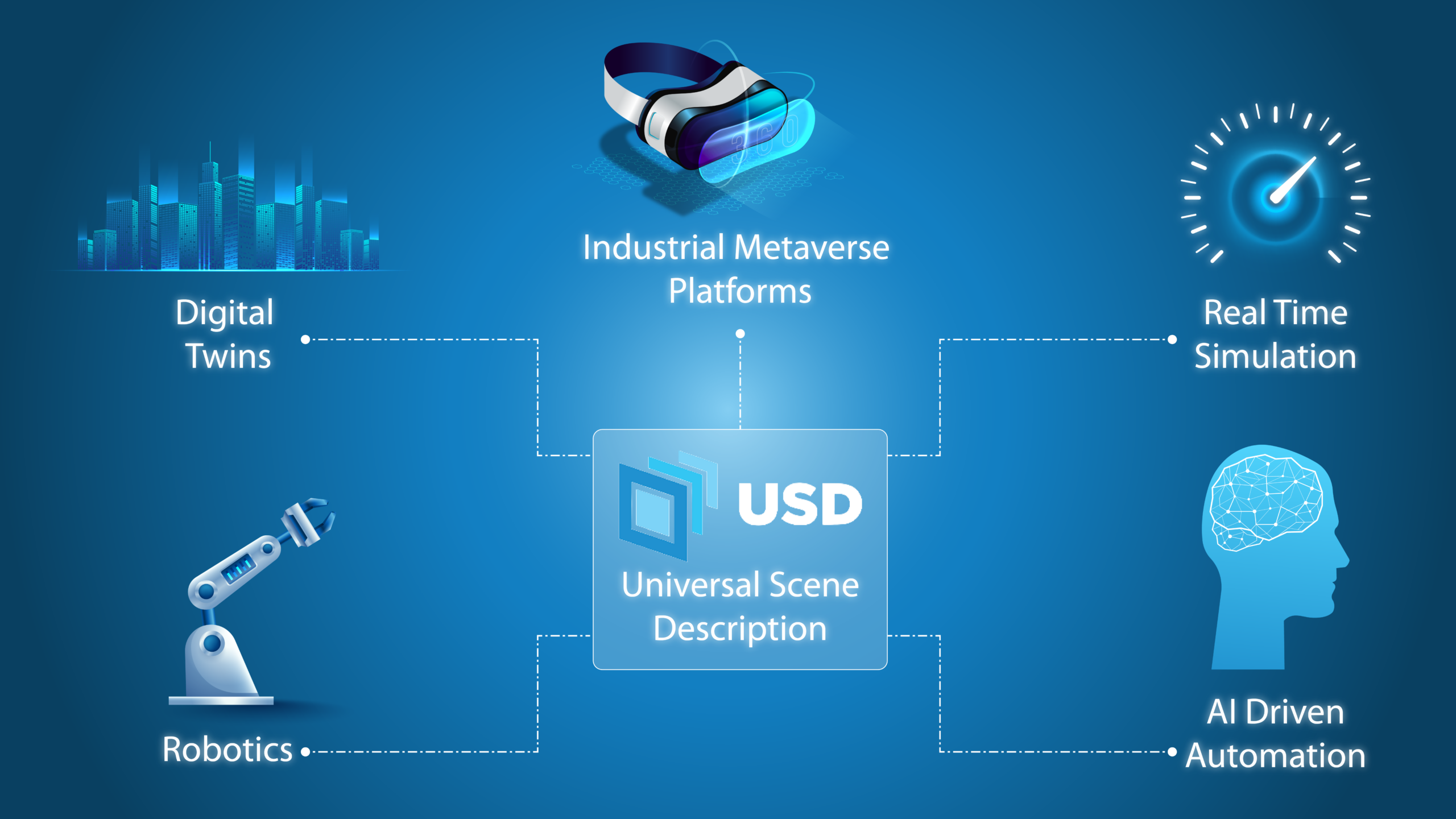
Because USD is extensible and future‑proof, it becomes the backbone for long‑term digital‑twin lifecycle management, allowing IT service providers to deliver ongoing value as systems evolve. In many ways, USD is creating the same kind of ecosystem shift that HTML created for the web—opening the door for entirely new service models and enterprise capabilities.
Industry Momentum: The Alliance for OpenUSD
The rapid rise of USD across industries is reinforced by the formation of the Alliance for OpenUSD (AOUSD), a consortium that includes Pixar, NVIDIA, Apple, Autodesk, and other major technology leaders. The alliance exists to formalize USD as an open standard, ensuring interoperability, long‑term stability, and cross‑industry adoption. This level of industry alignment is rare, and it signals that USD is not just a niche tool for entertainment or visualization—it is becoming a foundational technology for spatial computing. The alliance is focused on governance, schema standardization, and expanding USD’s capabilities beyond its original scope, making it suitable for robotics, manufacturing, simulation, AI, and enterprise digital‑twin ecosystems. For organizations evaluating USD, the presence of AOUSD provides confidence that the technology is backed by a broad, committed ecosystem and will continue to evolve in a stable, open, and industry‑aligned direction.
Conclusion
USD is more than a format — it’s a strategic foundation for the next decade of enterprise technology. As digital twins, simulation, robotics, and AI converge, USD provides the common language needed to unify heterogeneous systems.
For IT services organizations, the opportunity is clear:
USD is becoming the backbone of spatial computing, and early adopters will define the next generation of enterprise workflows.