From Vision to Reality: Making Networks Think
In my previous article, we explored how knowledge graphs can give telecommunications networks the ability to think and adapt like living organisms. We saw how the TM Forum’s vision places knowledge graphs at the heart of autonomous networks through the K interface. Now, let’s dive into the practical side: how are telecom companies actually building these intelligent systems? What does the architecture look like? And how do they progress from basic automation to full autonomy?
Turning Vision into Reality: The Implementation Challenge
The vision of autonomous networks we explored is compelling, but how do we get there? The answer lies in understanding that modern networks aren’t just bigger versions of old networks – they’re fundamentally different beasts. Where traditional networks handled predictable voice calls and basic data, today’s networks must juggle an incredible variety of services simultaneously: remote surgery that can’t tolerate a millisecond of delay, massive IoT deployments with millions of sensors, real-time gaming requiring consistent performance, and critical enterprise applications with zero-downtime requirements.
This complexity makes traditional management approaches obsolete. Manual configurations, siloed tools, and reactive troubleshooting simply can’t keep pace. That’s where knowledge graphs come in, they provide the semantic understanding that transforms this chaos into manageable, intelligent systems. Let’s explore how telcos are building these knowledge graph architectures to achieve the autonomous capabilities we’ve been discussing.
The Knowledge Graph Solution Architecture
Let’s explore how knowledge graphs are architected within the TMF Autonomous Networks framework. Remember the K interface we discussed? Here’s what actually sits behind it.
A comprehensive knowledge graph implementation for autonomous networks integrates four distinct knowledge domains, each contributing essential intelligence to create a holistic understanding of the network ecosystem:
- Network Domain Knowledge – Covers the technical infrastructure and network-specific information
- Operational Knowledge – Includes historical data, incidents, and expert knowledge from operations
- Business Knowledge – Encompasses Service catalogs, SLAs, customer requirements, and business policies
- External Knowledge – Incorporates vendor documentation, industry standards, and external best practices
These knowledge domains feed into a layered architecture that transforms raw data into actionable intelligence:
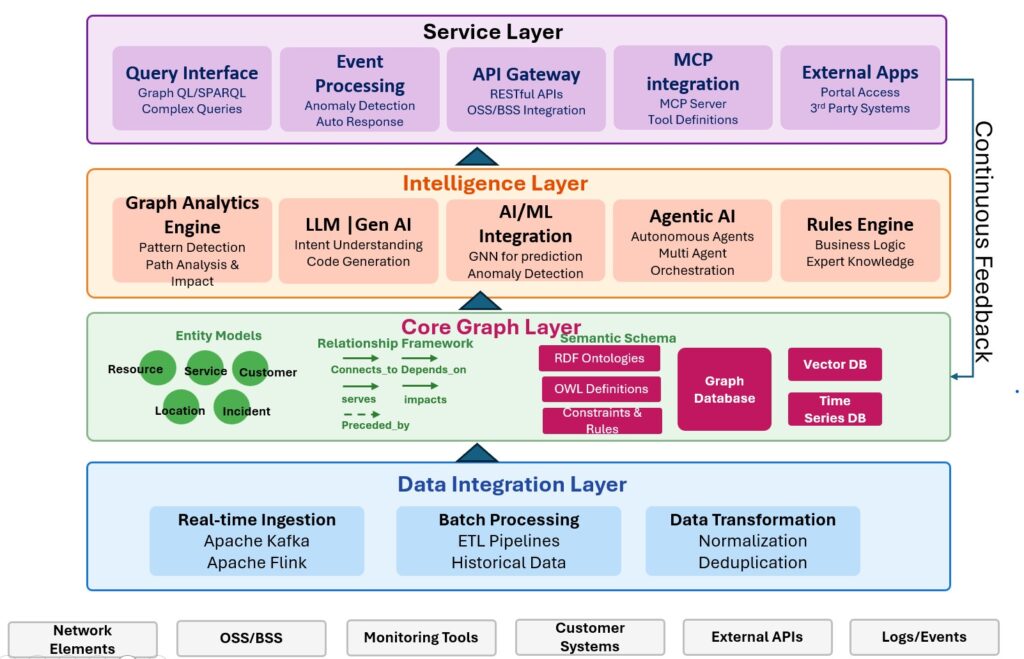
| Layer | Component | Description |
|---|---|---|
| Data Integration Layer | Real-time Ingestion | Stream processing pipelines (Apache Kafka, Flink) for continuous data flow from network elements |
| Batch Processing | ETL pipelines for historical data, inventory systems, and customer databases | |
| Data Transformation | Normalization, deduplication, and enrichment services to ensure data quality | |
| Core Graph Layer | Entity Models | Network elements (physical/virtual), services, customers, locations, and incidents as primary nodes |
| Relationship Framework | Hierarchical (contains, part-of), operational (connects-to, depends-on), business (serves, impacts), and temporal (preceded-by, triggers) relationships | |
| Semantic Schema | Ontologies defining entity types, relationship rules, and constraints using standards like RDF and OWL | |
| Storage Systems | Graph databases (Neo4j, Neptune) for relationship-centric queries • Vector databases (Pinecone, Weaviate) for embedding storage and semantic similarity search • Time series databases (InfluxDB, TimescaleDB) for high-frequency network metrics | |
| Intelligence Layer | Graph Analytics Engine | Pattern detection, path analysis, and impact assessment algorithms |
| LLM/GenAI Integration | Large Language Models for natural language understanding of network intents • Code generation for automated remediation scripts • Conversational interfaces for network operations | |
| Agentic AI Framework | Autonomous agents for specific network domains (RAN Agent, Core Agent, Transport Agent) • Multi-agent orchestration for cross-domain problem solving • Agent memory and learning capabilities using knowledge graph as persistent context • Goal-oriented task planning and execution | |
| ML Models | Graph Neural Networks (GNN) for predictive maintenance and anomaly detection • Embedding models for semantic similarity and intelligent search • Time series forecasting for capacity planning | |
| Rules Engine | Business logic and expert knowledge encoded as graph traversal patterns | |
| Service Layer | Query Interface | GraphQL/SPARQL endpoints for complex queries across domains |
| Event Processing | Real-time anomaly detection and automated response triggering | |
| API Gateway | RESTful APIs for integration with OSS/BSS systems and external applications | |
| MCP Integration | Model Context Protocol servers exposing knowledge graph as context for LLMs • Tool definitions for graph traversal, entity lookup, and relationship queries • Context windows optimized with relevant subgraphs for agent decision-making • Standardized interface for multiple AI models to access network knowledge |
With proper implementation, telcos can expect transformative results such as:
- Significant reduction in mean time to detect (MTTD) for complex network issues through intelligent correlation
- Majority of incidents resolved autonomously without human intervention
- Dramatic decrease in customer-impacting outages through predictive maintenance
- Substantial operational cost savings from reduced manual interventions
- Notable reduction in energy consumption through intelligent resource optimization
Beyond these operational improvements, knowledge graphs enable strategic advantages that fundamentally change how telcos operate.
- The unified view across network, service, and customer domains breaks down traditional silos, enabling cross-functional teams to collaborate more effectively.
- Real-time intent translation capabilities allow business requirements to be automatically converted into network configurations, dramatically reducing the time from strategy to implementation.
Furthermore, the self-learning nature of the system means that every incident, every optimization, and every customer interaction makes the network smarter, creating a compounding effect where improvements accelerate over time. This positions telcos not just as connectivity providers, but as intelligent service orchestrators capable of rapidly adapting to market demands and technological evolution.
Implementation Roadmap: From Foundation to Intelligence
Building a knowledge graph for autonomous networks is a step-by-step process that delivers value at each stage. Start with core network infrastructure and progressively add intelligence layers. This approach ensures manageable implementation while teams learn and adapt.
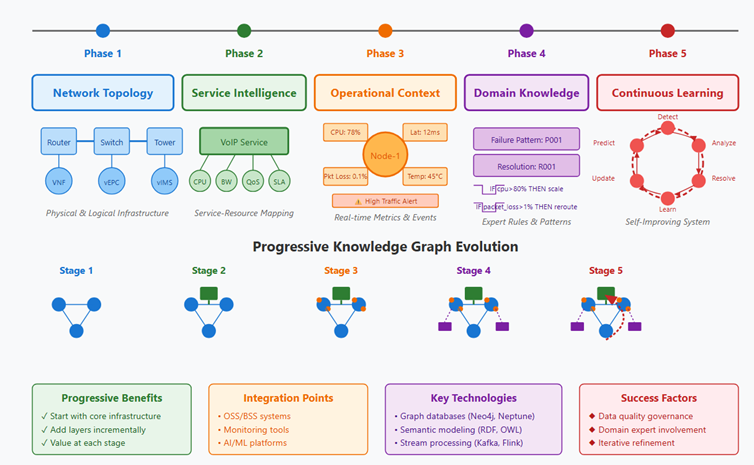
- Model Infrastructure – Map physical/logical network elements (towers, routers, switches) as connected nodes with dependency relationships
- Add Service Layer – Connect network resources to customer services, enabling service impact visibility during failures
- Integrate Operations – Link real-time performance data, alarms, and events to network entities for pattern recognition and predictive analytics
- Embed Expert Knowledge – Capture network behavior insights, failure patterns, and resolution strategies for AI accessibility
- Enable Learning – Feed resolution outcomes back into the system, creating continuous self-improvement with each interaction
Bringing Intelligence to Life: The AI-Knowledge Graph Synergy
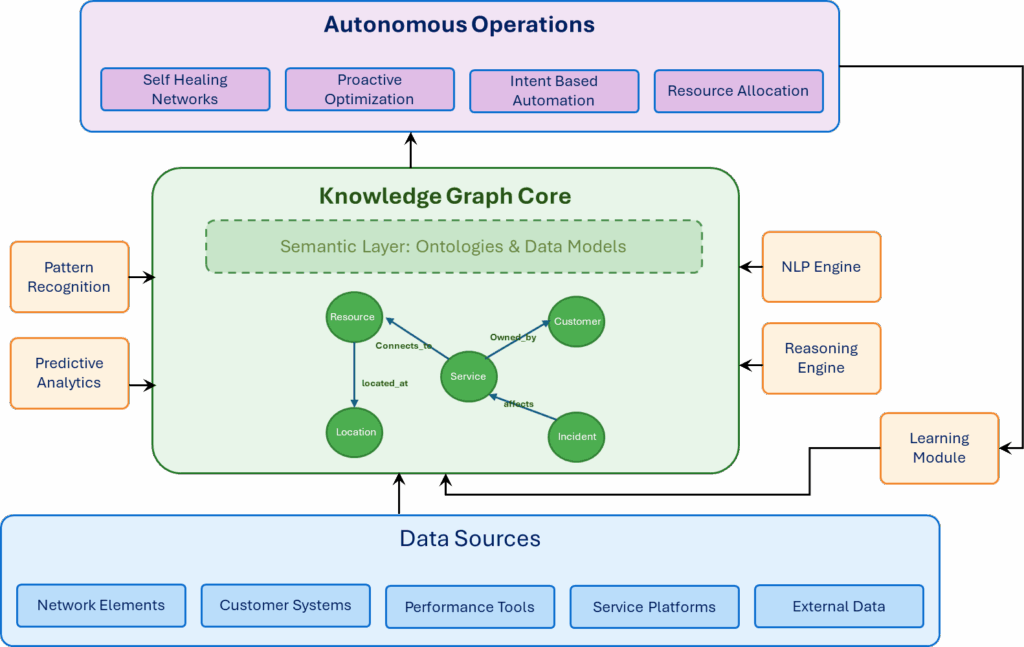
Knowledge graphs and AI create a powerful combination that transforms reactive network management into proactive, self-optimizing operations. AI provides pattern analysis and predictions, while knowledge graphs offer structured context that makes insights actionable.
- Explainable AI through Graph Traversal
- Unlike black-box models, decisions can be traced through relationship paths. Example: Traffic rerouting shows affected services → dependent customers → alternative paths → SLA optimization rationale
- Builds trust in autonomous operations through transparent decision-making
- Hybrid Intelligence Architecture
- Pattern Recognition – Analyzes historical data within graph structure
- Predictive Analytics – Uses relationships to forecast cascading failures
- NLP Engine – Converts intents into executable graph queries
- Reasoning Engine – Navigates semantic relationships for root cause analysis.
- Continuous Evolution
- Autonomous decisions (self-healing, optimization) feed outcomes back to the knowledge graph
- Creates self-improving system where every resolved incident enriches understanding
- New technologies (6G, quantum networks) integrate as nodes/relationships with automatic AI learning
AI continuously enriches the graph with insights, while the graph provides AI with semantic understanding for accurate decisions.
The Road Ahead: From Level 4 to Level 5
The transition from Level 4 to Level 5 autonomous networks represents the shift from highly automated systems requiring human oversight to fully self-governing networks with true cognitive capabilities. This isn’t merely adding automation—it’s creating networks that understand context, predict future states, and make complex decisions independently.
Knowledge graphs enable this transformation by providing the semantic foundation for networks to reason about their environment, understand business intent, and continuously adapt to new technologies without human intervention. The telecommunications industry stands at the threshold of a fundamental shift from programmed responses to genuine network intelligence.
Conclusion
Knowledge graphs aren’t just another technology trend, they’re the foundational intelligence layer that makes true network autonomy possible. As the telecommunications industry races toward the TMF’s vision of zero-touch, zero-wait, zero-trouble networks, those who master the art of knowledge graphs will lead the transformation.
The question isn’t whether to implement knowledge graphs, but how to approach this transformation strategically. With CSPs already achieving Level 4 autonomy and targeting Level 5 by 2027, the technology landscape is rapidly evolving.
Your network generates terabytes of data every day. Knowledge graphs transform that data from operational overhead into strategic intelligence, the neural system that powers truly autonomous operations.
The future of telecommunications isn’t just automated, it’s intelligently autonomous. And knowledge graphs are the key to unlocking that future.