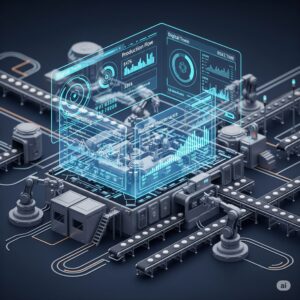
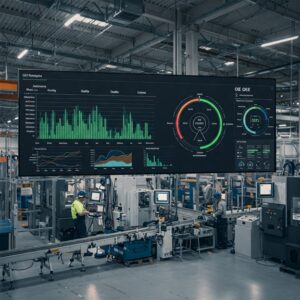
How multi-agent AI, digital twins, and IT/OT convergence are turning the periodic energy audit into a continuously self-optimizing capability.
Introduction
For decades, energy audits have been the cornerstone of industrial energy efficiency programs. Whether driven by cost optimization, sustainability commitments, or regulatory compliance, organizations have relied on periodic assessments to identify opportunities for reducing energy consumption.
However, the industrial landscape has fundamentally changed. Manufacturing plants are increasingly digital, connected through Industrial IoT, powered by cloud platforms, and enriched with real-time operational data. Yet many organizations still perform energy audits as isolated, manual exercises conducted once every few years.
The emergence of Agentic AI presents an opportunity to transform this traditional approach. Instead of static reports, enterprises can move toward autonomous, continuous, and intelligent energy optimization.
The future is no longer about conducting an energy audit — it is about creating an intelligent system that performs one every day.
The limitations of traditional energy audits
Conventional energy audits typically involve:
● Manual collection of utility and equipment data
● Short-term measurements and site inspections
● Spreadsheet-based analysis
● Static recommendations
● Follow-up implementation with limited monitoring
While valuable, this approach has inherent limitations. Energy consumption changes continuously due to production schedules, equipment degradation, maintenance activities, weather conditions, and operator behavior. A report generated today may no longer represent plant performance a few months later. Industries need continuous intelligence rather than periodic assessments.
Enter Agentic AI
Unlike traditional AI systems that respond to prompts, Agentic AI can reason, plan, collaborate with other agents, and take actions toward defined objectives. Imagine a team of AI agents working together across a plant’s energy footprint:
● One agent continuously monitors plant energy consumption
● Another correlates energy usage with production throughput
● A third compares equipment performance against digital twins and historical benchmarks
● Another predicts energy wastage before it occurs
● Yet another recommends corrective actions and raises maintenance work orders
None of this works without a data foundation, though: it depends on reliable OT/IT integration and clean sensor data feeding the agents — the prerequisite the industry has to get right before any of this compounds (more on this in Challenges below).
Instead of waiting for the next audit cycle, the organization receives actionable insight in near real time.
From energy audit to continuous energy intelligence
Agentic AI enables a shift from periodic assessment to continuous optimization:
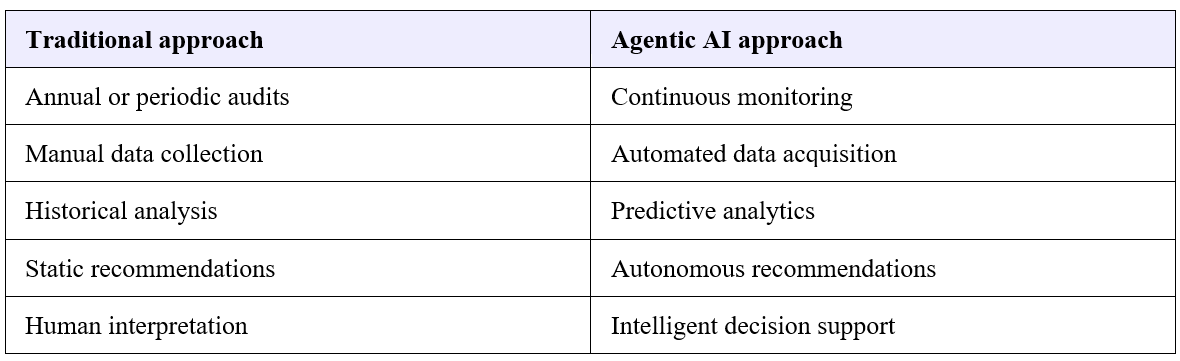
Traditional Approach vs Agentic AI Approach
Annual or periodic audits → Continuous monitoring
Manual data collection → Automated data acquisition
Historical analysis → Predictive analytics
Static recommendations → Autonomous recommendations
Human interpretation → Intelligent decision support
Agentic AI transforms traditional assessment and compliance processes from periodic, manual, and reactive activities into continuous, automated, predictive, and intelligent operations. Instead of relying solely on human interpretation and historical analysis, Agentic AI enables real-time monitoring, autonomous recommendations, and data-driven decision support.
This evolution significantly improves responsiveness while reducing operational cost.
Practical industrial use cases
HVAC optimization:
AI agents monitor occupancy, weather forecasts, production schedules, and indoor environmental conditions to optimize HVAC operation while maintaining employee comfort.
Compressed air systems:
Compressed air often represents one of the largest hidden energy losses in manufacturing — industry benchmarks commonly cite leaks alone accounting for 20–30% of compressor output in plants without an active leak-detection program. Autonomous agents can detect leaks, identify inefficient compressor sequencing, recommend maintenance windows, and estimate associated energy savings.
Motors and drives:
Continuous monitoring of current, vibration, and operating profiles enables AI to identify overloaded motors, inefficient operating points, or opportunities for variable-speed-drive optimization.
Steam and utility networks:
AI agents detect steam leaks, insulation degradation, abnormal condensate losses, and boiler inefficiencies before they significantly impact energy costs.
Renewable energy integration:
Agentic AI can intelligently balance solar generation, battery storage, grid consumption, and production demand to minimize both energy cost and carbon emissions.
Illustrative case study: a multi-site manufacturing group:
Consider a multi-site industrial manufacturer running compressed-air-intensive production lines, legacy motors, and a mix of grid and on-site solar supply — a profile common across automotive components, packaging, and process manufacturing plants.
Under a traditional model, the group commissions an external audit every 18–24 months. Findings typically surface after inefficiencies have already accumulated: a compressor sequencing fault running for months, a steam trap failure discovered only during a plant walk-down, or a demand-charge spike traced back weeks later.
In an Agentic AI-enabled model, the same plant instead operates a standing set of agents layered over its existing SCADA, DCS, and IoT sensor infrastructure:
● A monitoring agent flags compressor short-cycling within hours rather than months, using vibration and current signatures
● A correlation agent ties a rise in specific energy consumption (kWh per unit produced) to a specific shift, product changeover, or ambient condition
● A digital-twin agent simulates the cost and emissions impact of three corrective options before any technician is dispatched
● A scheduling agent proposes the lowest-disruption maintenance window and auto-drafts the work order for human approval
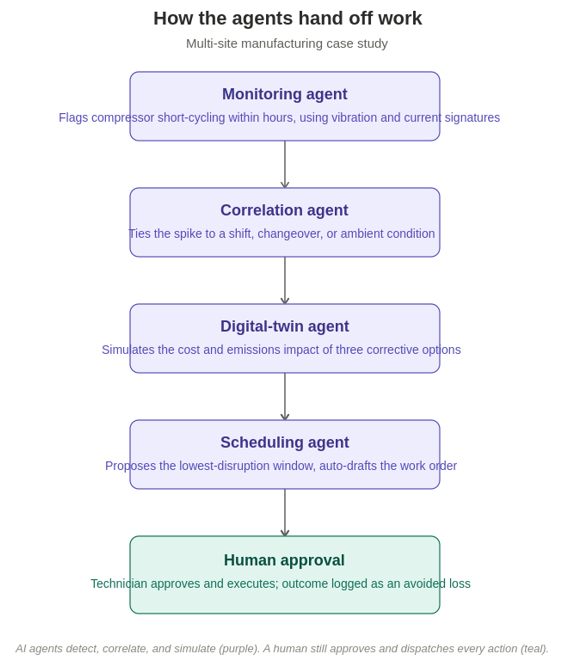
Figure 1. How the agents hand off work, from detection to a human-approved action.
AI agents detect, correlate, analyze, and simulate potential actions autonomously. However, human experts remain responsible for approving and dispatching corrective actions, ensuring governance, accountability, and operational safety.
The result is a shift from an audit that produces a report to a system that produces a running log of avoided losses — with humans approving and executing, not chasing down where the waste occurred. Typical benefits reported by early industrial adopters of similar continuous-monitoring architectures include faster fault detection, fewer unplanned energy spikes, and audit teams redeployed toward strategic efficiency projects rather than manual data collection.
The role of digital twins
Digital twins become significantly more valuable when combined with Agentic AI. Instead of simply visualizing equipment status, digital twins evolve into decision-making environments where AI agents can simulate multiple optimization scenarios before recommending operational changes. This minimizes risk while improving confidence in implementation.
Sustainability beyond energy savings
Energy optimization is no longer solely about reducing electricity bills. Organizations increasingly measure Scope 1, 2, and 3 emissions, ESG disclosures, regulatory compliance, and operational resilience side by side. Agentic AI enables enterprises to optimize all these objectives simultaneously rather than treating them as separate initiatives — and to align continuous monitoring with structured frameworks such as ISO 50001 energy management systems, giving the audit trail a standards-based backbone rather than an ad hoc one.
For the plant energy managers, sustainability leads, and OT/IT directors who actually act on this, that backbone matters as much as the technology: it is what turns a vendor pitch into something a compliance or ESG team can stand behind.
Reference architecture
A unified energy intelligence ecosystem typically follows this flow, from field-level sensing through to closed-loop action:
Industrial Assets & Sensors → IoT Platform → Digital Twin → Multi-Agent AI → Recommendations → Automated Actions → Continuous Learning ↺ (feedback loop to continuously improve the Digital Twin and AI models)
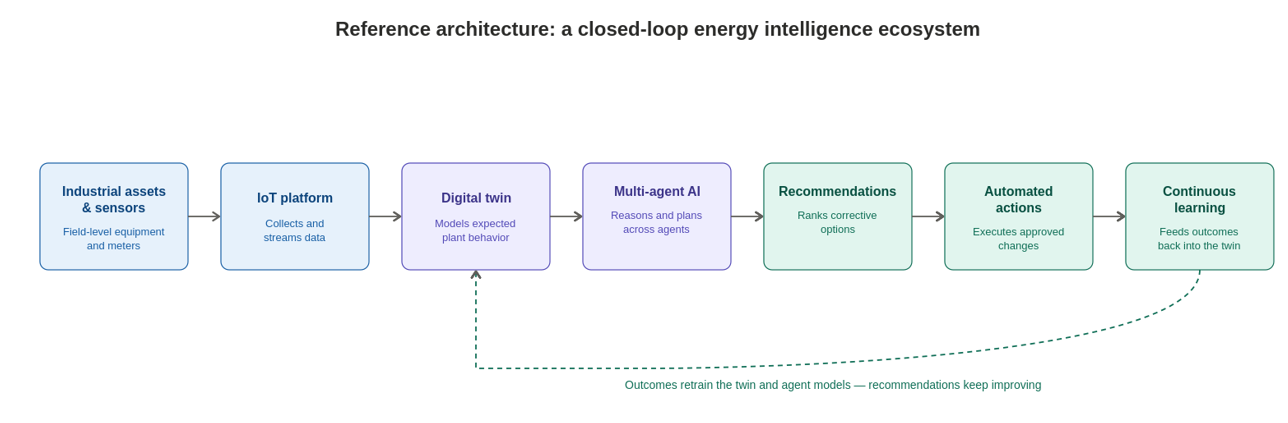
Figure 2. Each stage feeds the next in a closed loop — automated actions and their outcomes flow back into the digital twin and agent models, so recommendations keep improving rather than staying static.
A closed-loop energy intelligence ecosystem combines IoT, Digital Twins, and Agentic AI to move from reactive monitoring to proactive optimization. Data flows from industrial assets into intelligent models, AI agents generate and execute recommendations, and outcomes are continuously fed back into the system. The result is a self-improving operational environment that delivers sustained gains in energy efficiency, reliability, cost optimization, and sustainability.
Challenges to address
Successful adoption requires more than deploying AI. Organizations must invest in:
● Reliable OT and IT data integration
● High-quality sensor data
● Cybersecurity, aligned with standards such as IEC 62443
● Explainable AI
● Human oversight
● Governance frameworks
The objective is not autonomous decision-making without accountability, but human-supervised intelligent automation.
The opportunity
As industries accelerate their digital transformation journeys, there is an opportunity to combine Industrial IoT, Digital Twins, Cloud Platforms, Advanced Analytics, and Agentic AI into a unified energy intelligence ecosystem. Such a platform can continuously learn, adapt, and optimize operations — helping organizations improve operational efficiency, reduce carbon emissions, and accelerate sustainability goals.
For technology partners like Infosys, this represents more than another AI application. It is an opportunity to redefine how industries manage one of their most critical resources: energy.
Conclusion
The next generation of energy audits will not be periodic reports stored in filing cabinets. They will be intelligent, autonomous, and continuously evolving digital capabilities embedded within industrial operations.
As Agentic AI matures, organizations that embrace continuous energy intelligence will move beyond compliance toward predictive, sustainable, and self-optimizing operations.
The future of energy management has already begun — and it is autonomous.
Further reading & standards referenced
● ISO 50001 — Energy Management Systems
● IEC 62443 — Industrial Automation and Control Systems Security
● Industrial AI and Digital Twin frameworks for OT/IT convergence