Introduction
In today’s rapidly evolving manufacturing and industrial sectors, productivity is not only about efficiency but also about creating a more personalized, human-centric workspace. The arrival of Industry 5.0 is driving this shift, focusing on seamless collaboration between humans and advanced technology, such as robotics, AI, and IoT. Edge computing, private 5G, and the semantic layer are at the core of this transformation, enabling a smarter, more agile shop floor that enhances both automation and the human element.
The Power of Edge Computing and Private 5G
Edge computing brings the power of data processing closer to where it’s generated—on the shop floor. By processing data locally, edge computing allows for real-time analytics, faster decision-making, and more responsive automation. This is crucial for time-sensitive manufacturing processes, where delays can lead to inefficiency and higher operational costs.
Key Benefits of Edge Computing in OT:
– Real-Time Decision Making: With data processed locally, anomalies and inefficiencies are detected immediately, enabling rapid adjustments.
– Reduced Latency: Edge computing enables faster responses from automated systems, which is vital for precise operations.
– Bandwidth Efficiency: By processing data at the edge, only essential information is sent over the network, improving bandwidth usage.
Private 5G: Revolutionizing Connectivity and Security
Private 5G networks provide dedicated, ultra-reliable connectivity that ensures seamless communication between machines, IoT devices, and operators. This is critical in manufacturing environments where machines and devices need to exchange high volumes of data with minimal delay.
How Private 5G Enhances OT on the Shop Floor:
– High-Speed, Low-Latency Connectivity: Private 5G offers the speed and reliability required for real-time communication in complex systems.
– Increased Network Reliability: A private 5G network ensures more reliable connections and better security compared to public networks.
– Scalability for IoT Devices: With private 5G, it’s easier to scale the number of connected devices and sensors on the shop floor, enabling smarter automation and better monitoring.
Semantic Layer: Normalizing Industrial Data
In an environment where data comes from multiple, often siloed sources—such as sensors, machines, human inputs, and control systems—ensuring that all this data is interpreted in a consistent way becomes essential. This is where the semantic layer comes in.
A semantic layer acts as an abstraction layer that normalizes data by applying standardized tags and meanings to it, regardless of its source. It ensures that data is categorized and understood consistently across systems, eliminating discrepancies and improving the accuracy of analytics. This is especially important in an industrial setting, where timely, precise insights are required to optimize performance.
How the Semantic Layer Enhances Shop Floor Productivity:
– Data Consistency: By tagging data from different sources in a standardized way, the semantic layer ensures that systems can interpret and use data accurately, regardless of its origin.
– Improved Data Accessibility: Operators and decision-makers can easily access data from disparate sources in a unified format, enabling more informed, real-time decisions.
– Advanced Analytics: With normalized data, advanced analytics tools can work more efficiently, uncovering insights that would be difficult to achieve with raw, unstructured data.
Industry 5.0: The Evolution of Human-Machine Collaboration
Industry 5.0 focuses on collaboration between humans and advanced technologies, creating a more human-centric, personalized, and flexible manufacturing environment. Edge computing, private 5G, and the semantic layer are foundational to enabling this shift by facilitating seamless interaction between human workers and intelligent systems.
How Edge Computing, Private 5G, and the Semantic Layer Enable Industry 5.0:
– Collaborative Robotics: Edge computing processes data in real time, allowing robots to adapt to human actions, while private 5G ensures fast, reliable communication between robots and human workers.
– Personalized Manufacturing: By integrating human oversight with AI-powered machines, manufacturers can create more flexible, personalized production lines that respond to customer demands in real time.
– Human-Centric Automation: The semantic layer helps unify data from various systems, allowing humans to better understand and interact with complex automated systems, creating a safer and more efficient work environment.
The Synergy Between Edge Computing, Private 5G, the Semantic Layer, and Industry 5.0
The synergy between these technologies enables new levels of automation, intelligence, and human involvement in manufacturing. With edge computing powering real-time analytics, private 5G ensuring seamless connectivity, and the semantic layer providing consistent data interpretation, the shop floor of the future will be more intelligent, efficient, and adaptable than ever before.
– Smarter Automation with Human Oversight: Edge computing and private 5G enable faster, more reliable automation, while the semantic layer ensures that data from humans and machines is unified and actionable.
– Predictive Maintenance and Worker Safety: Real-time insights and consistent data, facilitated by these technologies, allow for predictive maintenance and enhanced worker safety.
– Intelligent Decision-Making: By normalizing data from multiple sources, the semantic layer helps improve the decision-making process, enabling more accurate predictions and responses.
The Path Forward: Embracing Industry 5.0 for a Smarter Future
As industries move toward Industry 5.0, the integration of edge computing, private 5G, and the semantic layer will be key to creating the next generation of smart factories. These technologies enable a more collaborative, human-centered approach to manufacturing, where machines and humans work together to enhance productivity, safety, and personalization.
By adopting these digital-first solutions, industries will be better equipped to meet the demands of a connected, intelligent, and human-centric future.
Translating the principles of Industry 5.0 into operational reality requires more than isolated technologies—it demands a cohesive architecture that unites real time intelligence, resilient connectivity, and context aware data. Edge computing, private 5G networks, and the semantic layer together form the foundation of this transformation, enabling low latency processing, secure machine to machine communication, and consistent interpretation of industrial data. Figure 1 illustrates how these components converge into a unified smart manufacturing architecture, connecting the shop floor, edge, and enterprise systems to enable intelligent, human centric operations.
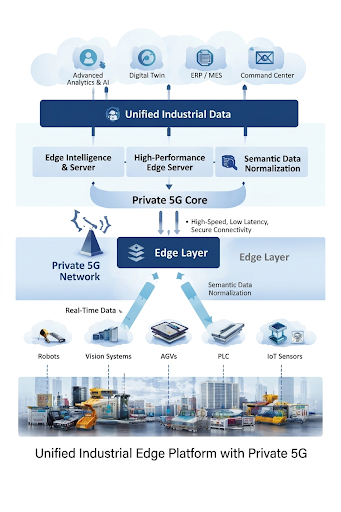
Figure 1: Architecture of Smart Manufacturing with Edge Computing, Private 5G, and Semantic Data Normalization. The diagram illustrates the flow of real-time data from the shop floor through edge layers to cloud and enterprise apps, highlighting the integration of these technologies to enable smarter, more efficient manufacturing operations.
Figure 1 represents more than a static reference model—it depicts a living, operational system. When edge computing, private 5G connectivity, and semantic data normalization are integrated, the architecture enables continuous interaction between data, intelligence, and actuation. Real time insights generated at the edge can be securely transmitted, contextualized, and acted upon across the shop floor, creating the foundation for adaptive automation, human–machine collaboration, and closed loop control. It is this shift—from passive monitoring to responsive, feedback driven operations—that defines the practical realization of Industry 5.0.