Manufacturing businesses face common challenges – how to report P&L from their manufacturing activities correctly? How to track manufacturing costs as they happen? How to manage inventory efficiently?
If you are implementing Oracle EBS or Oracle Project Management cloud, then there is a solution to the challenge of linking manufacturing to projects, and it should be evaluated carefully, weighing the value addition compared to efforts put in.
The solution is called Oracle Project Manufacturing (PJM) module in Oracle EBS, and Oracle Project Management Cloud includes it as Project-driven Supply Chain (PDSC).
While it was initially developed for aerospace, defense, and medical industries that need to track every component that goes into manufacturing tied to a project, the module can be widely used in all manufacturing-centric industries.
What is it?
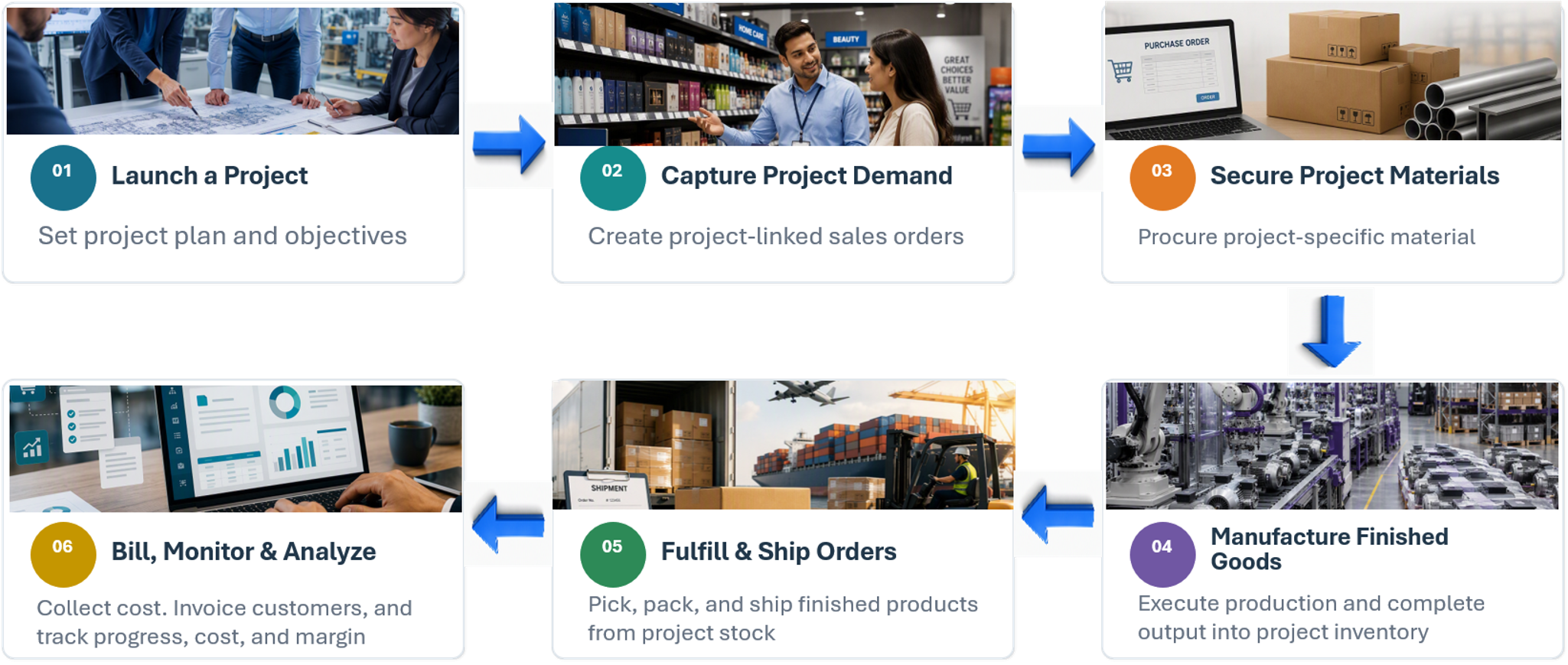
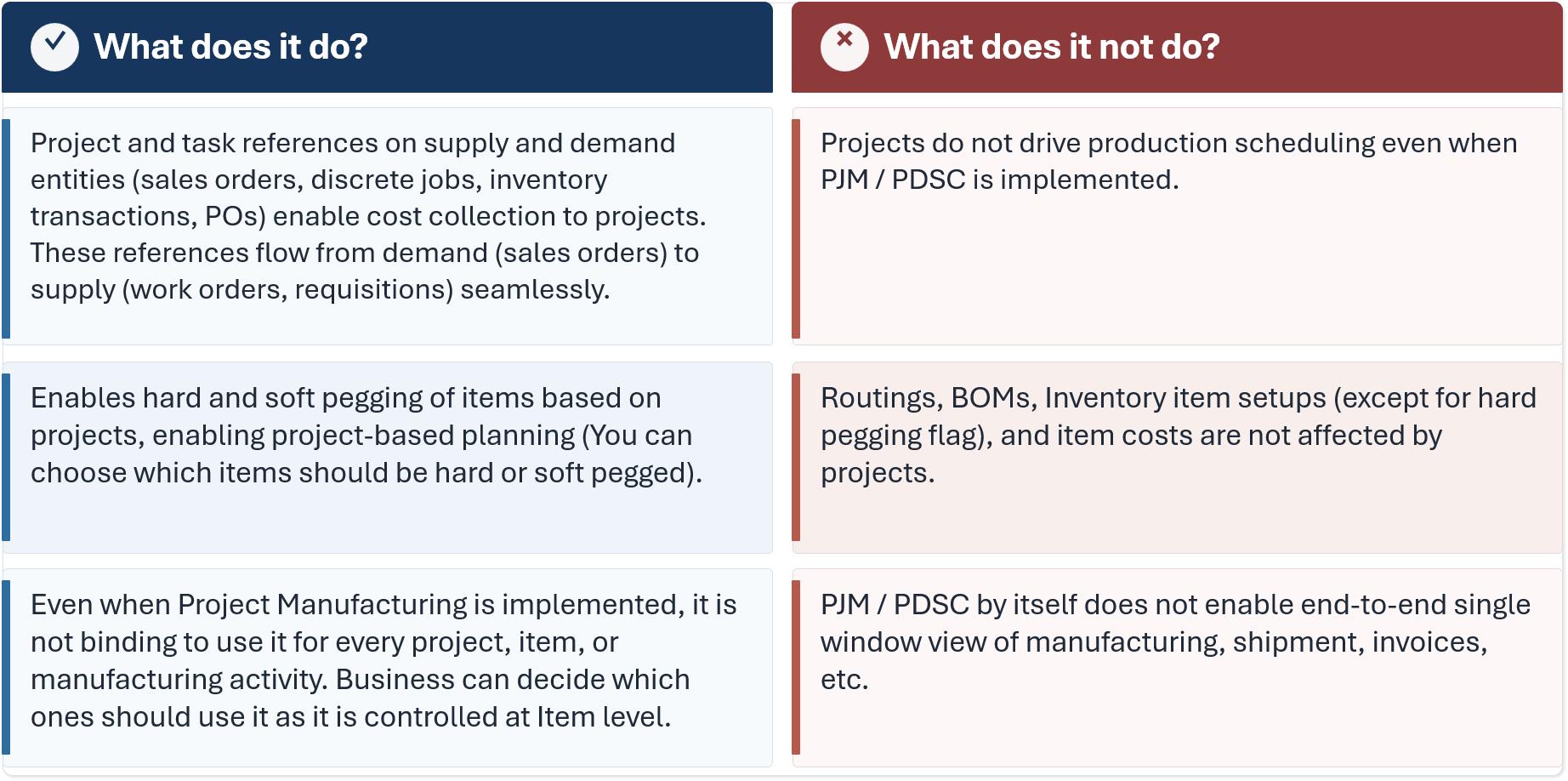
PJM/PDSC is primarily implemented to:
- Hard-peg inventory items to projects- Items that are marked as hard-pegged need to be received in project-specific locator during Purchase Order receipts, their on-hand quantity is calculated based on project locators, and planning engine plans supply based on project-specific demand. These are material tied to a specific project and cannot be used on any other project. Every hard-pegged material used in manufacturing for a project is tracked throughout its life cycle on the shopfloor. This is especially important for industries like medicine or defense where each component from each batch needs to be always traceable for audits, quality checks, etc.
- Cost transfer to projects- whenever an inventory transaction (PO receipt, WIP issues, or project transfers, et al) happens in or out of a project locator, cost is transferred to project.
Oracle makes sure there is no duplicate cost transfer. For example, if a component is received in a project locator via a PO that has project and task on its line distribution and then issued to a manufacturing work order, cost transfer happens only during the first (receipt) transaction. Since that component’s cost has already been sent to the project, WIP issue transaction does not send it again. That said, any additional cost (e.g. resources) not covered by earlier material transactions will be sent to project upon work order completion. Thus, Oracle ensures there is no under-reporting of cost either.
Pros
- Frequent cost transfer to projects- cost is transferred to projects as soon as material first enters a project locator, without waiting for it to be used in a manufacturing job or be shipped.
- Cost-based revenue and billing can happen based on latest and accurate costs collected from manufacturing/inventory.
- On-hand, PO, WO Planned orders are pegged to project demands
- Project-based P&L visibility including accurate manufacturing costs
- Freedom to have non-project transactions even when project manufacturing is enabled.
Cons
- Does not work with non-project standard Sales Orders.
- Maintaining hard-pegged inventory is a process overhead as on the floor it needs to be segregated (though not all items needs to be hard-pegged)
- Additional housekeeping is required for projects for on-hand inventory maintenance and accuracy
- It changes inventory locator configuration (adds two extra segments, that can impact existing custom reports or programs if PJM is rolled out on top of exiting solution)
Special consideration for Oracle Project Management Cloud:
Oracle Supply Chain cloud now enables linking projects and tasks to sales order lines even without implementing PDSC. Supply chain orchestration will then automatically create work orders that carry reference to the project tasks.
This approach does not include frequent cost transfers to projects (though cost is transferred at certain process steps) and inventory hard pegging. Cost is transferred to projects only at the time of shipment, and not when the work orders are progressing.
Conclusion
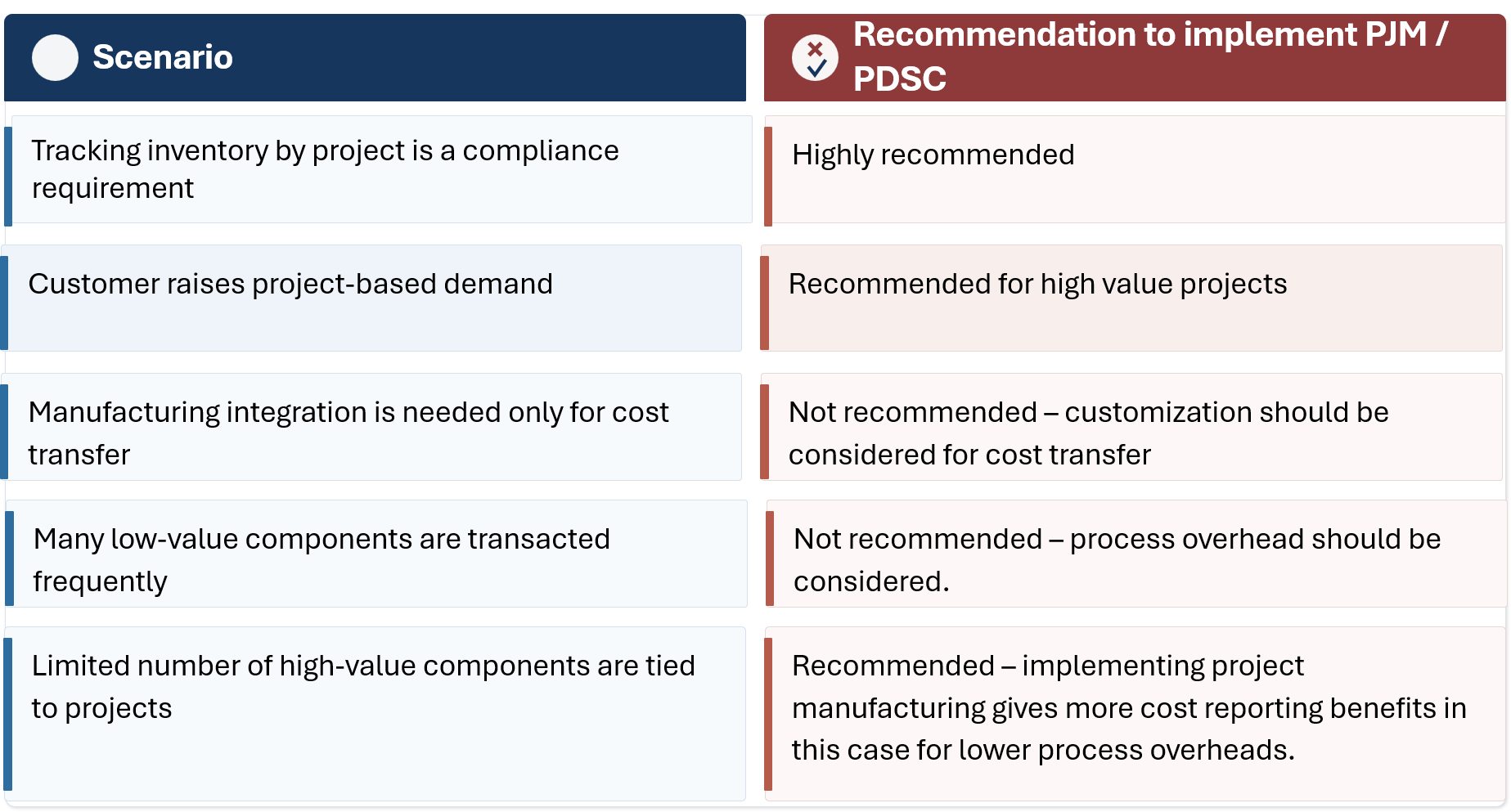
PJM/PDSC should be implemented when business wants to
- Hard-peg material to projects for planning, auditing, quality, compliance, etc.
- Transfer manufacturing costs to projects for P&L reporting or cost-based billing/revenue recognition.
In essence, it works when the business manufactures based on projects and has a project-centric systematic approach to warehouse and shopfloor management.
Careful thought should be provided to time and effort overheads associated with inventory housekeeping, evaluating them against criticality of requirements.