Most deal teams treat the Transition Service Agreement (TSA) as paperwork to get through on the way to close — a necessary evil negotiated by lawyers in the final weeks of a carve-out. Those framing costs value.
A TSA is not an administrative afterthought. It is the operating model of the business for the first 6–24 months of its independent life. Its scope, pricing, governance, and exit design determine whether Day 1 is a controlled handover or a scramble, whether the buyer’s underwriting case survives contact with reality, and whether the seller’s residual brand and relationship with the divested unit stay intact through TSA exit.
This piece argues for a shift in mindset: TSA design should be treated as a strategic workstream owned by deal leadership, not a legal deliverable owned by counsel — and lays out a framework for doing that in practice.
Why This Matters to PE and Corporate Development
For private equity sponsors, the TSA is a direct input into the underwriting model. Stranded costs, service pricing assumptions, and exit timing all move IRR. A TSA that is scoped loosely — “the seller will provide reasonable transitional support” — is not a protective clause; it is unpriced risk sitting inside the deal model.
For corporate development teams on the sell side, the TSA is a reputational instrument as much as a commercial one. A carve-out that goes badly during the TSA period — missed SLAs, disputed invoices, functions that quietly never separate — damages the seller’s credibility with the market for the next divestiture and often draws senior management attention back into a business they were trying to exit.
Both sides have the same interest, even though it doesn’t always feel that way at the negotiating table: a TSA engineered for a clean, timely exit protects value for buyer and seller alike.
Why Infosys Consulting for TSA Design
Infosys Consulting combines deep M&A separation expertise, technology transformation capabilities, and proven TSA execution experience to design TSAs that enable Day 1 readiness while accelerating long-term separation objectives. Our end-to-end approach spans TSA strategy, service design, cost modeling, governance, dependency management, stranded cost mitigation, and exit planning, ensuring agreements are commercially sound, operationally effective, and aligned with value realization goals. Backed by extensive experience supporting complex global divestitures and carve-outs, we help clients minimize transition risk, maintain business continuity, and achieve faster TSA exits.
- Track record: Delivered 75+ carve-out, divestiture, and separation engagements over the last three years across multiple industries
- End-to-end capability: Ability to move from TSA strategy through IT/functional disentanglement execution — not just advisory
- Technology depth: Relevant where TSAs involve ERP, data, and systems separation, which is often the largest and longest-lived category of TSA scope
- Global delivery model: Relevant if TSA governance and service delivery span multiple geographies
The Infosys TSA Design Framework
A disciplined TSA should be built around four design principles, applied before the term sheet is drafted:
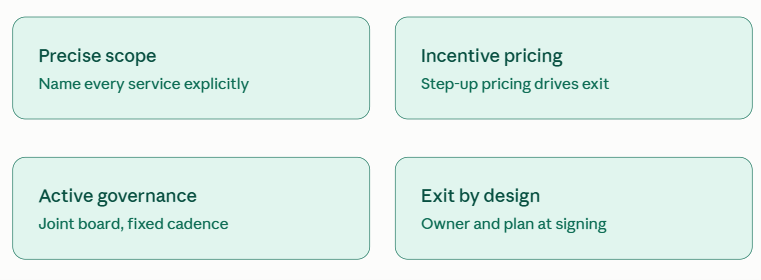
- Scope with precision, not convenience Every service should be named, not bundled. “IT support” is not a scope line; “Tier 2 helpdesk support for [system], 8×5, response SLA of 4 hours” is. Vague scope is where cost overruns and disputes live.
- Price to incentivize exit, not to subsidize dependency Flat or below-market TSA pricing removes the buyer’s incentive to stand up its own capability quickly. Step-up pricing schedules — where the cost of a service rises the longer it’s used — build urgency into the separation timeline without punitive penalty clauses.
- Govern actively, not contractually A TSA governance board with joint seller/buyer representation, meeting on a fixed cadence, catches service degradation and scope creep early. Relying on the contract’s dispute clause is a lagging indicator; active governance is a leading one.
- Design the exit on Day 1, not month 18 Every service line should have an exit plan and owner named at signing — not “TBD” pending the buyer’s separate IT roadmap. Services without a credible exit path by month 6 are the ones still running, unbilled or disputed, at month 24.
The Infosys Approach

A typical approach moves through four phases:
- Pre-Signing Diagnostic — Map functional and system dependencies between the divested unit and RemainCo before term sheet negotiation, so TSA scope reflects operational reality rather than legal boilerplate.
- TSA Structuring — Translate the dependency map into priced, SLA-bound service schedules with built-in step-up pricing and governance cadence.
- Day 1 Stand-Up — Stand up the joint governance board, reporting cadence, and issue-escalation path concurrent with close.
- Managed Exit — Actively track each service line against its exit plan, re-baselining as needed, until full separation.
Case Studies
Case Study 1: Global Energy Sector Divestiture
Infosys Consulting is supporting a large-scale energy sector divestiture by leading TSA design, stranded cost management, financial governance, planning, and contract disposition activities. The engagement involves designing TSA service schedules, establishing governance structures, defining service scope and costing models, and managing dependencies across multiple workstreams. By integrating TSA architecture with financial and operational separation planning, Infosys has enabled Day 1 readiness, improved cost transparency, and provided a structured foundation for a controlled and efficient separation.
Case Study 2: Global Industrial Manufacturing Carve-Out
Infosys Consulting led the end-to-end IT carve-out of a global industrial manufacturing business, encompassing applications, cloud, workplace, security, data, integrations, and IT/OT networks across 19 countries and 26 sites. Through a robust Separation Management Office, integrated governance, TSA dependency management, and coordinated cutover execution, Infosys established a fully independent technology landscape while maintaining operational continuity. The program successfully accelerated go-live by two months, demonstrating the value of embedding TSA planning, governance, and exit readiness into the overall separation strategy from the outset.
Conclusion
TSA design sits at an underappreciated intersection of legal structuring, operational execution, and deal economics. Treated as boilerplate, it becomes a source of friction, cost leakage, and eroded trust between buyer and seller. Treated as a strategic lever — scoped precisely, priced to incentivize exit, governed actively, and designed for separation from Day 1 — it becomes one of the more reliable ways to protect and even create value in a carve-out.
For PE sponsors and corporate development teams alike, the message is the same: get TSA design into the deal strategy conversation early, not into the legal appendix late.