Every M&A deal team obsesses over valuation, synergies, and integration planning. Far fewer obsess over something quieter but equally consequential: what happens to the thousands of IT contracts sitting underneath the deal.
Software licenses, SaaS subscriptions, managed service agreements, telecom and network contracts, data processing agreements, outsourcing arrangements — in a mid-sized enterprise, this portfolio can easily run into the hundreds or thousands of individual agreements. In a carve-out or divestiture, many of them were never written with separation in mind. In a merger, many of them duplicate each other. Either way, someone has to decide, contract by contract: does this get assigned, novated, renegotiated, bridged through a TSA, or terminated?
That decision-making process is IT contract disposition — and in our experience advising clients through carve-outs, divestitures, and post-merger integrations, it is one of the most under-resourced workstreams on the deal, right up until it becomes one of the most urgent.
Why This Gets Harder Than Most Teams Expect
A few dynamics make IT contract disposition genuinely difficult, not just administratively heavy:
- Entanglement. Many enterprise IT contracts are signed at the parent or group level and cover multiple business units, legal entities, or geographies. A single ERP hosting agreement might need to be split three ways.
- Change-of-control clauses. A meaningful share of vendor contracts include consent, assignment, or termination rights triggered by a change of control — which means the counterparty has leverage at exactly the moment you have the least time to negotiate.
- License and entitlement complexity. Software licensing models (per-user, per-core, site licenses, enterprise agreements) don’t map cleanly onto a smaller post-separation footprint, and vendors know it.
- Incomplete or outdated contract repositories. It is common to discover, mid-diligence, that the definitive list of “which contracts actually support this business” doesn’t exist anywhere in a single, current form.
- Time pressure. Disposition decisions are often still being finalized while TSAs are being drafted and Day 1 operating models are being locked — three workstreams competing for the same legal and procurement bandwidth.
None of this is a reason to under-invest in the workstream. It’s the reason to start it early, run it systematically, and treat it as a first-class deal workstream rather than a legal afterthought.
A Five-Stage Approach
The disposition process we run with clients breaks into five stages, moving from discovery through to post-close monitoring.
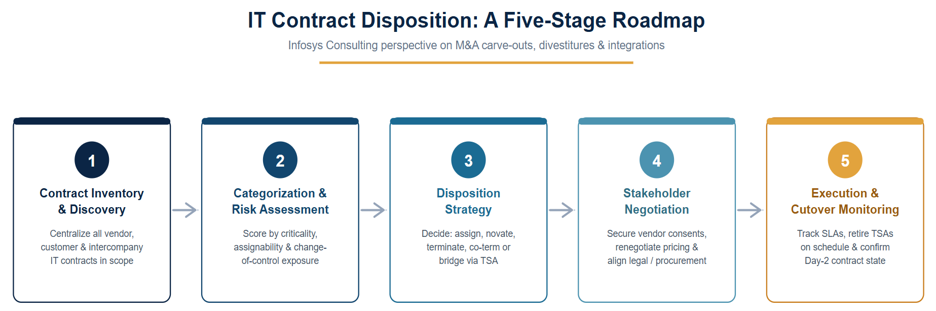
1. Contract inventory and discovery. Before anything can be decided, everything has to be found. This means pulling together vendor contracts, SaaS subscriptions (including the ones procured outside central IT — “shadow IT” is a real contributor here), intercompany service agreements, and telecom/network contracts into a single, deal-scoped repository.
2. Categorization and risk assessment. Each contract gets scored against a small number of dimensions: how critical is it to Day 1 operations, how easily can it be split or transferred, does it contain a change-of-control clause, and what’s the commercial exposure if it’s mishandled.
3. Disposition strategy. This is where the categorization turns into a decision — assign, novate, terminate, let lapse, renegotiate, or bridge temporarily through a Transition Services Agreement. We’ll go deeper on how to make this call below.
4. Stakeholder negotiation. Legal, procurement, and the business unit align on the target position for each contract, then negotiate directly with vendors and counterparties — securing consents, renegotiating volumes and pricing, and formalizing novation or assignment paperwork.
5. Execution and cutover monitoring. Contracts transfer, TSAs go live on a defined exit schedule, and the deal team tracks service levels through cutover to confirm the target Day-2 contract state is actually in place — not just documented as a plan.
The Decision That Actually Matters: How Do You Categorize a Contract?
Stage 3 is where most of the real judgment gets exercised, and it’s worth making that judgment explicit rather than leaving it to case-by-case instinct. We find it useful to plot every contract against two axes: how critical it is to the business, and how separable or assignable it actually is given its structure and counterparty relationship.
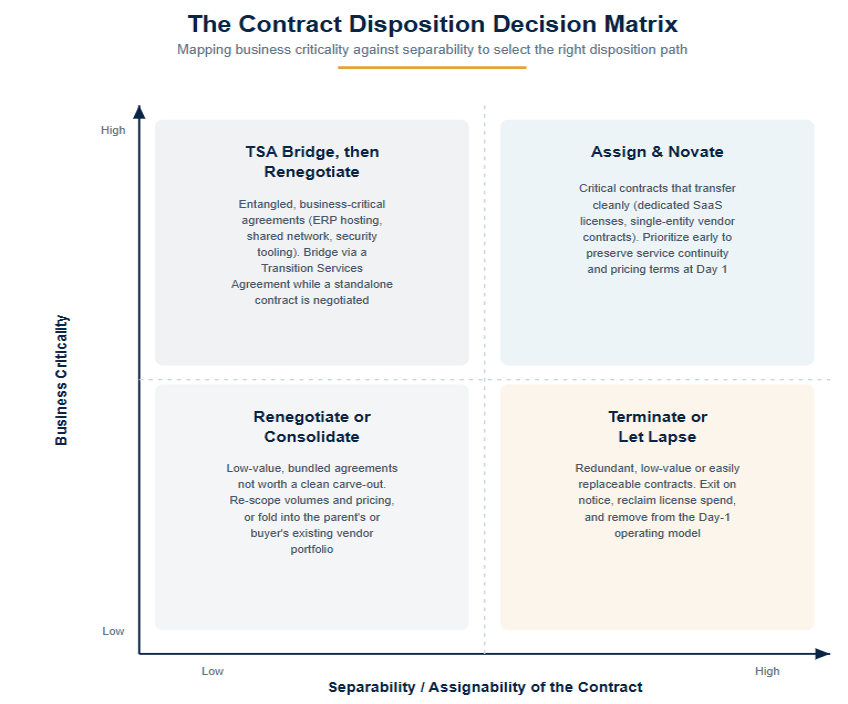
A few patterns worth calling out:
- High criticality, low separability is the danger zone. These are the contracts — often core infrastructure, ERP, or security tooling — that are too important to lose and too entangled to cleanly split before Day 1. This is precisely what Transition Services Agreements exist for: buy time operationally while a standalone contract is negotiated in parallel, with a hard exit date attached so the TSA doesn’t quietly become permanent.
- Don’t default to “keep everything” out of caution. The bottom-right quadrant — low criticality, easily separable — is usually the fastest source of cost takeout in the whole IT estate. Redundant tools and legacy licenses that nobody re-justifies tend to survive by inertia alone.
- Separability is a legal and technical question together. A contract can look “assignable” on paper and still be operationally inseparable if the underlying service is delivered from shared infrastructure. Bring technical architecture owners into this conversation, not just legal.
Practical Lessons From the Field
A few things consistently separate deals where this workstream goes smoothly from deals where it becomes a Day 1 fire drill:
- Start the inventory during diligence, not after signing. The later this starts, the less negotiating leverage you have with vendors, because everyone can see the clock.
- Treat TSA scope and contract disposition as one conversation, not two. Every contract that ends up needing a TSA is a disposition decision that didn’t get resolved in time — plan the TSA exit schedule and the underlying contract negotiation together.
- Assign clear contract owners. Ambiguity about who owns the decision for a given contract — IT, procurement, legal, or the business — is one of the most common causes of dispositions slipping past close.
- Build in a true-up mechanism. Some disposition decisions will turn out to be wrong once operational reality sets in post-close. A lightweight process to revisit a subset of contracts in the first 90 days post-Day 1 saves far more pain than treating every decision as final.
Closing Thought
IT contract disposition rarely makes it into the deal thesis or the investor deck. But mishandled, it shows up fast — in service outages, in vendors using a change-of-control clause as commercial leverage, in TSAs that quietly run months past their intended exit date. Handled well, it’s largely invisible, which is exactly the point.
Treating it as a structured, early-starting workstream — with clear categorization logic and named owners — is one of the highest-leverage things a deal team can do to protect Day 1 continuity and Day 2 cost efficiency alike.