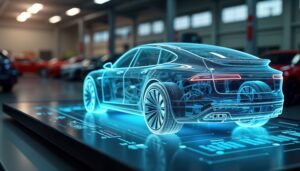
Tesla, widely regarded as a pioneer of Software-Defined Vehicles (SDVs), has firmly established the fact that the automobile is no longer merely an assembly of mechanical and electrical components. Consumer Electronics Show (CES) 2026 reinforced this message loud and clear. Across the show floor, auto OEMs and Tier 1 suppliers demonstrated how deeply they have invested in making their products software-centric, enabling dynamic configuration, continuous updates and evolving customer needs. This transformation has accelerated exponentially over the last decade. Some of the most compelling themes I came across at CES included the digitalized cockpit solutions, accelerated development of SDV components, large-scale hardware and ECU virtualization, management of massive real-time driving data, and AI inference models powering autonomous driving.
The transformation driven by Software-Defined Vehicles (SDVs) is no longer theoretical. At CES 2026, OEMs showcased their software roadmaps rather than highlighting different trims and physical features, emphasizing how they are approaching the development of user experience enhancements, personalization, and advanced driver-assistance capabilities. OEMs also highlighted the core building blocks enabling this shift, including the vehicle operating system, centralized compute platforms, middleware that connects the application layer to the underlying system, and OTA infrastructure required to continuously deliver these features.
Software has become pervasive in the vehicle, and this software-centric shift has not only changed what OEMs offer, but also how they collaborate with the Tier 1 suppliers and technology enablers. During one of the Mobility Stage sessions at CES 2026, an automotive industry leader remarked that while the technology is largely ready, evolving partnership models remain the primary bottleneck, a challenge industry is actively focusing on. This focus was evident through initiatives like SDV accelerator platform announced by AWS along with HERE Technologies. The platform brings together a growing ecosystem of 14 partners, including Tier 1 suppliers, virtual development environment providers, test hardware vendors, and system integrators, highlighting how SDV is increasingly driven by ecosystem-wide collaboration. A similar trend was observed at platform-level partnerships such as QNX, which provides vehicle operating system, along with Vector, a key middleware provider, introduce AlloyKore. By reducing the explicit integration between the platforms, AlloyKore increases the performance.
The increasing complexity of SDVs, along with the need for a tight collaboration across the ecosystem, has created a demand for faster and safer development environments. Virtualization has emerged as a clear enabler, with all stakeholders in this journey actively pursuing it. Virtualization allows the engineers to design, test, and validate software at scale without being constrained by the availability of physical components. This was evident in demonstrations by companies such as dSpace GmbH, a leading provider of simulation and validation solutions for developing autonomous and connected vehicles. dSpace showcased its SCALEXIO simulation platform, traditionally used for simulating hardware testing, highlighting use cases such as multi-ECU testing, XIL (Anything-In-Loop) test farm management. Siemens also demonstrated its PAVE360 digital twin of the E/E-System, which provides a comprehensive development environment with pre-integrated tools and reference models to represent the entire vehicle system, including both hardware and software.
Complementing these hardware-level virtualization, semiconductor vendors are also pushing virtualization deeper into their stack. Qualcomm introduced their Virtual System-on-Chip (vSoC) platform on Google Cloud, which enables the automakers to utilize their cloud-based Snapdragon cockpit automotive SoC for early software development and validation on virtual representation of SoCs. As part of the demonstration, Qualcomm also showcased Cloud AI 100 accelerators, which enables cloud-based workflows for AI inference processing. These capabilities allow developers to simulate and validate real-world scenarios, including ADAS and SDV workloads, well before physical hardware is available.
Over the last decade, the automotive industry has amassed an unprecedented volume of driving data, and that’s fueling the next generation SDVs and autonomous capabilities. CES 2026 highlighted how data infrastructure companies are focusing to speed up the process of collecting petabytes of data effectively, storing them efficiently complying with data sovereignty, and scale their storages and analytics for ADAS/SDV workloads. Equinix, for example, showcased its interconnected hybrid IT infrastructure, designed to enable ADAS data ingestion and HIL/SIL testing use cases. One of its offerings, Equinix Smart Hands, facilitates high-speed transfer of vehicle data while filtering, anonymizing, and prioritizing the data before storing it.
AI has become an integral part nearly every product and offering showcased, and it has become a default capability rather than an add-on. Fujitsu, for example, showcased a suite of AI agents which provides powerful support throughout the software devlopment lifecycle, helping team accelerate development, improve quality, and streamline process. Beyond development support other AI-driven use cases like processing of massive volumes of vehicle data collected, anomaly detection, training and test dataset preparation, inference engines, were also showcased.
CES 2026 made it clear that the automotive industry has crossed a critical inflection point. Software-Defined Vehicles are no longer aspirational concepts but production realities, supported by mature ecosystems, scalable virtualization, data-driven development, and AI-first workflows. CES 2026 did not just showcase the future of mobility, it demonstrated that the foundation for that future is already firmly in place.
As a final thought, during a conversation at this event, I asked an automotive industry leader why the transition from hardware-based products to software-defined vehicles remains so challenging from an organizational perspective. The response was both simple and revealing: “We are moving from mechanical certainty to disciplined uncertainty.” It was a powerful reminder that while the technology, platforms, and data may be ready, the true challenge of the SDV transition lies in rethinking processes, skills, and organizational mindsets. An evolution that may ultimately prove more complex than the technology itself.
About Infosys Software-Defined Vehicles
Infosys Software-Defined Vehicles – an Infosys Business Incubator venture – is a cloud‑native engineering toolchain and services offering that helps OEMs and suppliers build and validate Software‑Defined Vehicles faster. It unifies development and platform operations with scalable virtual validation, including virtual ECUs, cloud CI/CD, and early‑in‑cycle test benches to raise software quality and reliability. By decoupling hardware and software and standardizing environments across teams and suppliers, it shortens cycles, reduces rework, and boosts reuse. Backed by 3,200+ engineers, 15+ labs, 12+ partners, and 10+ accelerators, Infosys Software-Defined Vehicles enables programs to deliver at scale with confidence.