Traditional observability tools—logs, metrics, and traces—were designed for deterministic, request-response systems. Agent-based AI systems fundamentally change this model. They are goal-driven, probabilistic, and capable of autonomous decision-making across models, tools, and memory. As a result, traditional logging no longer explains system behavior, only activity.
To operate agentic AI safely and at scale, organizations must rethink observability—from event tracking to decision understanding.
WHY TRADITIONAL LOGGING FALLS SHORT
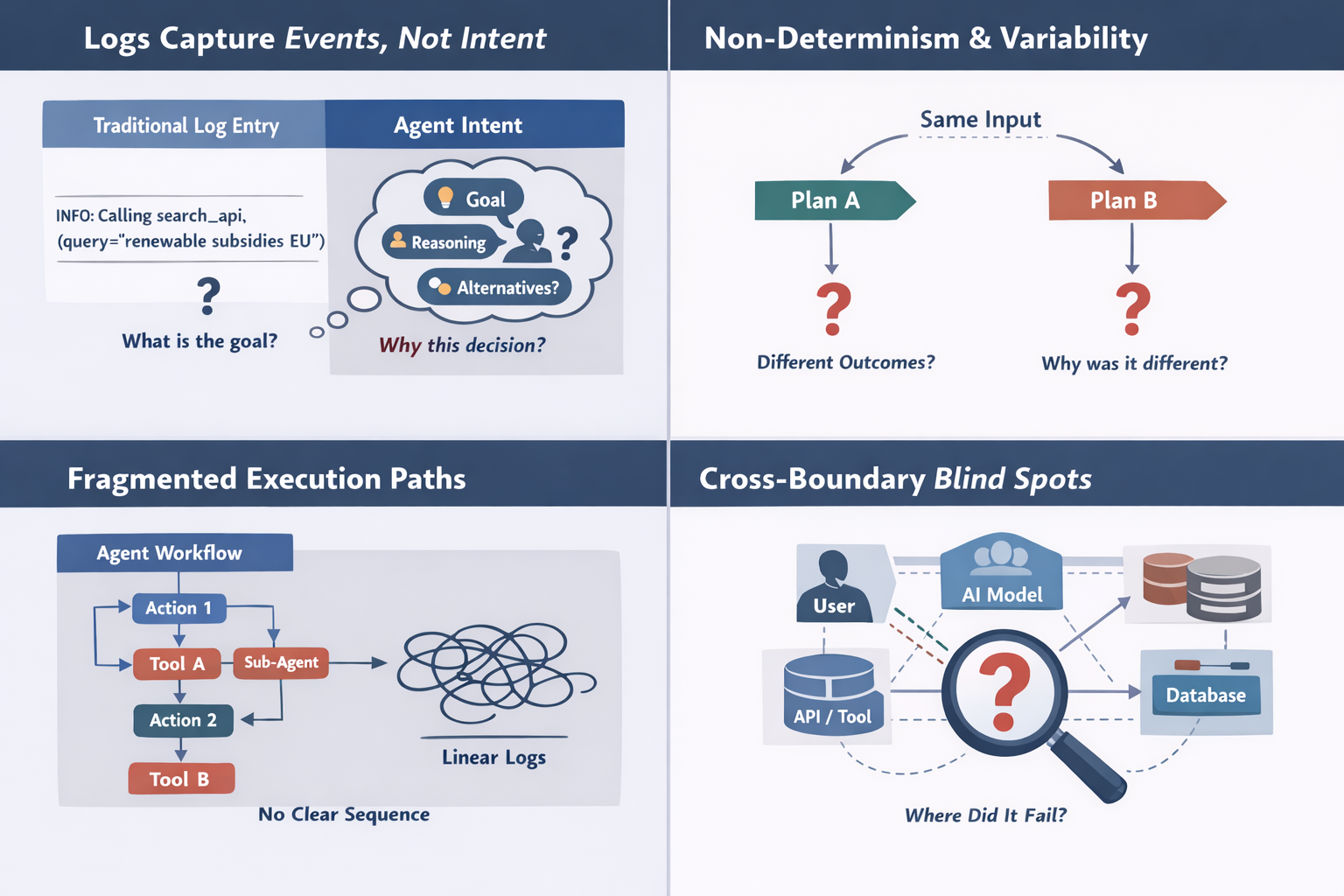
1. Logs Capture Events, Not Intent
A standard log line shows what happened but not why it happened. Without visibility into agent goals, reasoning, or alternatives considered, logs become contextless and misleading.
2. Non-Deterministic Behavior Breaks Log Comparison
Agent systems can produce different outcomes for the same input due to prompt changes, retrieval variation, memory state, or model sampling. Comparing logs across runs offers limited insight.
3. Agent Execution Is Not Linear
Agents branch, retry, and dynamically alter plans. Flat, timestamp-based logs cannot represent these decision graphs, making execution hard to reconstruct.
4. Cross-System Blind Spots Hide Failures
Agent workflows span user interfaces, models, tools, databases, and policy layers. Failures often occur between boundaries that traditional logs cannot correlate.
5. AI Failures Are Semantic, Not Technical
An agent can return a technically successful response while being factually incorrect, non-compliant, or hallucinated. Traditional logs cannot detect these semantic failures.
THE SHIFT: FROM LOGS TO AI OBSERVABILITY
AI observability focuses on understanding decisions, not just executions. Instead of asking whether the system ran successfully, teams must ask whether the agent made the right decision for the right reason.
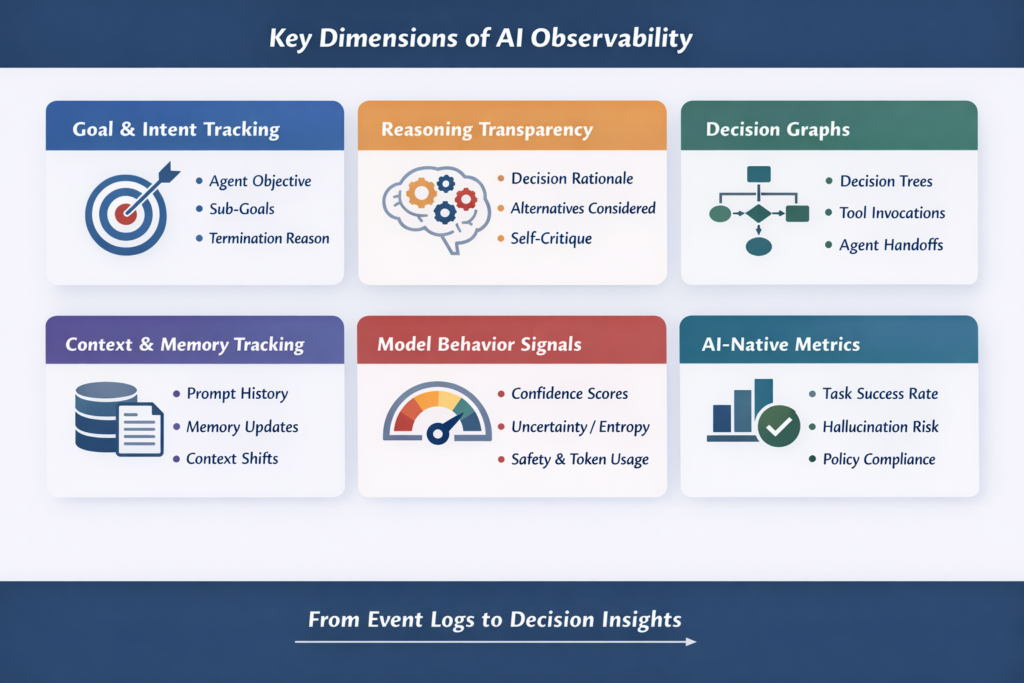
KEY DIMENSIONS OF AI OBSERVABILITY METRICS
1. Goal & Intent Tracking
Track primary objectives, derived sub-goals, and termination reasons.
2. Reasoning Transparency
Capture structured reasoning summaries, alternatives considered, and confidence indicators.
3. Decision Graphs
Model execution as branching decision graphs instead of linear traces.
4. Context & Memory Tracking
Monitor prompt versions, retrieval context, memory usage, and context evolution.
5. Model Behavior Signals
Observe latency, token usage, safety triggers, and uncertainty indicators.
6. AI-Native Outcome Metrics
Measure task success, hallucination risk, policy compliance, tool efficiency, and human escalation rate.
WHY THIS MATTERS
Without AI-native observability, debugging becomes slow, compliance is harder to prove, and trust in AI systems erodes. Proper observability enables safe scaling, faster root-cause analysis, and enterprise confidence.
FINAL THOUGHT
Logs remain necessary but are no longer sufficient. To run agent-based AI responsibly, organizations must observe intent, decisions, context, and outcomes—not just execution.
AI observability is the foundation for trustworthy, scalable agentic systems.