Background
The global digital accessibility landscape is dominated by web accessibility and related initiatives. The accessibility of digital documents, including PDFs, is an equally important concern but remains largely overlooked. Increased digitalization has made paperless transactions a reality with PDFs becoming the standard and most popular method for electronic document exchange. PDFs are widely used by businesses, governments, institutions and individuals to represent bodies of important information. Adobe has seen a significant increase in the usage of PDFs using Acrobat. As per smallpdf.com, there exist 2.5 trillion PDF documents globally and making them accessible for all users is a critical necessity.
Inclusion of accessibility should become a non-negotiable requirement in the PDF creation process than retrofitting it later. Unstructured PDFs create barriers for people with disabilities. Awareness of the need is the first step followed by a well-defined inclusive PDF generation process. Integration of AI and modern technologies can enhance the accessibility experiences further. This blog gives the reader a brief introduction about the importance of PDFs and how they can be created with built-in accessibility.
The Case of PDF
Portable Document Format (PDF) version 1.0 was created and released by Adobe in 1993. Since then, PDF has come a long way in terms of features and usage. As one of the landmark decisions, Adobe made PDF an open standard to the public by handing it over to International Organization for Standardization (ISO) in the year 2007. In 2012, PDF/UA, standard for accessible PDF technology was released. The latest version is PDF 2.0 following ISO 32000-2:2020 standards.
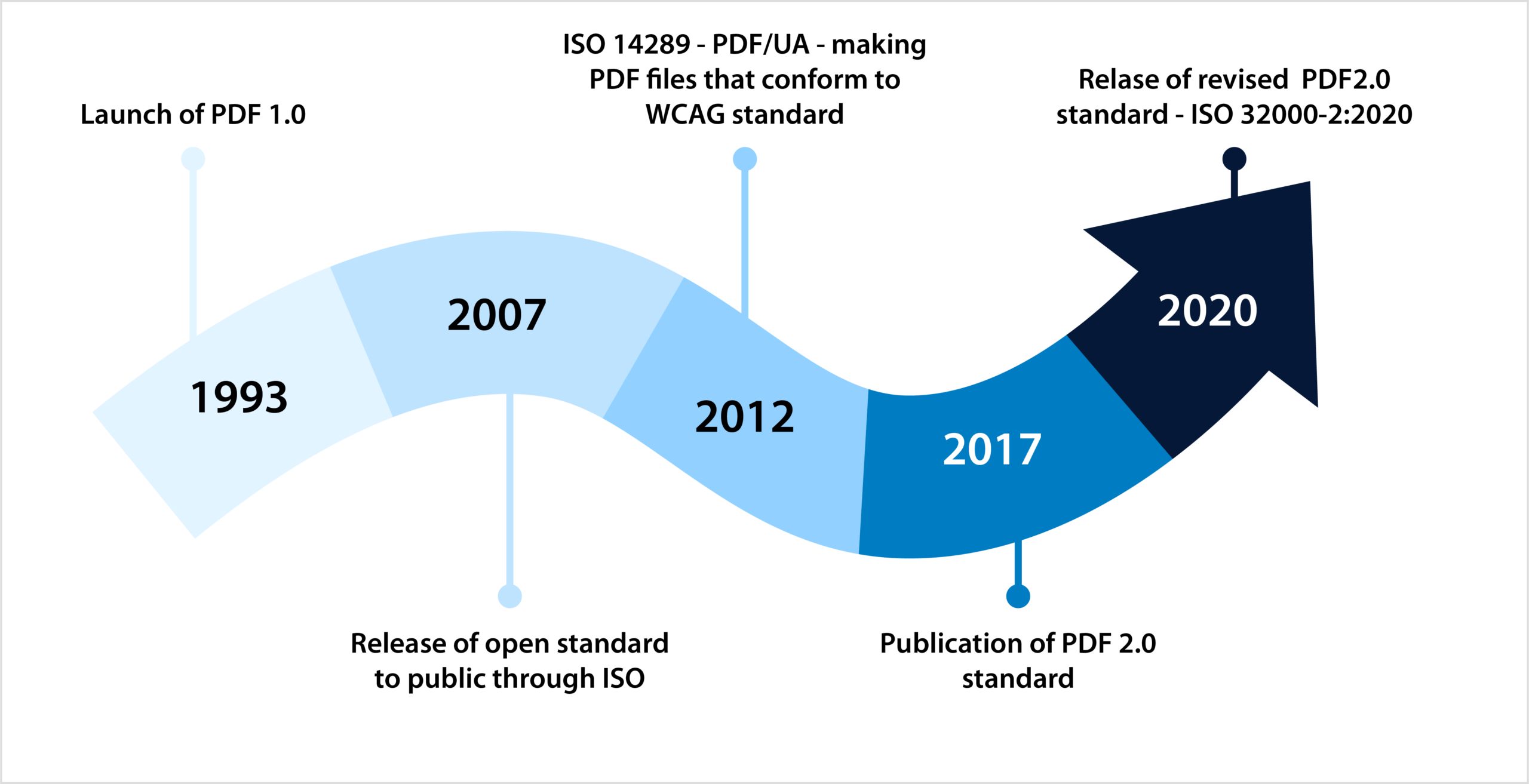
Evolution of PDF (Source: Adobe/ISO)
Unlike other document formats, PDFs have the advantage of being platform agnostic. The format and layout remain the same irrespective of the environment or device it is being created or used. This enables organizations and users to have easy and reliable exchange of electronic documents independent of the environment in which they were created or consumed. PDFs have become the de facto standard for printable documents. Almost all sectors – from private corporates to government offices – have embraced PDF as standard for document sharing, consumption, storage and archival.
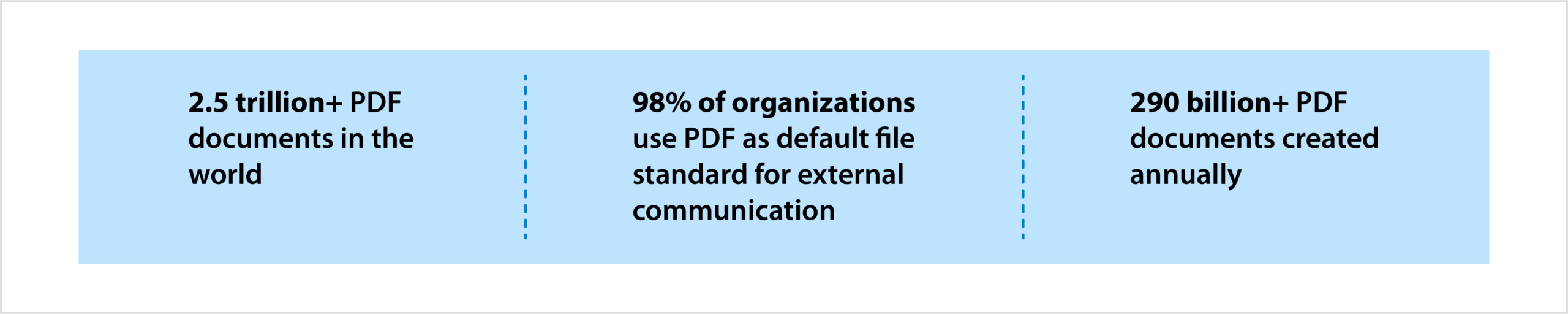
PDF Usage Statistics (source: smallpdf.com)
As businesses, public agencies, and educational institutions continue to streamline their operations to digital first workflow from paper-based ones, the impact and opportunity for the usage of PDF will continue to grow at a rapid pace.
The Need for PDF Accessibility
Considering the wide popularity and relevance, accessibility is a major need and challenge for PDFs. The use of PDF by people with disabilities is the ultimate litmus test for its accessibility. Accessible PDFs are a must for improved inclusion, user adoption, and legal compliance. The accessibility features built in PDF have improved over the versions. But there is a need for improved awareness and implementation of accessibility right from creation phase.
Accessible PDFs are also a strategic advantage. Organizations that prioritize accessible PDFs unlock several tangible benefits, including enhanced customer experience and brand reputation, a competitive edge in government and enterprise contracts, and significant cost savings by avoiding retrofitting and reducing support queries from users with disabilities.
Shifting Left – Creation of Accessible PDFs
PDFs are highly versatile and can be generated using multiple ways. Users with visual impairments use screen reader assistive technology to navigate PDFs. It is important to enable tagging of PDFs to follow accessibility standards which in turn enable screen readers and other assistive technologies to interpret the document’s structure correctly. We also need to ensure that all images included in PDFs have meaningful alternate text and follow good color contrast for improved readability.

PDF Accessibility (Source: Author)
Infosys Accessibility Platform offers comprehensive PDF accessibility analysis and provides recommendations for remediation. It has the capability to tag untagged pdfs using Adobe Auto Tag API for improved accessibility. AI based agents enable verification of color contrast, color blindness and creation of meaningful image descriptions.
Conclusion
PDFs have become the go-to standard for document storage and transfer and are central to organizational business processing needs. It will remain a digital mainstay for its platform independence and content integrity capabilities. Considering the increased importance and relevance, accessibility is a critical priority that should be mandated right from creation. Inclusion of accessibility tags and settings are mandatory checks to make these documents inherently accessible. With increased awareness and adoption of the latest technologies, PDF documents can become truly inclusive for all users.
References
https://www.equalweb.com/a/44194/11527/what_is_pdf_accessibility_and_why_is_it_important