Food waste is one of the world’s most persistent sustainability, economic, and supply‑chain challenges. Nearly one‑third of all food produced globally is wasted every year, contributing to massive financial losses, resource depletion, and greenhouse gas emissions. The rise of Artificial Intelligence (AI)—combining computer vision, machine learning, predictive modeling, and IoT—has fundamentally transformed how businesses across the food chain track, prevent, and repurpose food waste.
As regulatory pressures increase, margins tighten, and sustainability becomes a strategic priority, organizations are rapidly adopting AI‑powered systems to forecast demand, optimize handling, automate waste tracking, and enhance traceability. The result: measurable reductions in waste, improved operational efficiency, and new circular‑economy revenue models.
Importance of Food Waste management
Predict and Prevent Waste Before it Happens–AI forecasting models optimize ordering, inventory, and production schedules—helping avoid overstocking and spoilage. This aligns with market research emphasizing AI’s rising adoption across farm-to-fork supply chain.
Automate Waste Measurement with High Accuracy–Computer‑vision‑enabled waste tracking, already deployed in thousands of kitchens, reduces manual effort and provides granular insights into why waste occurs—leading to faster corrective actions. This has been proven across hospitality operations worldwide.
Reduce Environmental Impact–Food waste generates roughly 3 billion tons of greenhouse gas emissions annually. AI systems help businesses cut emissions by minimizing stock loss, optimizing production, and diverting edible waste.
Improve Profitability Through Efficiency–AI‑powered dynamic pricing, forecasting, and process automation directly reduce shrink, increase sell‑through, and optimize resource usage—factors cited as driving strong industry adoption.
Market Stats: AI in Food Waste Management
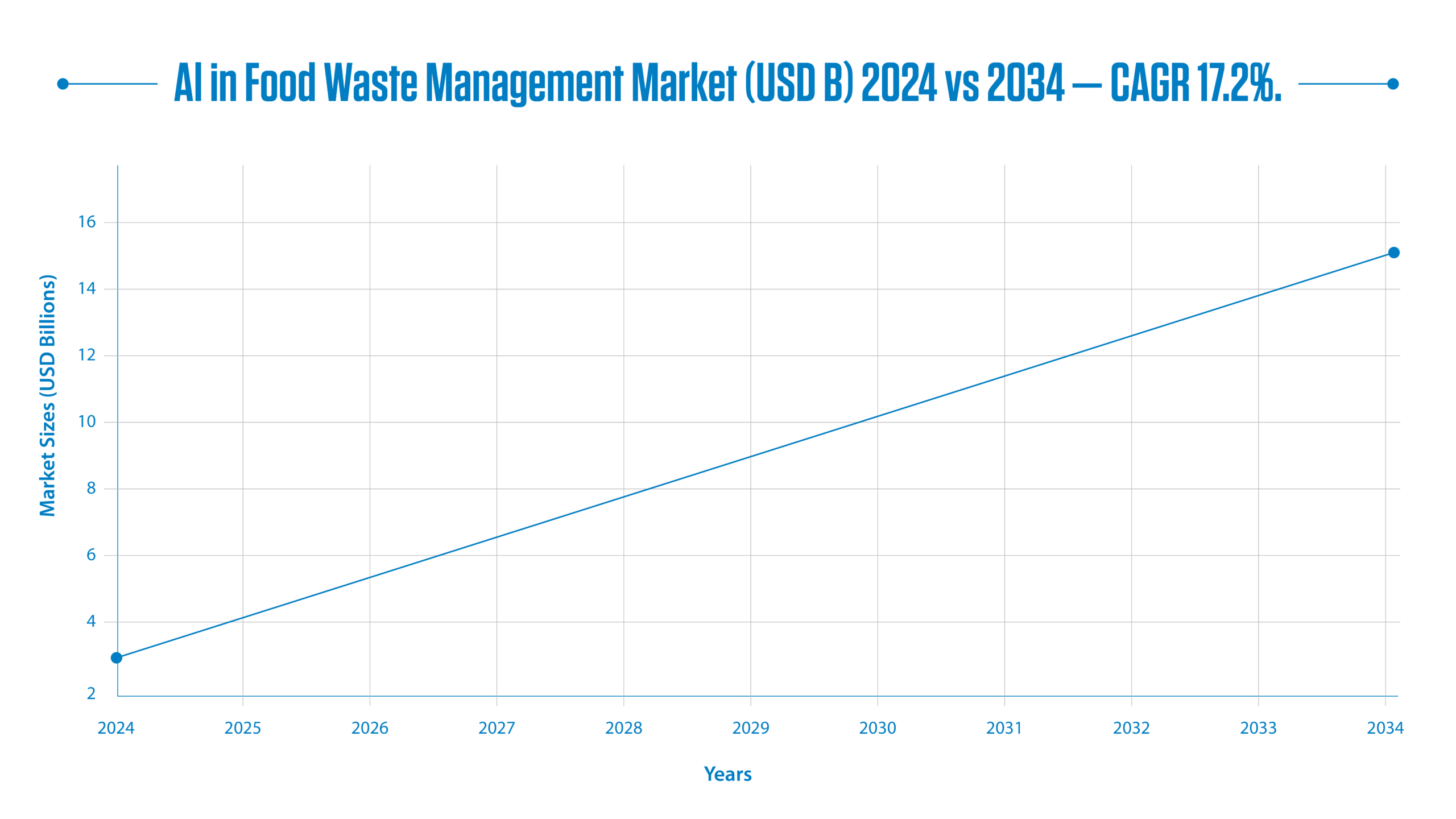
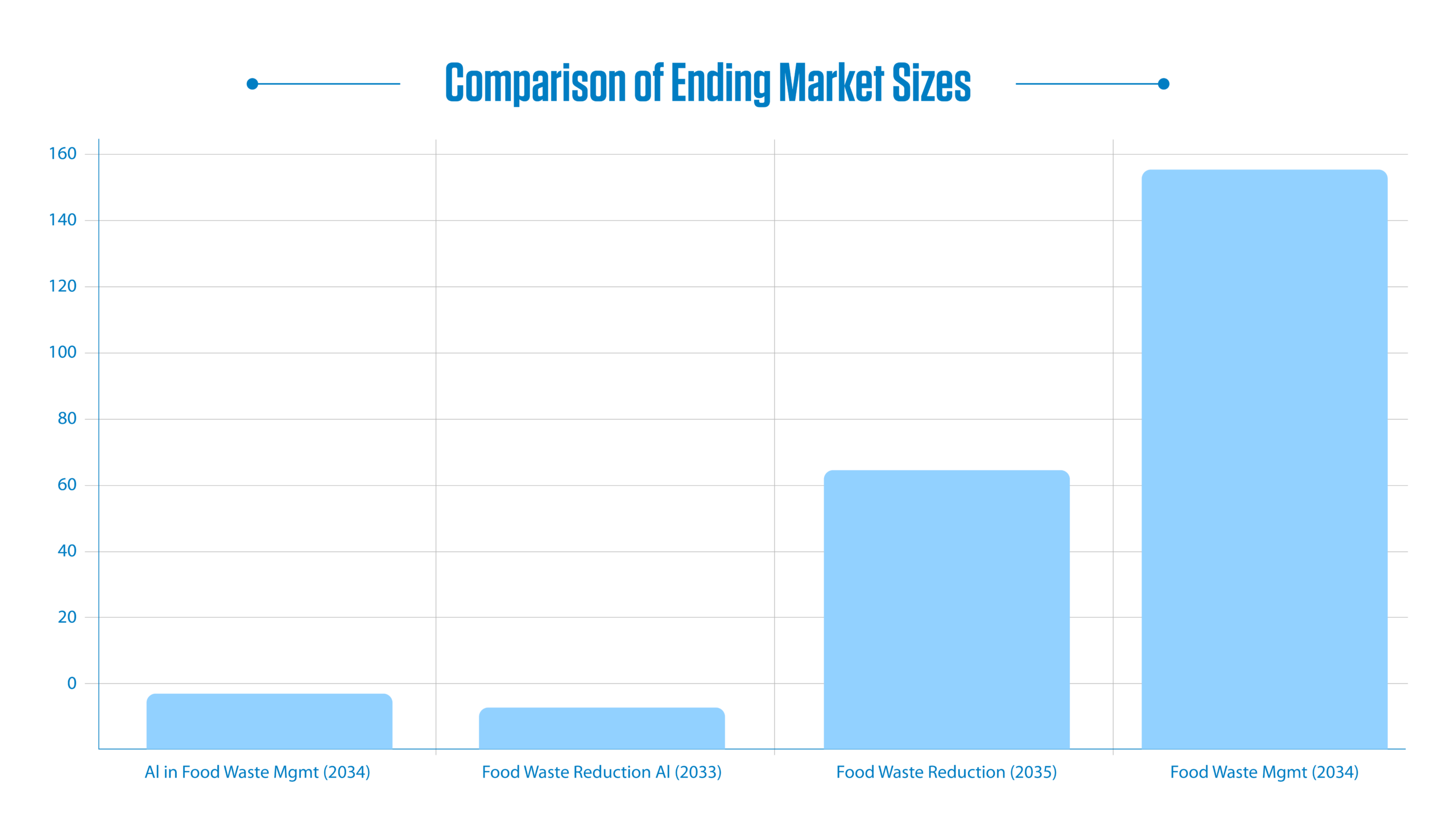
Global Market Size & Growth-The AI in Food Waste Management Market was valued at USD 3.10 billion in 2024 and is projected to reach USD 15.16 billion by 2034, growing at a CAGR of 17.2%.
Food Waste Reduction AI Market-A closely related category, the Food Waste Reduction AI market, reached USD 1.31 billion in 2024 and is expected to hit USD 10.38 billion by 2033 at a CAGR of 24.7%, propelled by regulatory and sustainability drivers.
Food Waste Reduction Market- USD 35.4B in 2025 → USD 68.3B in 2035, 6.8% CAGR.
Food Waste Management Market-USD 86.69B in 2025 → USD 152.8B in 2034, 6.5% CAGR.
Solutions and Technologies Involved
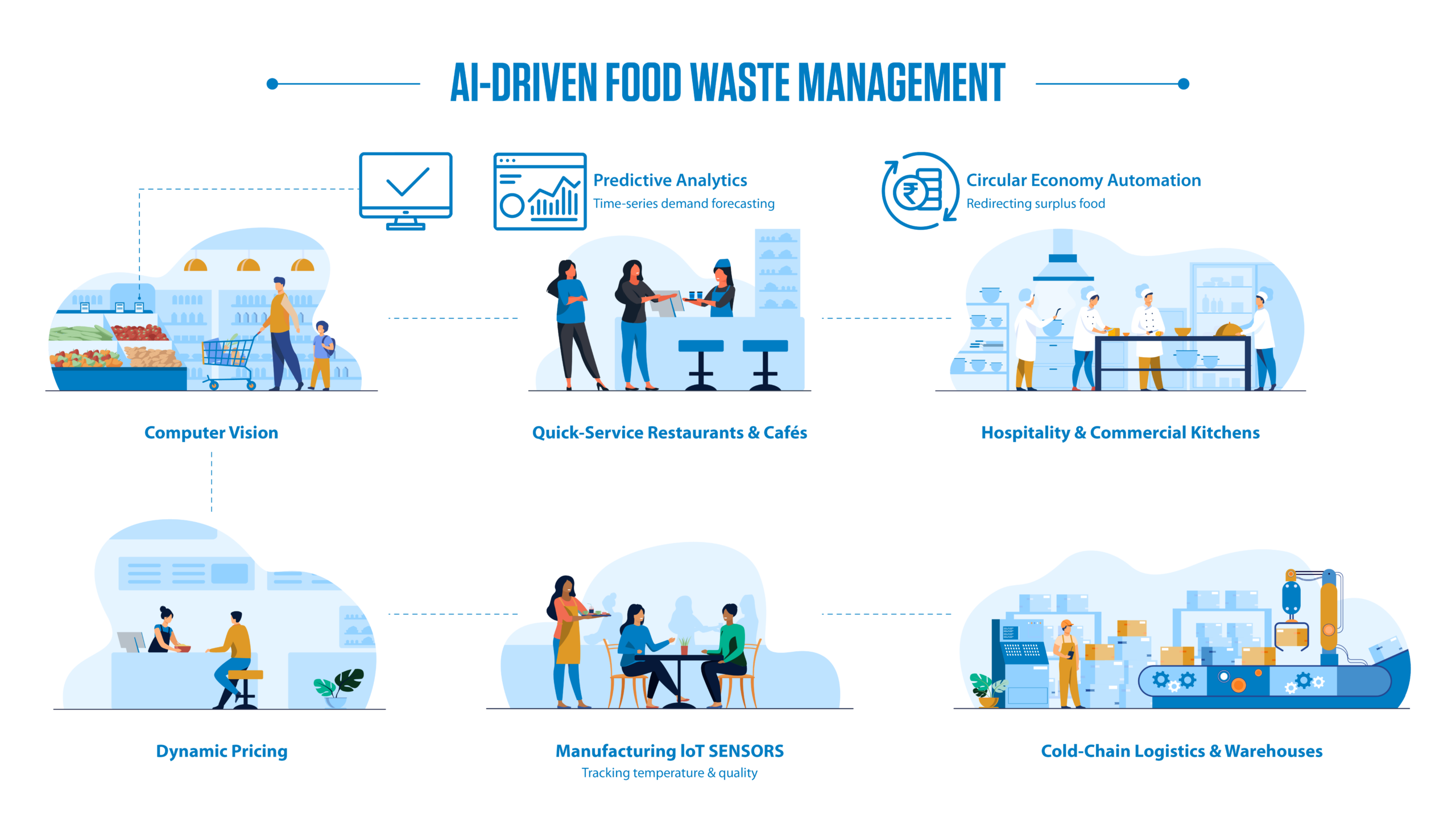
Computer Vision (CV) Waste Tracking– Computer vision automates the identification and categorization of food waste by analyzing images, enabling precise measurement and pattern detection across operations. It supports real‑time monitoring, reduces manual logging, and provides data that helps optimize processes and minimize avoidable waste.
Predictive Analytics & Time‑Series Forecasting–Predictive models use historical sales, seasonal factors, and real‑time data to forecast demand, preventing overproduction and spoilage. These algorithms optimize inventory, guide purchasing decisions, and enhance planning efficiency across foodservice and retail environments.
Dynamic Pricing & Freshness Optimization–AI‑driven dynamic pricing adjusts item prices based on expiry dates, remaining shelf life, and sales velocity. This helps increase sell‑through of perishable goods, reduce last‑minute markdown waste, and incentivize earlier purchasing to prevent products from expiring unsold
IoT Sensors for Quality, Temperature & Ripeness Monitoring–IoT sensors track temperature, humidity, and biochemical indicators like ethylene to maintain product quality throughout storage and transportation. These systems help detect spoilage risks early, preserve freshness, and reduce waste linked to cold‑chain failures or improper environmental conditions
Circular‑Economy Automation–AI automates the sorting, processing, and conversion of organic waste into secondary resources, supporting circular systems that recover nutrients or energy. Automated classification and processing reduce landfill dependence, improve resource efficiency, and enhance overall sustainability within the food ecosystem.
Use Cases and Industry Example Across Industries
Grocery & Retail-AI helps grocery and retail operators address chronic issues like overstocking, shrink, and expired inventory by combining demand forecasting, dynamic pricing, and automated freshness checks. Forecasting models have reduced store‑level waste by 14.8%, improving product availability and freshness. Dynamic pricing systems further cut waste by up to 80% while increasing revenue by 20–50%, preventing products from expiring unsold.
Hospitality, Hotels & Commercial Kitchens–AI technologies combat overproduction, buffet waste, and plate waste through computer‑vision tracking, predictive menu planning, and optimized batch preparation. These tools have enabled major hotel groups to save over $100M annually by reducing unnecessary food production. Individual hotel deployments have shown strong results, including 25% waste reduction in six months and 18–60% reductions in data‑driven kitchen environments, highlighting AI’s effectiveness in operational optimization.
Supply Chain & Cold Chain Logistics–AI strengthens cold‑chain reliability by using IoT sensors and predictive analytics to prevent spoilage caused by temperature abuse and poor ripeness management. These systems provide real‑time alerts for deviations in temperature, humidity, and biochemical indicators, thereby reducing losses across storage and distribution. Their adoption continues to rise as global policies tighten and supply chains modernize toward waste‑mitigating, environmentally resilient operations.
CPG Manufacturing-AI improves efficiency in CPG manufacturing by managing overproduction, identifying byproduct‑reuse opportunities, routing short‑dated inventory, and supporting automated rework processes. Intelligent circular‑economy systems now transform previously discarded organic materials into secondary resources such as animal feed, significantly reducing waste volumes. These AI‑enabled recycling loops demonstrate how smart manufacturing can reinforce sustainability while optimizing resource recovery within the broader food ecosystem.
Industry Example
1. Amazon Fresh
Amazon Fresh benefits from AI‑driven waste‑reduction technology through Amazon’s investment in Mill’s commercial‑scale AI system, which will be deployed across Whole Foods and integrated into Amazon’s broader grocery operations. AI‑equipped waste processors generate real‑time insights into discarded items, enabling smarter replenishment, improved food safety, and lower operational costs. Amazon’s Climate Pledge Fund supports this technology to build a circular, low‑waste supply chain, converting organic scraps into stable feedstock and reducing associated emissions across Amazon’s grocery ecosystem.
2. Walmart
Walmart has implemented AI tools across its grocery operations, including systems that track freshness, optimize handling, and improve shelf‑life management. AI‑based “freshness algorithms” help associates manage perishable items more effectively, reducing shrink and preventing premature spoilage. These tools support smarter purchasing, improved inventory rotation, and better quality assurance, helping Walmart address one of retail’s largest contributors to food waste.
3. McDonald’s (Global Quick‑Service Restaurant Chain)
McDonald’s uses AI‑powered predictive analytics across its global supply chain to better forecast demand, optimize procurement, and reduce food waste. Through its partnership with Google Cloud, McDonald’s leverages machine‑learning models that analyze massive real‑time POS and operational datasets to improve inventory planning across 40,000+ restaurants. This shift enhances accuracy in ingredient ordering, minimizes overproduction, and reduces in‑store waste. McDonald’s Sweden specifically uses an AI forecasting system to prevent unsold prepared food, improving sustainability outcomes through more precise production
4. Starbucks (Global Coffee Chain)
Starbucks has deployed AI‑powered inventory systems across more than 11,000 North American stores, using computer vision, 3D spatial intelligence, and real‑time analytics to minimize waste caused by overstocking and product spoilage. These systems count inventory eight times more frequently with 99% accuracy, enabling precise demand planning and reducing excess perishable stock. The resulting optimization cuts waste, improves availability of key ingredients, and saves an estimated $150–225 million annually through smarter replenishment and reduced spoilage.
5. IKEA’s Global Food Operations
IKEA uses AI‑enabled food‑waste tracking technologies across its global restaurant and kitchen operations to measure, analyze, and prevent waste. AI systems track what food is discarded, when, and why, helping kitchen teams adjust production volumes, improve menu planning, and reduce unnecessary preparation. These AI‑supported operational changes enabled IKEA to achieve 30% food‑waste reduction in one year, strengthening its broader sustainability commitments and demonstrating large‑scale impact across multinational foodservice environments
Solutions
1. Winnow Solutions (Global – Hospitality & Commercial Kitchens)
Winnow providesAI‑powered food‑waste tracking systems used across thousands of hotel and commercial kitchens worldwide. Its computer‑vision tools automatically identify and quantify food waste, delivering data‑driven insights that help chefs reduce overproduction and optimize kitchen operations.
USP: Winnow’s major strength is its AI‑vision waste tracking, enabling large hospitality groups such as Hilton, Accor, Marriott, and others to achieve over $100M in annual savings through measurable, real‑time food‑waste reduction. This proven large‑scale impact is unmatched in the hospitality secton.
2. KITRO (Switzerland – Smart Kitchen Automation)
KITRO uses AI‑powered in‑bin tracking to automatically capture, classify, and analyze food waste in commercial kitchens. Its automated system provides daily operational insights that help chefs adjust portions, improve prep accuracy, and cut food waste without interrupting workflow.
USP: KITRO’s unique fully automated, in‑bin waste‑tracking technology allows kitchens to operate without manual input. Customers achieve 18–60% food‑waste reduction, making KITRO one of the most effective AI‑driven waste‑prevention systems for healthcare, hotels, and institutional kitchen
3. Mill (U.S. – Circular‑Economy AI for Grocery & CPG)
Mill provides an AI‑enabled food‑waste conversion system that processes produce scraps on‑site in grocery stores, transforming them into nutrient‑rich chicken feed through automated grinding and dehydration. Whole Foods Market will deploy this system across stores starting 2027.
USP: Mill’s USP is its AI‑powered, closed‑loop circular system that reduces waste volume by up to 80%, while providing real‑time analytics on discarded food and converting scraps into feed ingredients for suppliers—creating a fully circular retail supply chain.
Conclusion
AI in food waste management has moved from pilot to proven value creator across the entire food system. By uniting computer vision, predictive analytics, dynamic pricing, IoT sensing, and circular automation, organizations can predict, prevent, and repurpose waste with measurable ROI. The market’s rapid growth—double‑digit CAGRs in AI segments and steady expansion in broader reduction/management—signals sustained investment and maturity. Practically, grocers cut shrink and boost sell‑through; hotels and kitchens right‑size production and portions; supply chains uphold cold‑chain integrity with real‑time telemetry; CPGs close loops by turning organic byproducts into valuable inputs. Just as important, these gains translate into climate impact: fewer emissions from avoided waste, smarter use of water, land, and energy, and credible progress against ESG commitments. The imperative now is execution—stand up data pipelines, embed AI into daily decisions, and govern with audit‑ready traceability. Done well, AI turns waste from a hidden cost into a strategic lever for margin, resilience, and sustainability.
References
- https://www.foodbeveragestrategies.com/ai-in-food-waste-management-market-size/
- https://growthmarketreports.com/report/food-waste-reduction-ai-market
- https://www.factmr.com/report/food-waste-reduction-market
- https://www.futuremarketinsights.com/reports/food-waste-management-market
- https://www.waste360.com/food-waste/how-dynamic-pricing-tech-is-cutting-grocers-food-
- https://www.grocerydive.com/news/whole-foods-market-amazon-mill-industries-in-store-on-site-food-waste-technology-sustainability/808122/
- https://procurementmag.com/news/mcdonalds-harnessing-predictive-analytics
- https://www.growthhq.io/our-thinking/how-starbucks-ai-powered-inventory-revolutionized-waste-reduction-across-11000-north-american-stores-key-lessons-for-retail-leaders
- https://info.winnowsolutions.com/2024-25-impact-report
- https://www.mill.com/news/Mill-commercial-partnering-with-amazon