Continuing from Part 1, we now turn our attention to the next set of considerations:
V. Key Players and the Research Landscape
The VLA landscape for autonomous mobile robots spans academic research groups, robotics-focused AI labs, and a growing number of commercial efforts. It is useful to distinguish between foundational VLA models developed primarily for manipulation tasks, and efforts to extend or adapt VLAs for mobile navigation and task execution.
Foundational VLA Models
RT-2 (Google DeepMind, 2023): The paper that established the modern VLA paradigm. RT-2 co-trains a web-scale vision-language model (PaLI-X or PaLM-E backbone) with robot demonstration data by tokenising actions as text tokens. The resulting model exhibits emergent generalisation: it can execute novel instructions and reason about objects it encountered only in internet pre-training data, not in robot demonstrations. Though focused on tabletop manipulation, RT-2 set the architectural template that subsequent mobile robot work has built upon.
RT-X / Open X-Embodiment (Google DeepMind + 33 institutions, 2023): A large-scale collaboration that aggregated robot demonstration data across 22 different robot embodiments and trained cross-embodiment VLA policies. Demonstrated that a single policy can transfer across robot types — a capability with direct relevance to AMR fleets that include multiple robot models.
pi-zero / pi0 (Physical Intelligence, 2024): Introduced a flow-matching (diffusion-based) action head that produces significantly smoother, more dexterous actions than tokenised prediction. Trained on a large proprietary dataset across many task types. Represents the current state of the art in action quality for VLA models, with implications for AMRs that require smooth base motion in human-shared environments.
OpenVLA (Stanford, 2024): An open-source VLA (Llama 2 backbone with DINOv2 + SigLIP vision encoder) trained on the Open X-Embodiment dataset. Provides a reproducible, fine-tuneable baseline that AMR researchers and companies can adapt without access to proprietary training infrastructure.
Octo (UC Berkeley, 2024): A transformer-based robot policy designed for generalist cross-embodiment transfer. Emphasises modularity and efficient fine-tuning to new robot configurations — an important property for AMR vendors who need to adapt foundation models to specific hardware.
Mobile Robot-Specific Efforts
NavVLM and related navigation VLMs: A growing body of work applying VLMs to object-goal navigation — the task of navigating to a named object in an unseen environment. Systems like EmbodiedScan, SQA3D, and NavGPT demonstrate that language-grounded spatial reasoning can enable robots to navigate to targets they have never explicitly been programmed to find.
Mobile ALOHA (Stanford, 2024): A mobile manipulation system that combines a wheeled base with a bimanual manipulator and trains whole-body policies using imitation learning at scale. Demonstrated that end-to-end learned policies could handle complex household tasks requiring coordinated navigation and manipulation — a capability previously considered out of reach for learned systems.
GR-1 (Beijing Institute for General Artificial Intelligence, 2024): A generalist robot policy based on a GPT-style backbone, trained on video prediction and robot demonstration data. Showed strong transfer to locomotion and manipulation tasks with limited fine-tuning data.
Commercial AMR platform integrations: Companies including Boston Dynamics (Spot), Anybotics (ANYmal), Clearpath Robotics, and several warehouse AMR vendors are actively integrating large language and vision-language model capabilities into their platforms, primarily for natural language task specification, anomaly reporting, and human-robot communication.
The Open-Source Ecosystem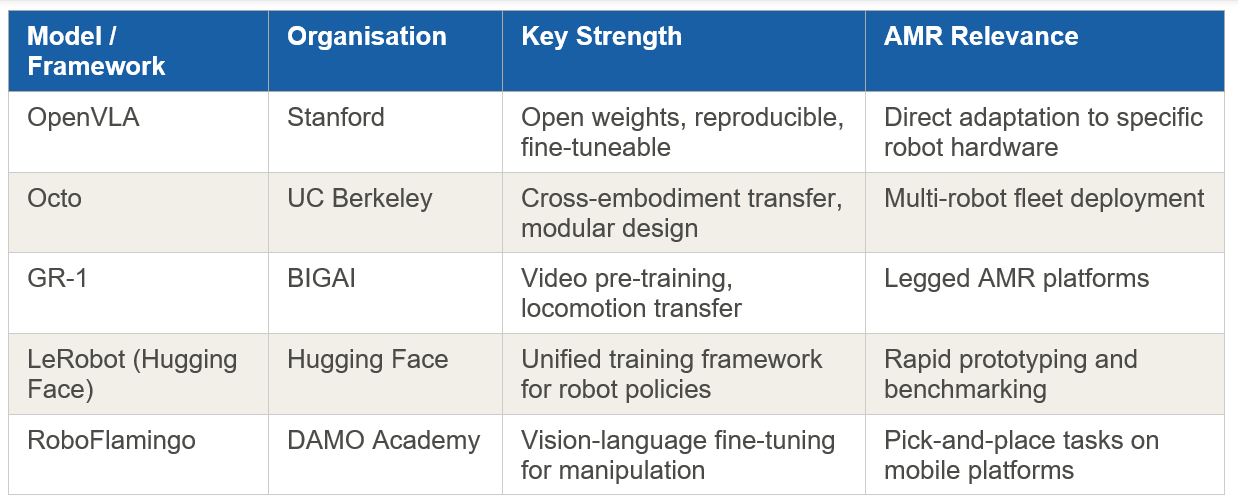
VI. Reengineering the AMR Pipeline — What Changes?
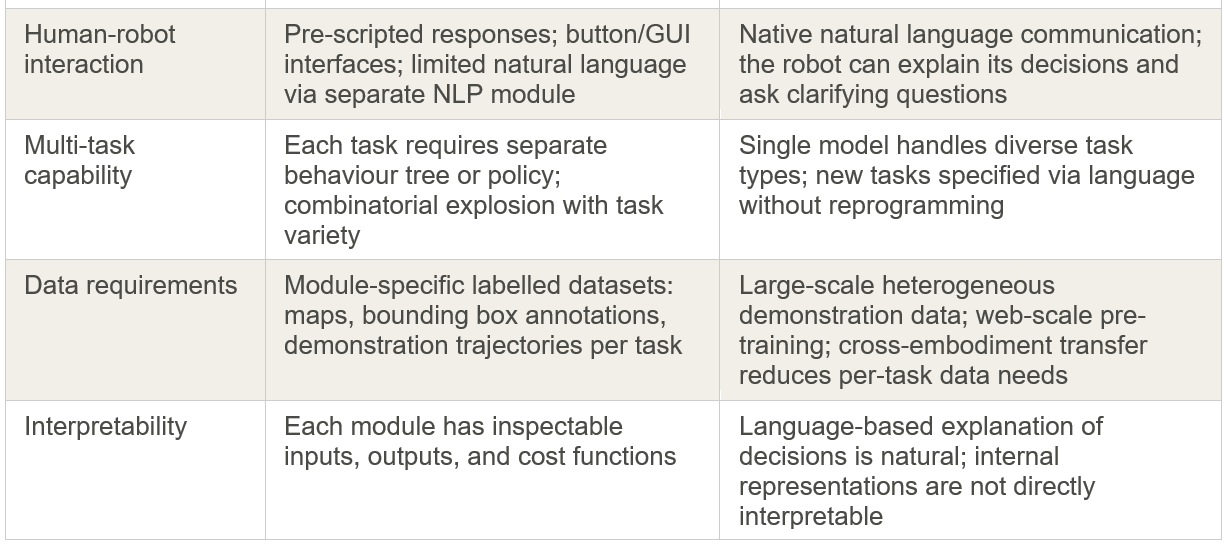
The transition from a classical AMR stack to a VLA-driven one is not a binary switch. It is a spectrum of architectural choices, ranging from VLA-augmented hybrids that preserve most of the classical stack to fully end-to-end learned systems that replace it almost entirely. Understanding this spectrum is essential for AMR engineers planning near-term and medium-term development roadmaps.
Classical AMR Stack vs. VLA-Driven Stack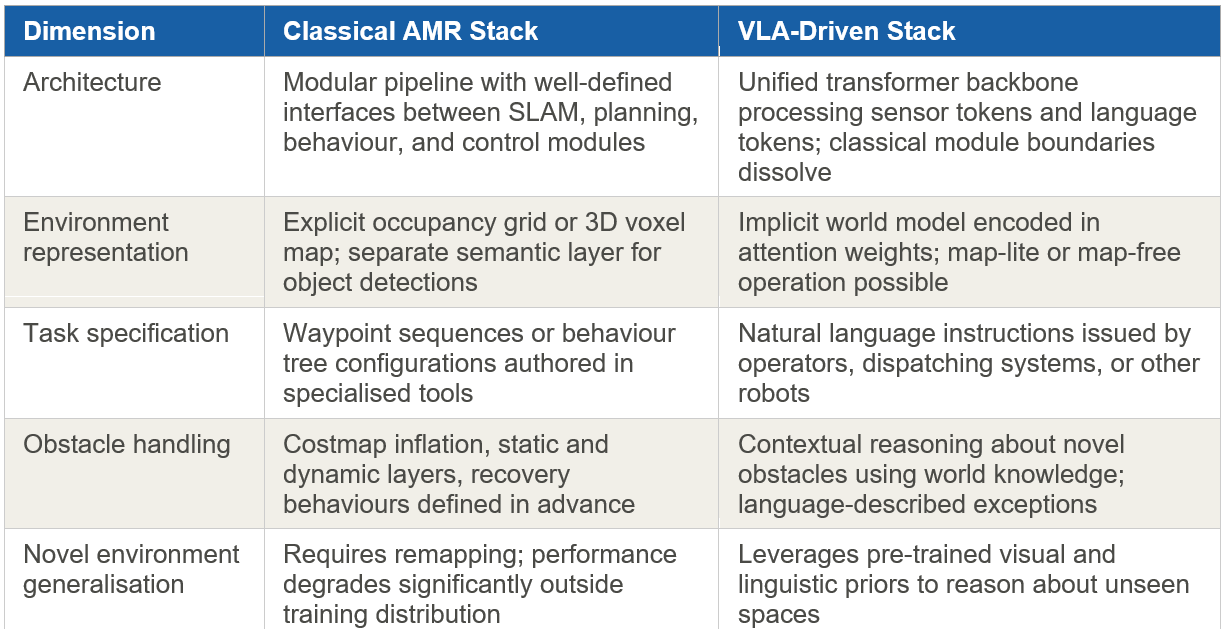
The Hybrid Middle Ground
For most near-term commercial AMR deployments, the most practical path is a hybrid architecture in which a VLA or VLM handles semantic reasoning and task planning, while a classical motion controller handles low-level velocity execution with known latency and safety properties. In this configuration:
The VLA layer receives natural language task instructions and camera observations. It reasons about the scene, identifies relevant objects, determines the appropriate high-level action sequence, and communicates navigation goals as language-described waypoints or semantic targets to the classical layer. The classical layer handles precise localisation, costmap-based collision avoidance, and smooth velocity execution — well-solved problems that do not benefit from the flexibility of a large model.
This decomposition preserves the real-time guarantees and certification pathway of the classical stack while unlocking the semantic understanding and generalisation capabilities of the VLA. It is not a permanent architecture but a pragmatic bridge while inference latency, safety tooling, and certification frameworks for fully end-to-end learned systems mature.
Part 2 concludes here. In the next and final section, we will tie together these perspectives and present a holistic view.