Introduction
Industrial enterprises are at a turning point. The traditional divide between Information Technology IT and Operational Technology (OT) has created inefficiencies, data silos, and security vulnerabilities. As organizations push toward Industry 5.0, IT/OT convergence is no longer optional — it’s the backbone of digital transformation.
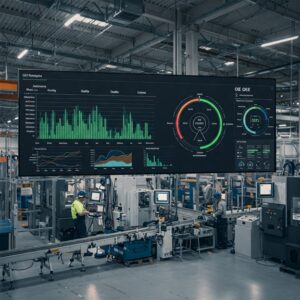
This blog post explores how Agentic AI, when deeply integrated across IT and OT systems, is revolutionizing operational efficiency in manufacturing plant, with a focus on typical process areas: spray painting conveyor systems. We will examine how these intelligent agents orchestrate data from PLCs, SCADA, DCS (OT) and MES, ERP, CMMS (ET/IT), enabling real-time decision-making, predictive maintenance, and process optimization. Real-world use cases—such as anomaly detection in conveyor speed, paint quality consistency monitoring, and chemical bath condition tracking—will illustrate the tangible benefits, including reduced downtime, improved quality, and significant energy savings.
IT/OT convergence is no longer about connecting systems. It’s about building an adaptive, secure, and intelligent enterprise where productivity, resilience, and scalability are not aspirations — they’re measurable outcomes.
The organizations that embrace this shift will lead the next wave of industrial transformation.
Existing Limitations in IT/OT Integration
Despite decades of automation, most plants still struggle with:
- Rule-Based Systems: Rigid logic that fails to adapt to dynamic process changes.
- Manual I/O Allocation: Error-prone, time-consuming mapping of tags and IP addresses.
- Data Silos: OT data locked in proprietary historians, inaccessible to IT analytics.
- Legacy System Hurdles: Incompatibility between PLC/DCS protocols and modern IT platforms.
- Security Risks: Flat networks, weak segmentation, and outdated patching cycles.
- Scalability Limits: Adding new devices or plants often requires re-engineering from scratch.
The result is Poor productivity, delayed implementations, and high error rates that directly impact business outcomes.
Recent industry surveys and reports underscore the accelerating adoption of Agentic AI and IT/OT convergence:
Gartner: Predicts that by 2028, one-third of enterprise software will include agentic AI, and 15% of daily work decisions will be made autonomously by agentic systems.
Solution Approach: ISA-95 as the Foundation
The ISA-95 standard provides a structured model for integrating enterprise IT systems (ERP, MES) with OT systems (SCADA, PLC, DCS).
Key principles:
- Hierarchical Modelling: Enterprise → Site → Area → Unit → Equipment → Instrument.
- Semantic Normalization: Consistent tag naming, units, and metadata across systems.
- Interoperability: Standardized interfaces for ERP/MES to consume OT data.
By aligning integration with ISA-95, organizations eliminate ambiguity and create a common language for IT and OT systems.
Multi-Agent & Cross-Domain Orchestration (ISO 42001)
The next leap is AI-driven orchestration, guided by ISO 42001 (AI Management Systems).
Multi-Agent System
- Device Agents: Discover and classify sensors, actuators, and controllers.
- Process Agents: Interpret control narratives and P&IDs to generate logic templates.
- Security Agents: Monitor traffic, enforce zero-trust, and detect anomalies.
- Business Agents: Align OT data with KPIs (OEE, downtime, triage efficiency, energy efficiency).
Cross-Domain Orchestration
- Dynamic I/O Allocation: AI assigns IPs and maps I/O automatically.
- Self-Healing: Agents reconfigure mappings when devices fail or are replaced.
- Cyber Resilience: Continuous monitoring, anomaly detection, and automated response.
- Scalability: Cloud-edge hybrid architecture supports thousands of devices seamlessly.
This orchestration transforms IT/OT convergence from a manual, rule-based exercise into a self-learning, adaptive ecosystem.
The Imperative for IT/OT Convergence
IT/OT convergence is the seamless integration of information technology systems (business, planning, analytics) with operational technology systems (control, automation, real-time process data). This convergence is foundational for Industry 4.0 and, increasingly, Industry 5.0, enabling:
- Unified Data Flows: Breaking down silos between shop floor and enterprise systems.
- Real-Time Decision-Making: Leveraging live process data for immediate, data-driven actions.
- Closed-Loop Optimization: Enabling feedback-driven process improvements and predictive interventions.
- Agentic AI thrives in this environment, acting as the connective tissue that orchestrates data, decisions, and actions across IT and OT layers.
Tangible Benefits
When executed correctly, IT/OT convergence delivers measurable outcomes:
- Alarm Triage Efficiency: 40% fewer nuisance alarms via AI prioritization.
- Anomaly Reduction: 30% fewer unplanned downtime events.
- Cyber Resilience: MTTD < 5 minutes, MTTR < 30 minutes.
- Scalability: 10x increase in connected devices without performance degradation.
- Business Impact: Faster commissioning, reduced OPEX, improved asset utilization.
Core IT/OT Integration Standards
- ISA-95 (IEC 62264): The foundational global standard for integrating enterprise (IT) and control (OT) systems. It uses the Purdue Model to organize technology into layers, from Level 0 (physical processes) to Level 4 (business activities). The latest version, ISA-95.00.01-2025, enhances convergence by providing shared ontologies and semantic models to define how IT systems like ERP exchange data with OT systems like MES.
- Model Context Protocol (MCP): An open standard protocol (introduced in late 2024 and widely adopted by 2026) that acts as a “universal connector” for AI integration. It allows AI agents to securely access real-time data from enterprise tools and databases through a standardized interface, eliminating the need for custom connectors between every AI model and data source.
- MESA Functional Framework: Absorbed into ISA-95 to define the core functions of Manufacturing Execution Systems (MES)
How Agentic AI Orchestrates OT Data: PLCs, SCADA, and DCS
The OT Landscape: Data-Rich, Historically Siloed
Operational Technology (OT) systems—PLCs (Programmable Logic Controllers), SCADA (Supervisory Control and Data Acquisition), and DCS (Distributed Control Systems)—are the backbone of real-time control in manufacturing. They generate vast streams of sensor and actuator data, capturing every nuance of process behavior, equipment status, and environmental conditions.
However, OT data has traditionally been siloed, used primarily for local control and monitoring. Unlocking its full value requires:
Standardized Data Acquisition: Using protocols like OPC UA and Modbus to extract real-time data from PLCs and SCADA systems.
Edge Computing: Deploying gateways or edge devices to preprocess, filter, and normalize data before it reaches AI agents.
Secure, Low-Latency Integration: Ensuring data flows are robust, secure, and compliant with industrial cybersecurity standards (e.g., IEC 62443).
How Agentic AI Orchestrates IT Data
Agentic AI treats IT systems—ERP, MES, CMMS, and BI platforms—as structured sources of intent constraints and historical context rather than passive repositories. It ingests transactional records (orders schedules inventory), contextualizes them with production recipes from MES, and adds asset health, work order and maintenance history from CMMS so agents can make decisions that are both operationally feasible and commercially optimal.
Key considerations clarifying questions and decision points
- Data model alignment; latency tolerance; master data quality; governance and explainability.
- Clarifying questions to answer internally: Which IT system is the source of truth for product routing; what SLA exists for decision latency; who approves automated plan overrides.
- Decision points: place learning at edge or cloud; allow agents to auto‑execute setpoints or require human approval; map KPIs to reward functions
Agentic AI Integration Patterns
Agentic AI agents’ interface with OT systems through several architectural patterns:
- Middleware and Gateways: Software or hardware gateways bridge OT protocols (OPC UA, Modbus) to IT-friendly formats (MQTT, REST APIs), enabling seamless data flow.
- Edge AI and On-Device Inference: ML and edge AI models run directly on microcontrollers or edge gateways, enabling real-time anomaly detection and control with minimal latency.
- Event-Driven Architectures: Agents subscribe to event streams (e.g., MQTT topics) for immediate response to process changes or alarms.
Real-World Example: Conveyor System Monitoring
In a conveyor system, PLCs monitor motor speed, hydraulic pressure, and load status. An Agentic AI agent ingests this data via an OPC UA gateway, applies anomaly detection models at the edge, and, upon detecting abnormal speed fluctuations, can autonomously trigger a controlled slowdown, alert maintenance, and log the event in the MES and CMMS.
Agentic AI and IT System Integration: MES, ERP, and CMMS
The IT Layer: Context, Planning, and Enterprise Coordination
Information Technology (IT) systems—MES (Manufacturing Execution Systems), ERP (Enterprise Resource Planning), and CMMS (Computerized Maintenance Management Systems)—provide the business context, planning, and resource management essential for end-to-end operational excellence.
MES: Orchestrates production schedules, tracks work-in-progress and manages quality data.
ERP: Handles procurement, inventory, finance, and supply chain coordination.
CMMS: Manages maintenance schedules, work orders, and asset histories.
Agentic AI as the Orchestrator
Agentic AI agents bridge IT and OT by:
- Unifying Data Pipelines: Aggregating real-time OT data with MES/ERP/CMMS records for holistic situational awareness.
- Contextual Decision-Making: Factoring in production targets, inventory levels, maintenance windows, and quality standards.
- Automated Workflow Execution: Triggering work orders, rescheduling production, or adjusting procurement based on live process insights.
Integration Technologies
- APIs and ETL Pipelines: Extract, transform, and load data between systems, often using cloud-based integration platforms.
- OPC UA/MQTT Bridges: Enable real-time, event-driven data exchange between OT and IT layers.
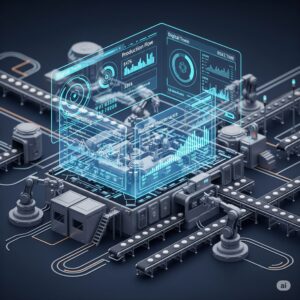
- Digital Twins: Virtual representations of physical assets and processes, continuously updated with live data from both OT and IT sources.
Takeaway
Intelligent agents transform IT/OT convergence from data exchange into autonomous orchestration. By embedding them into spray painting, conveyor, and pretreatment processes, manufacturers achieve predictive resilience, operational agility, and measurable efficiency gains
Implementation Roadmap and Pilot Design
Stepwise Approach
- Identify High-Impact Use Cases: Start with predictive maintenance, quality inspection, or energy optimization in a single process area (e.g., conveyor anomaly detection, paint defect monitoring).
- Data Integration: Connect relevant OT (PLCs, SCADA) and IT (MES, ERP, CMMS) systems using OPC UA, MQTT, and APIs.
- Pilot Deployment: Run agentic AI models in shadow mode, validate predictions, and refine workflows with human-in-the-loop oversight.
- Scale Gradually: Expand to additional lines, integrate with digital twins, and increase agent autonomy as trust and reliability are established.
- Governance and Training: Establish clear boundaries, audit trails, and operator training to ensure safe, explainable, and compliant operations.
- Continuous Improvement: Use feedback loops, outcome analysis, and cross-functional collaboration to drive ongoing optimization and ROI.
Key Success Factors - Cross-Functional Teams: Involve operations, IT, maintenance, and quality experts from the outset.
- Data Quality and Labelling: Invest in robust data pipelines, annotation, and model validation to ensure reliable AI performance.
- Change Management: Address workforce skills, trust, and adoption through training, transparency, and incremental autonomy.
Conclusion: The Future Is Agentic, Adaptive, and Autonomous
Agentic AI embedded within IT/OT convergence is not just a technological upgrade—it is a strategic imperative for manufacturers seeking to thrive in an era of complexity, volatility, and relentless quality demands. By orchestrating data, decisions, and actions across spray painting, conveyor, and pretreatment lines, Agentic AI delivers:
- Reduced Downtime: Through predictive maintenance and real-time anomaly detection.
- Improved Quality: Via AI-driven inspection, closed-loop control, and continuous process optimization.
- Energy and Resource Savings: Through intelligent scheduling, adaptive control, and sustainability-focused interventions.
- Scalable, Resilient Operations: Enabled by modular, edge-first architectures and multi-agent collaboration.
- Empowered Workforce: With human-in-the-loop governance, explainable AI, and a focus on strategic, value-added tasks.