In today’s fast-moving supply chains, efficient distribution is critical to business success. Supply chain managers play a key role in leveraging Oracle E-Business Suite (EBS) to manage orders, inventory, purchasing, and logistics, which can make them feel valued and essential to operational success. However, traditional rule-based processes often struggle with changing demand and complex operations.
AI enhances Oracle E-Business Suite (EBS) by adding predictive intelligence to existing workflows. Instead of reacting to issues after they occur, organizations can anticipate demand, optimize inventory, and automate key decisions. This results in fewer stockouts, lower excess inventory, faster order fulfillment, reduced logistics costs, and a better overall customer experience.
Why Distribution Efficiency Matters and Challenges in Oracle EBS
In today’s customer-driven marketplace, distribution efficiency is vital for revenue, margins, and customer loyalty. Recognizing this importance can motivate stakeholders to prioritize speed, accuracy, and cost control, which define success. Even minor delays or inventory misallocations can lead to lost sales, higher freight costs, dissatisfied customers, and margin erosion.
Oracle E-Business Suite (EBS) serves as a robust transactional system of record across Order Management (OM), Inventory (INV), Warehouse Management (WMS), Purchasing, Logistics, and optionally Oracle Transportation Management (OTM). It ensures reliable execution, control, and auditability of orders and inventory movements. However, distribution environments are becoming increasingly complex due to:
- Rapidly fluctuating demand and promotions
- Shorter product life cycles and frequent product introductions
- Global, multi-warehouse, and multi-supplier networks
- Higher expectations for fast, accurate deliveries
- Tighter service level and cost-to-serve constraints
Despite EBS automation, many planning and execution decisions still rely on manual analysis and static rules. AI can provide predictive insights for inventory replenishment, order prioritization, warehouse labor planning, and delivery scheduling, reducing stock-outs, excess inventory, and logistics costs. This makes distribution more proactive and efficient.
AI enhances Oracle E-Business Suite (EBS) with predictive and optimization capabilities. Instead of replacing EBS, AI adds an intelligent layer that empowers decision-makers with proactive planning, automated decision-making, and end-to-end visibility, transforming distribution from reactive to predictive performance and fostering confidence in future operations.
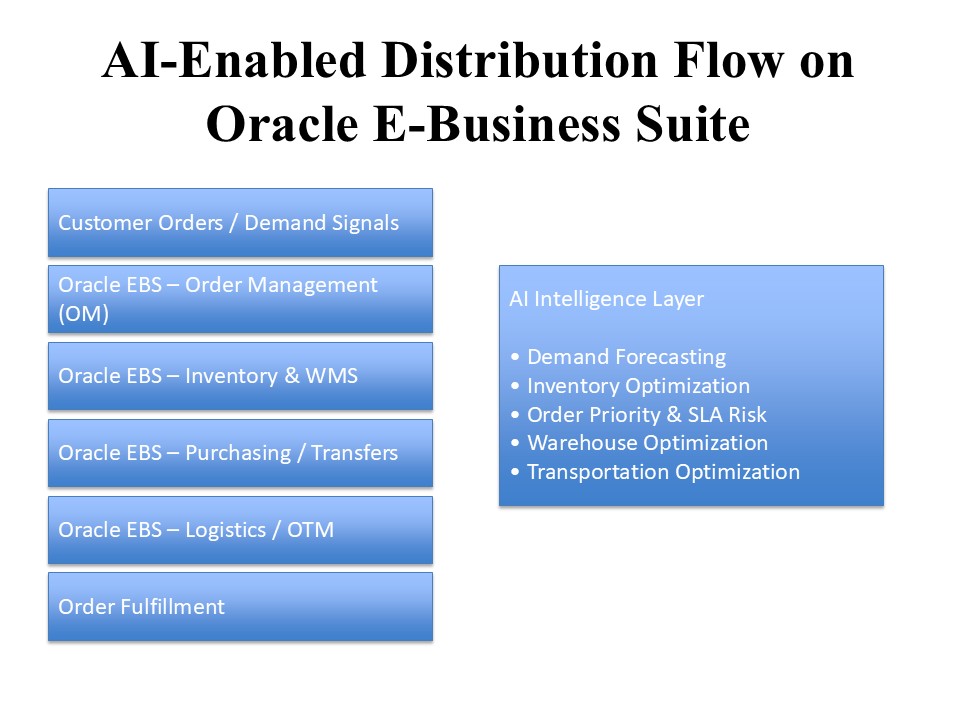
Figure 1: AI-Enabled Distribution Flow on Oracle E-Business Suite
Figure 1 illustrates how Oracle E-Business Suite (EBS) continues to function as the transactional execution layer, while AI operates as an intelligence layer that continuously analyzes operational data, predicts risks, and feeds optimized recommendations back into EBS. This closed-loop flow enables proactive, data-driven distribution execution without compromising system control or auditability.
Traditional vs. AI-Enabled Distribution
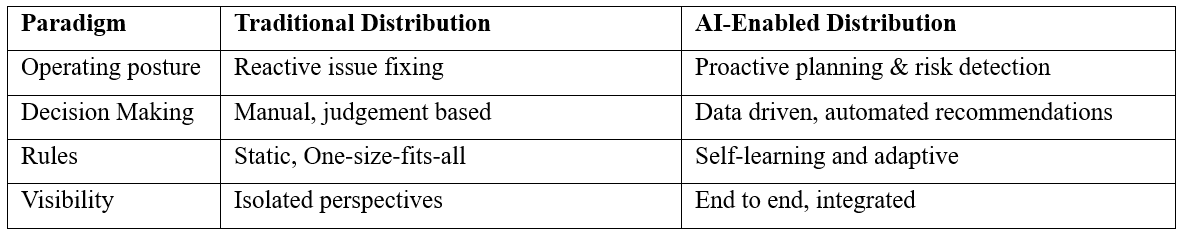
As distribution complexity grows, AI-enabled execution is becoming essential for improving efficiency, reducing costs, and delivering consistent customer service within Oracle E-Business Suite (EBS)-driven supply chains.
AI in Supply Chain & Distribution – Enhancing Decision-Making and Automation
Artificial Intelligence (AI) adds an intelligent decision layer on top of Oracle E-Business Suite (EBS), empowering supply chain and distribution teams to make smarter choices and feel more confident in their operations. By continuously learning from transactional data, master data, operational events, and external signals, AI helps organizations analyze trends, predict future outcomes, and recommend optimal operational actions. Unlike traditional systems that rely heavily on manual interpretation, AI makes distribution operations more responsive, efficient, and resilient.
As illustrated in Figure 1 (AI-Enabled Distribution Flow on Oracle EBS), Oracle E-Business Suite (EBS) continues to function as the system of record for execution. Simultaneously, AI serves as an intelligence layer that analyzes data, generates insights, and provides recommendations to EBS for controlled execution, minimizing disruption to existing workflows and user roles.
Within Oracle-based supply chain environments, AI enhances distribution performance across three core dimensions, including metrics like order accuracy, lead times, and inventory turnover, providing measurable improvements that support strategic decision-making.
A. Better Visibility and Insight
Many distribution challenges originate from limited visibility into real-time supply, demand, and operational constraints. While Oracle EBS holds rich transactional data across Order Management (OM), Inventory (INV), Warehouse Management (WMS), Purchasing, and Oracle Transportation Management (OTM), critical patterns are not always apparent in standard reports.
AI improves visibility by:
- Aggregating and harmonizing data across multiple EBS modules
- Surfacing non-obvious patterns, correlations, and trends
- Identifying exceptions and risks early, along with contextual insights and recommended actions
Outcome: Raw transactional data is transformed into actionable intelligence that supports faster and better-informed decisions.
B. Predictive Decision-Making
AI models leverage historical transactions, demand variability, lead times, supplier performance, seasonality, promotions, and operational trends to forecast and predict likely outcomes, including:
- Near-term demand (3–12 weeks) by SKU and location
- Imminent stock-out or excess inventory risks
- Potential shipment delays and service-level failures
By shifting from hindsight-based reporting to forward-looking insights, planners can anticipate disruptions and proactively mitigate risks rather than react after issues occur.
Outcome: Distribution teams prevent problems instead of firefighting them.
C. Intelligent Process Automation
AI operationalizes insights by recommending or in some cases automatically executing—optimal actions within time-sensitive distribution workflows. Key examples include:
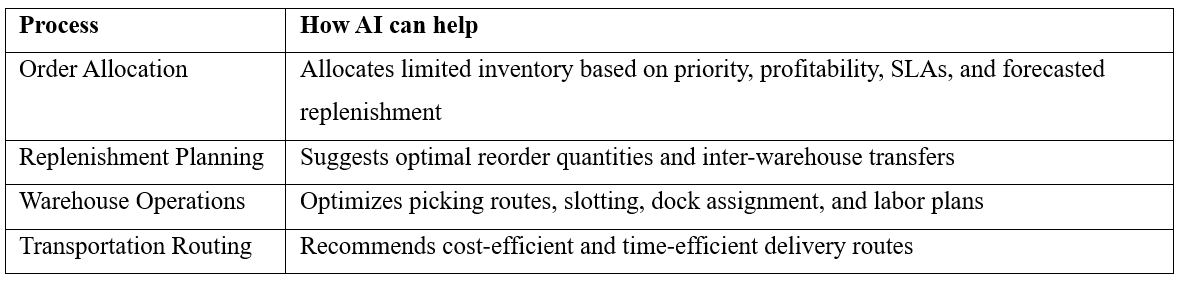
Outcome: Faster, consistent decisions aligned with business objectives.
Instead of relying on human judgment alone, the system recommends or executes the best action based on real-time data.
How AI complements Oracle EBS
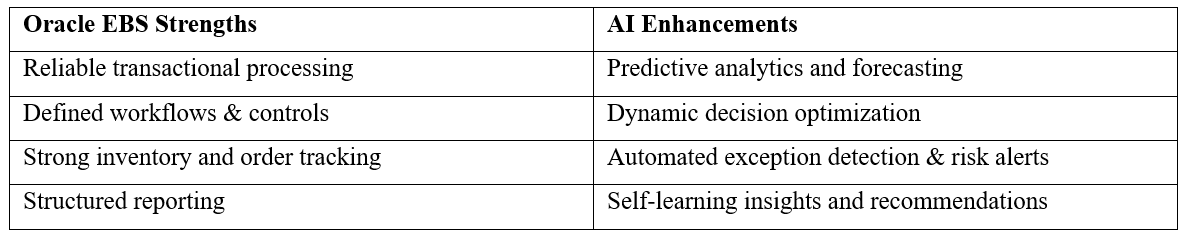
In summary, AI does not replace Oracle EBS. Instead, it acts as an intelligent engine that augments existing systems, helping planners, warehouse managers, and logistics teams plan better, respond faster, and operate more efficiently. Supporting scalable, efficient, and controlled supply chain operations reassures teams that they can confidently manage growth and complexity, ensuring stability and reliability in their workflows.
Key AI Applications in Oracle EBS Distribution
AI enhances Oracle E-Business Suite (EBS) distribution operations by embedding intelligence at every step of the distribution lifecycle, helping stakeholders feel more confident in their decision-making. Rather than relying on manual decision-making or static configuration rules, AI continuously analyzes operational data and applies real-time intelligence to optimize inventory planning, order prioritization, warehouse execution, transportation, and risk management.
As shown in the AI-enabled Oracle distribution flow, Oracle EBS continues to execute transactions across core modules. At the same time, AI operates as a decision layer that predicts outcomes, recommends actions, and feeds optimized decisions back into EBS for controlled execution, fostering trust in the system’s reliability.
The following sections outline key AI applications that enhance Oracle EBS modules, including Order Management (OM), Inventory (INV), Warehouse Management (WMS), Shipping, Oracle Transportation Management (OTM), and Advanced Supply Chain Planning (ASCP). These innovations aim to support your strategic objectives and improve operational efficiency.
A. Demand-Aware Allocation and Order Prioritization
When demand exceeds available inventory, determining which orders to fulfill first becomes critical. Traditionally, this has relied on static rules, such as FIFO, or on manual judgment.
What AI does:
AI replaces static prioritization with dynamic allocation by considering customer value, contractual SLAs, forecasted demand, and incoming replenishments. To achieve this, organizations need to ensure accurate, real-time data collection and integration across multiple sources, which may require infrastructure assessments and improvements in data quality.
Impact:
- High-value and strategic customers are served first
- Fewer order cancellations, escalations, and service failures
- Better alignment with profitability and service objectives
EBS Modules Impacted: Order Management, Inventory, ASCP
B. Predictive Inventory Replenishment
Traditional replenishment approaches often use fixed reorder points that fail to adapt to real-world demand and supply variability.
What AI does:
AI dynamically adjusts reorder points and safety stock levels by forecasting demand at the SKU-location level and analyzing seasonality, consumption trends, supplier reliability, and variable lead times. Organizations should plan phased implementations, starting with pilot projects, to evaluate benefits and address integration challenges over a typical timeline of [X] to [Y] months.
Impact:
- Fewer stock-outs for high-velocity items
- Reduced excess and slow-moving inventory
- Improved working capital utilization
EBS Modules Impacted: Inventory, Purchasing, ASCP
C. Smart Warehouse Operations
Warehouse performance directly affects fulfillment speed, accuracy, and cost.
What AI does:
AI optimizes warehouse execution by improving slotting strategies, pick paths, wave planning, dock scheduling, and labor planning based on workload forecasts and operational constraints.
Impact:
- Faster picking, staging, and loading
- Higher productivity per warehouse resource
- Reduced fulfillment time and handling errors
EBS Modules Impacted: WMS, Inventory, Shipping
D. Transportation Optimization
Transportation involves balancing cost, service, and capacity while managing uncertainty.
What AI does:
AI recommends cost- and time-optimal routes, dynamically assigns carriers, and predicts transit risks based on traffic, weather, and historical carrier performance.
Impact:
- Lower freight and transportation costs
- Improved on-time delivery performance
- Reduced manual transportation planning effort
EBS Modules Impacted: Shipping, Oracle Transportation Management (OTM)
E. Risk Detection and Exception Management
Operational disruptions such as supplier delays, demand spikes, warehouse congestion, or forecast errors often surface too late.
What AI does:
AI continuously monitors operational patterns, detects anomalies early, and triggers alerts with guided corrective actions.
Impact:
- Fewer emergencies and reactive firefighting
- Faster containment and recovery from disruptions
- More stable and predictable distribution execution
EBS Modules Impacted: Order Management, Inventory, WMS, ASCP
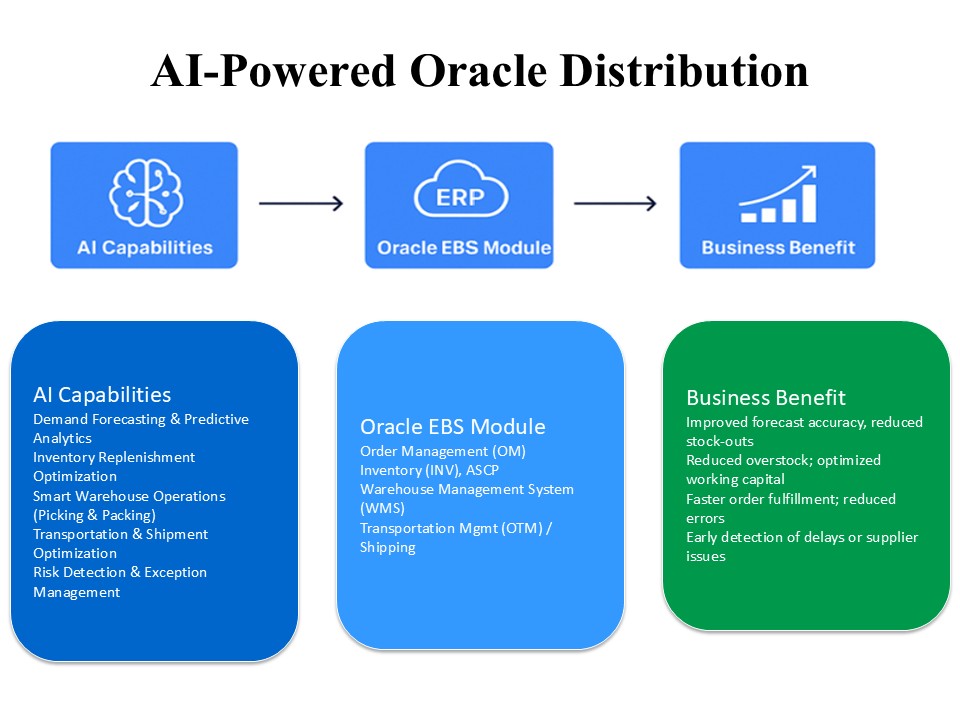
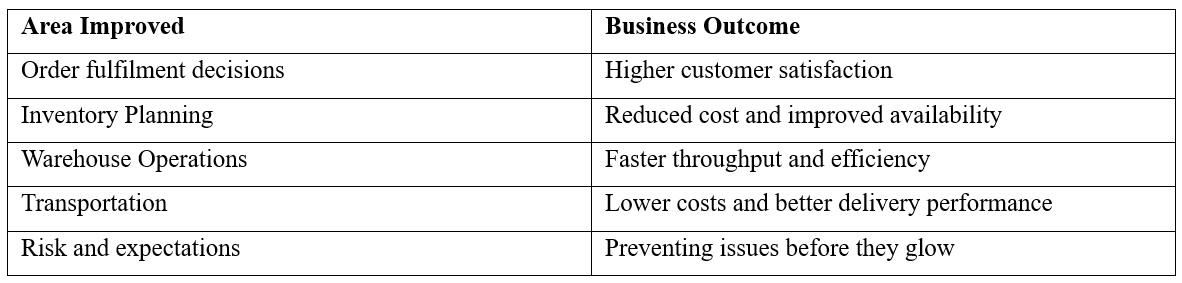
As a summary, AI enhances Oracle EBS distribution not by changing core process, but by making them smarter, faster, and more adaptive. It provides real-time intelligence that supports smarter decisions in:
Integration Considerations – Data Quality, AI Engines, and Organizational Change
Adopting AI in an Oracle E-Business Suite (EBS) distribution landscape is a business transformation initiative not merely a technical add-on. While AI can significantly enhance planning and execution, its success depends on data readiness, seamless technical integration, and effective change management across the organization.
To realize sustained value from AI-enabled distribution, organizations should focus on the following strategic pillars.
A. Data Quality and Readiness
AI performance directly reflects the quality, consistency, and completeness of source data. Oracle EBS already contains rich operational data, but it is often distributed across modules and may require harmonization before it can be used effectively for predictive modeling.
Key data readiness priorities include:
- Clean and consistent item, customer, and supplier master data
- Harmonized inventory policies and unit-of-measure (UoM) standards across sites
- Consolidated transactional data from OM, Inventory, WMS, Shipping, and ASCP
- Ongoing data governance to ensure accuracy, ownership, and stewardship
Outcome: A strong data foundation accelerates AI deployment and significantly improves forecast and optimization accuracy.
B. AI Engine and Technical Integration Approach
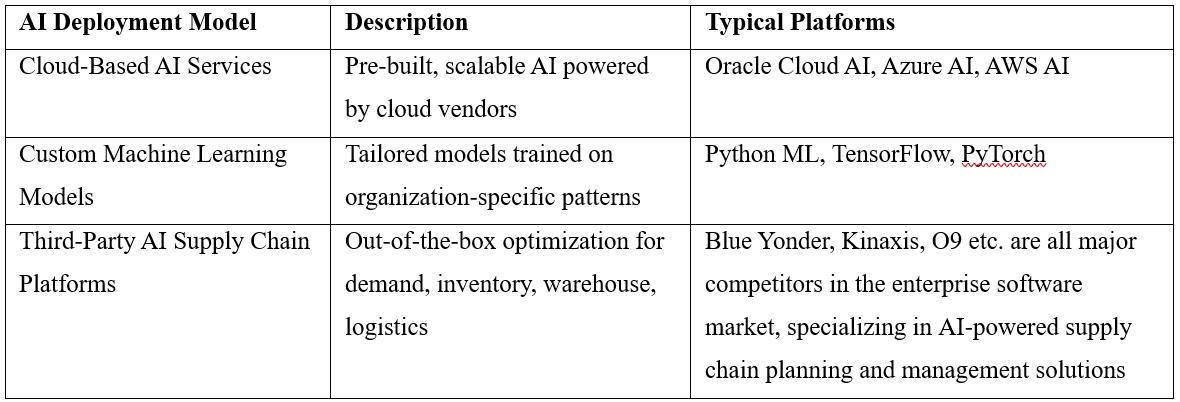
AI is typically implemented as an intelligence layer on top of Oracle EBS, connected through secure data feeds, APIs, or integration middleware. Organizations can choose from multiple AI deployment models depending on maturity, scale, and business needs.
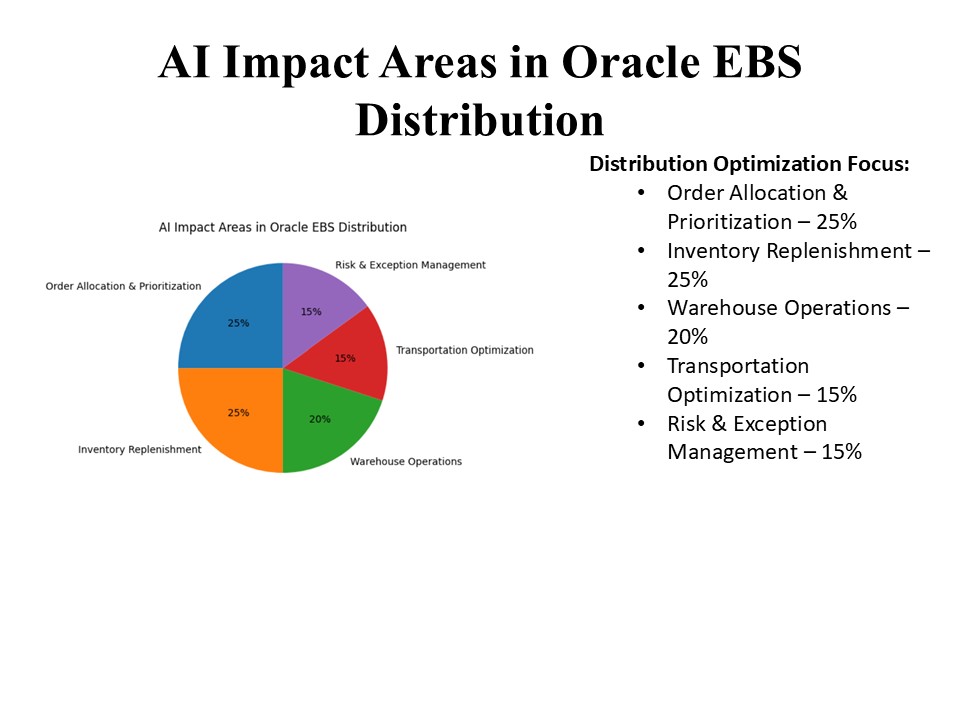
The above pie chart architecture enables AI to analyze operational data, generate insights, and feed optimized decisions back into Oracle EBS while preserving transactional control and auditability.
C. Change Management and Workforce Enablement
AI adoption fundamentally changes how decisions are made across planning, warehousing, procurement, customer service, and logistics. Successful adoption depends on workforce enablement and transparent governance.
Critical enablers include:
- Training planners and warehouse leaders to interpret and trust AI recommendations
- Clearly defining when AI provides recommendations versus when it executes actions automatically
- Establishing governance councils to validate models, tune thresholds, and manage exceptions
- Reinforcing a mindset shift from experience-driven to data-driven decision-making
AI delivers value when teams view it as a decision-support partner—not a replacement.
D. Phased Rollout Strategy
Organizations consistently achieve better results by adopting AI through a phased rollout approach:
- Start with a focused, high-impact use case (e.g., predictive replenishment or order allocation)
- Measure outcomes such as service levels, inventory turns, lead times, and cost-to-serve
- Expand to adjacent processes, including innovative warehousing and transportation optimization
- Continuously refining models based on operational feedback and performance results
This staged approach reduces risk, builds organizational confidence, and accelerates measurable value realization.
Section Takeaway
AI-enabled distribution success in Oracle EBS environments is driven as much by data discipline, integration design, and change management as by algorithms themselves. When implemented thoughtfully, AI transforms Oracle EBS from a transactional execution system into an intelligent, adaptive distribution platform that scales with business complexity.
Real-World Scenario / Example – Illustrate problem → AI solution → results
A mid-sized distribution company running Oracle E-Business Suite (Inventory, Order Management, Purchasing, and WMS) manages 2,000+ SKUs across five regional warehouses. Customer orders are time-sensitive, and product availability is critical to service levels and revenue.
Problem
The organization faced growing distribution inefficiencies:
- Frequent stock-outs on fast-moving SKUs, while slow-moving items were overstocked
- Buyers relied on manual spreadsheets for forecasting and replenishment decisions
- Inconsistent supplier lead times caused delivery delays and uncertainty
Business impact included:
- Late customer shipments
- High inventory carrying costs
- Ongoing reactive firefighting across planning and operations
AI Solution
The company integrated AI-driven demand forecasting and replenishment optimization with Oracle EBS:
- Machine learning models analyzed:
- Historical sales
- Seasonality and promotions
- Supplier performance and lead-time variability
- The system generated:
- Optimal reorder quantities and inter-DC transfer recommendations
- Dynamic safety stock levels by SKU and location
- Predictive alerts for potential shortages weeks in advance
- Recommendations flowed directly into Oracle Purchasing workflows for review and approval
Operating Model
- Planners focused on exceptions, while routine replenishment was auto-approved within governance thresholds
- Warehouses received forecast-driven picking waves and labor plans
- Logistics aligned transportation plans to priority orders and predicted SLA risks
KPIs Tracked
- Service: Fill rate, backorder rate, stock-out hours
- Inventory: Inventory turns, working capital, excess, and obsolete stock
- Warehouse: Pick/pack cycle time, dock-to-stock time, labor productivity
- Transportation: Freight cost per order, on-time delivery performance
Outcome
By augmenting Oracle EBS with AI, the distributor shifted from reactive to predictive, demand-driven inventory management. This transformation has improved service levels, reduced inventory costs, and stabilized day-to-day operations, making stakeholders feel optimistic and proud of the tangible progress achieved.
Benefits of AI in Oracle EBS Distribution
AI extends Oracle E-Business Suite by embedding predictive intelligence into planning, allocation, warehouse, and logistics operations. This helps decision-makers feel more confident and in control, enabling faster, more accurate decisions and consistently higher service levels across the distribution network.
- Improved Operational Efficiency
AI automates routine planning, allocation, and replenishment decisions, reducing manual workload and allowing teams to focus on true exceptions instead of day-to-day firefighting, helping IT managers and supply chain professionals feel supported and less overwhelmed.
- Reduced Inventory & Fulfillment Costs
Improved demand forecasting and risk-adjusted replenishment help maintain optimal inventory levels—reducing excess stock, emergency purchases, expedited freight, and storage costs.
- Higher Customer Satisfaction
Better inventory availability and smarter order allocation improve fill rates, lead times, and delivery promise reliability, strengthening customer trust and loyalty.
- Faster, Data-Driven Decision-Making
Real-time insights and AI-driven recommendations replace manual analysis and static rules, empowering decision-makers to act proactively and feel prepared for any situation, enabling quicker and more consistent decision-making.
- Proactive Risk Management
AI detects anomalies early—such as demand spikes, supplier delays, or warehouse congestion—enabling timely intervention and more resilient, stable operations.
Conclusion & Future Outlook
Artificial Intelligence is fundamentally reshaping how organizations leverage Oracle E-Business Suite in distribution and supply chain operations. While Oracle EBS remains the trusted transactional backbone, AI provides the predictive and optimization intelligence that enables faster decision-making, shifting execution from manual, reactive processes to proactive, automated, and data-driven ones. The result is lower operational costs, improved service reliability, and more resilient distribution networks.
Rather than replacing Oracle EBS, AI enhances it making existing processes smarter, more adaptive, and better aligned with real-world demand and operational variability. This empowers supply chain managers to deliver better outcomes for both the business and the customer.
Looking ahead, emerging capabilities such as IoT-enabled real-time tracking, predictive and prescriptive analytics, digital twins, and Generative AI–driven simulation and decision guidance will further deepen the value of AI in Oracle-driven supply chains. Organizations that invest early by establishing pilot projects, training staff, and integrating AI tools with existing systems will be best positioned to achieve the agility, scalability, and resilience required to outperform in increasingly dynamic markets.