The web was built for humans. But a new class of user is emerging now the AI agent, and it cannot reliably navigate the human web. The result is a growing structural gap between trillion-dollar digital commerce infrastructure and the agentic AI systems that consumers are and will be increasingly delegating their shopping to.
Web Model Context Protocol (WebMCP) is the W3C-backed standard, co-developed by Google and Microsoft, that introduces a structured, browser-native interface for AI agents to interact with websites, reducing reliance on fragile UI parsing while remaining early in adoption and implementation maturity. Published as a Draft Community Group Report on February 10, 2026, and available in early preview in Chrome 146, WebMCP allows commerce websites to expose their functionality as structured, callable “tools” that AI agents can discover and invoke directly replacing fragile guesswork with a guaranteed machine-readable interface. The protocol is early stage, but the competitive dynamics are already forming. This POV provides the perspective to assess when to act, how to sequence investment, and how to build the organizational capability to win in agentic commerce.
The Problem: The Web Was Not Built for Agents
AI shopping agents i.e. the systems that autonomously research, evaluate, and transact on behalf of users are growing rapidly. ChatGPT agent activity doubled in a single month in 2025. Major AI platforms including Gemini, Claude, ChatGPT, and Perplexity now route a meaningful share of high-intent queries toward direct commerce actions. Morgan Stanley estimates agentic AI will account for 10–20% of U.S. e-commerce by 2030.These agents interact with websites through two legacy methods, both deeply flawed:
DOM Parsing: The agent reads raw HTML and guesses at the semantics of the interface. A changed CSS class name or restructured component can silently break an agent’s ability to act.
Visual Scraping: The agent captures a screenshot, passes it to a vision model, and attempts to infer where to click. This is computationally expensive, slow, and brittle any UI redesign can break the flow.
Both methods share a structural flaw: the agent is reverse engineering what the website can do, rather than being told. This produces abandoned cart flows, failed checkouts, inaccurate product matches, and high token costs and creates competitive risk. If an AI agent cannot reliably complete a task on the brand or retailer site, it will route users to a competitor’s site that it can navigate.
The web needs a machine-readable interaction layer. WebMCP is that layer.
What WebMCP Is: Technical Foundations
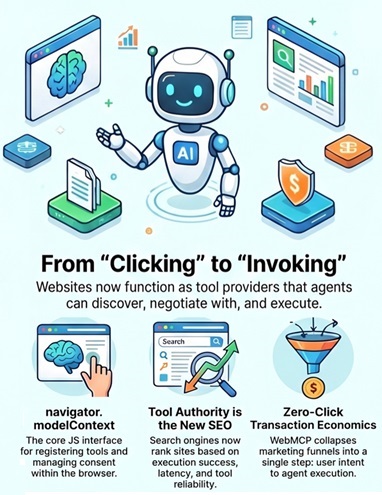
WebMCP (Web Model Context Protocol) is a browser-native API standard that inverts the agent-web relationship. Instead of agents guessing at website capabilities, websites explicitly declare what they can do and agents call those capabilities directly through structured tool invocations. At its technical core it is a new browser API: “navigator.modelContext“. Developers use this API to register tools JavaScript functions with natural language descriptions and structured JSON Schema definitions that any compliant AI agent can discover, understand, and invoke.
Key Concepts
Tool Contract: A versioned, structured declaration of a website’s agent-callable capabilities. Specifies tool names, natural language descriptions, parameter schemas (JSON Schema), and expected output formats. The machine-readable equivalent of a well-documented API specification.
Model Context Provider: A browsing context (browser tab) that exposes tools to agents via the WebMCP API. The website itself acts as a lightweight MCP server.
Agent: Any consuming application, a browser-integrated AI assistant, browser extension, agentic browser product, or desktop AI client with WebMCP support.
Two Implementation Paths
Declarative API: Add “toolname” and “tooldescription” HTML attributes to existing forms. The browser automatically translates fields into a structured schema. Low-effort; suited for search, contact, order-status flows.
Imperative API: Register tools explicitly using JavaScript via “navigator.modelContext.registerTool()”. Supports full parameter description, business logic encapsulation, and stateful session awareness. Required for dynamic product filtering, variant selection, multi-step checkout, and loyalty redemption.
Enterprises can use both paths in combination.
What Makes WebMCP Distinct from Server-Side MCP
Anthropic’s server-side MCP connects agents to backend services via JSON-RPC and requires a separate server deployment. WebMCP runs in the browser tab using the existing authenticated session no additional server infrastructure. For web-first commerce, this distinction is significant: the user’s session state, loyalty tier, cart, and saved preferences are natively available to WebMCP tools without rebuilding auth infrastructure.
End-to-End Reference Architecture
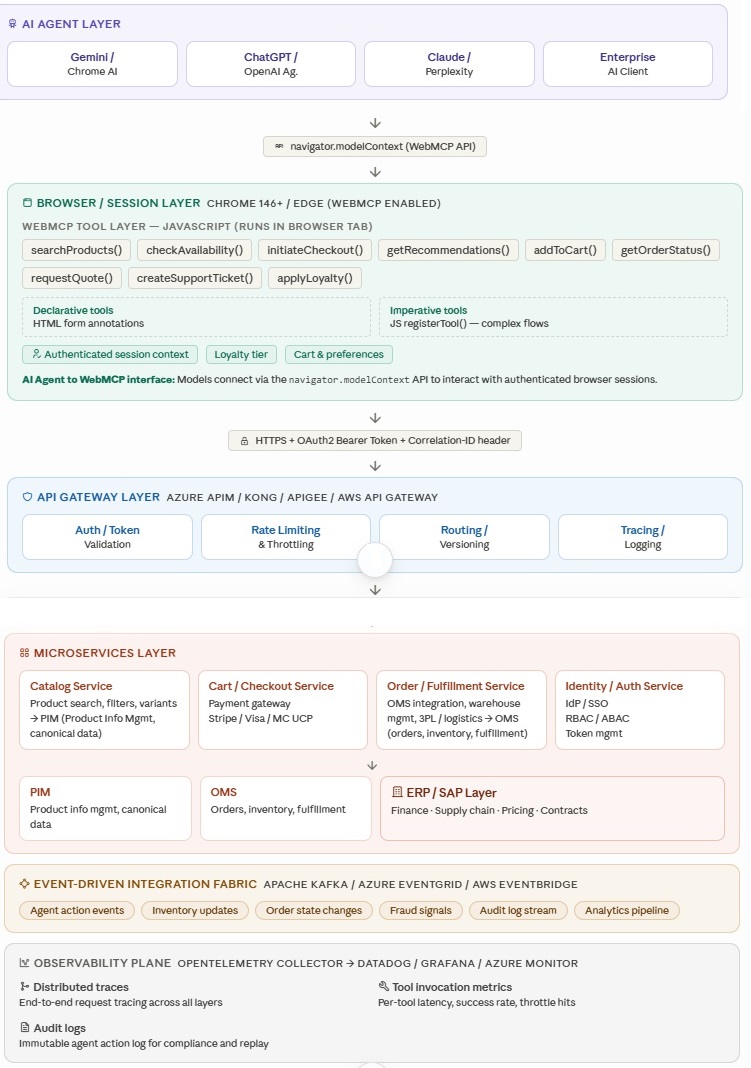
Key Architectural PrinciplesThin tool layer, thick backend: WebMCP tools are orchestration wrappers only they translate agent intent into validated API calls. All business logic, pricing rules, inventory checks, and fulfillment decisions live in backend microservices. This separation ensures that tool contracts remain stable as underlying services evolve.
API Gateway as the enforcement boundary: Authentication, authorization, rate limiting, and observability are enforced at the API Gateway never inside WebMCP tools. Tools should assume they run in an authenticated session but must not implement security logic themselves.
Event-driven for state propagation: Agent-triggered state changes (cart mutation, order placement, inventory reservation) should emit events to the integration fabric (Kafka / EventGrid). Downstream systems viz. ERP stock updates, OMS order creation, fraud systems will consume these events asynchronously. This decouples the agent interaction layer from backend system latency.
Session context is the WebMCP superpower: The browser session gives WebMCP tools native access to the user’s authenticated state: loyalty tier, saved addresses, purchase history, active cart, and account preferences. Backend MCP and direct APIs cannot access this without rebuilding auth infrastructure. Design tools to leverage this context deliberately.
Integration Decision Framework: WebMCP vs. Backend MCP vs. Direct API
| Use Case | Recommended Approach | Rationale |
|---|---|---|
| User browsing; agent assists in session | WebMCP | Leverages session context; UI stays in sync; zero infrastructure overhead |
| Personalization using account data | WebMCP (Imperative) | Session context (loyalty, preferences) natively available |
| Headless autonomous agent; no browser | Backend MCP or Direct API | WebMCP requires active browsing context |
| Cross-platform commerce (multi-site) | UCP + Backend MCP | WebMCP is site-scoped; UCP handles cross-platform journeys |
| B2B procurement automation | Backend MCP or Direct API | Headless, high-volume, no UI requirement |
| Batch catalog / inventory operations | Direct API / PIM/OMS API | Not suited for WebMCP; backend systems to be used directly |
| Internal ops / SaaS dashboards | Backend MCP | No consumer browser context; server-side access preferred |
Security Architecture: Zero Trust for Agent Interactions
Agent-initiated transactions introduce a new threat model. Unlike a human user who can be challenged with CAPTCHA or step-up authentication, an AI agent operates programmatically and at scale. Standard session security is necessary but not sufficient.
Zero Trust Security Model
Zero Trust principles should be applied to every agent interaction: always assume untrusted, verify explicitly, enforce least-privilege, log everything.
Agent Invokes Tool
│
▼
[1] Token Validation ← Is the agent token valid and unexpired?
│
▼
[2] Scope Enforcement ← Does the token scope permit this tool?
│
▼
[3] RBAC Check ← Is the user’s role permitted for this action?
│
▼
[4] ABAC Policy Evaluation ← Do contextual attributes allow execution?
│ (order value, device risk, geo, velocity)
▼
[5] Rate Limit Check ← Has this agent/session exceeded thresholds?
│
▼
[6] Input Validation ← Are parameters schema-valid and within bounds?
│
▼
[7] Execute Tool ← Call downstream API with sanitized params
│
▼
[8] Audit Log Entry ← Record invocation, outcome, agent identity
Authentication Model for Agents
Short-lived, scoped tokens specifically for agent interactions should be issues, distinct from the customer’s primary session token. Never allow agent tool invocations to inherit full session permissions.
OAuth 2.0 scopes by tool category:
Authorization: RBAC and ABAC
RBAC (Role-Based Access Control) for coarse-grained access:
– Guest agent: `commerce:read` only
– Authenticated user agent: read + cart write
– Business account agent: read + cart write + quote request
– Admin/operator: all scopes (never in consumer-facing WebMCP tools)
ABAC (Attribute-Based Access Control) for context-sensitive decisions:
– Order value > ₹50,000: require step-up consent regardless of role
– New device or unrecognized location: limit checkout scope to cart-only
– Agent velocity > 10 tool calls / 60 seconds: trigger fraud signal
Authorization checks execute at the API Gateway, not inside WebMCP tools.
Fraud Prevention for Automated Checkout
AI-driven checkout at scale is an attractive fraud target. Required controls:
– Velocity limits: Maximum cart creation rate, checkout attempts, and successful orders per identity per time window should be enforced
– Device fingerprinting: Session-level device signals correlated with agent identity
– Anomaly detection: Statistical models on agent transaction patterns (unusually high order values, bulk quantity, unusual shipping destinations)
– Payment tokenization: WebMCP tools never handle raw card data. Use tokenized payment references (Stripe, Visa Token Service, Mastercard MDES). The payment tool call passes a token, not credentials.
– 3DS / SCA compliance: For high-value transactions, Strong Customer Authentication should be enforced regardless of whether the initiator is human or agent.
Consent and Audit Logging
Every agent-invoked tool call that changes state must produce an immutable audit log entry:
{

"timestamp": "2026-06-22T10:34:55Z",

"correlation_id": "ag-7f3a2b91-...",

"tool_name": "initiateCheckout",

"agent_identity": "gemini-browser-assistant",

"user_id": "usr_0039124",

"session_id": "sess_abc123",

"parameters": { "cart_id": "cart_xyz", "shipping_tier": "standard" },

"outcome": "success",

"order_id": "ord_8821",

"duration_ms": 312

}
PII fields (addresses, payment references) must be tokenized or excluded from logs. Logs are compliance artifacts should be retained per applicable regulations (PCI-DSS, GDPR, DPDPA)
Canonical Data Strategy and Schema Governance
WebMCP tools are only as reliable as the data they surface. In enterprise commerce, product data flows through PIM, ERP, catalog services, and search indexes, the inconsistencies between systems produce unreliable agent interactions.
Canonical Product Model
Single canonical representation of a product should be defined before exposing. PIM is the system of record for product attributes. OMS is the system of record for inventory. Pricing services are the real-time source for transactional pricing. Tool contracts must pull from these systems of record never from stale search index caches for transactional operations.
Enterprise Schema Registry
All tool contracts must be registered in a central schema registry before exposure to agents. The registry provides:
– Single source of truth for tool names, descriptions, parameter schemas, and output schemas
– Version history for every tool contract
– Compatibility checks — automatic validation that new versions do not break existing agent implementations
– Ownership metadata — team, product owner, SLA, and support contact for each tool
Recommended tooling will be Confluent Schema Registry (Kafka-native), Azure API Center, or a dedicated API contract management layer in Kong or Apigee.
Contract Versioning Strategy
Tool contracts must follow a defined versioning lifecycle: Draft → Review → Approved → Active → Deprecated → Retired
Version naming: searchProducts_v1, searchProducts_v2
Deprecation notice: minimum 90 days
Parallel support: old + new versions run simultaneously during transition
Agent-side behavior: graceful degradation when tool version is unrecognized
Ensure on the breaking and non-breaking changes
– Non-breaking: adding optional parameters, adding output fields — no version bump required
– Breaking: renaming a required parameter, changing output schema, removing a tool, mandatory major version bump with deprecation notice
Observability and SRE Framework
Agent-initiated interactions introduce failure modes invisible to standard page-level monitoring. A tool invocation may succeed at the browser layer while silently failing at the API gateway, a microservice, or a backend system. Without distributed observability, these failures manifest as unexplained checkout drop-off with no attribution. Ensure Distributed Tracing Architecture, where every WebMCP tool invocation generates a correlation ID that propagates through the full call chain:
WebMCP Tool Invocation
│ correlation_id: ag-7f3a2b91
│
├── API Gateway (auth, routing) ← span: gateway.auth (12ms)
│
├── Catalog Service (searchProducts) ← span: catalog.search (45ms)
│ │
│ └── PIM Query ← span: pim.query (38ms)
│
├── Inventory Service (checkAvail) ← span: inventory.check (22ms)
│ │
│ └── OMS Stock Query ← span: oms.stock (18ms)
│
└── Cart Service (addToCart) ← span: cart.write (31ms)
│
└── Event Published to Kafka ← span: kafka.publish (8ms)
Total agent flow latency: 118ms
Use OpenTelemetry as the tracing standard. All services emit spans to a central collector (Jaeger, Zipkin, Datadog APM, or Azure Monitor).
Agent tool performance SLOs must be defined separately from page load metrics. A human tolerates a 2-second page load; an agent chaining 5 tool calls at 2 seconds each produces a 10-second workflow which is unacceptable. a Query able log of complete agent sessions should be maintained not just individual tool calls, but the full sequence, declared intent (where available), and final outcome. This log serves three purposes: product improvement (identify where agents drop off), fraud investigation (reconstruct suspicious sessions), and compliance (demonstrate consent and audit trail for regulated transactions).
The Commerce Opportunity by Segment
WebMCP is not uniformly valuable across all commerce contexts. Prioritize investment where agentic interactions are most likely and where errors directly impact revenue, conversion, or customer experience. for ex: Agents searching a catalog of 500,000+ SKUs through DOM parsing produce consistently poor results viz. wrong variants, inaccurate availability, broken filters. A `searchProducts` tool with structured filtering parameters (category, price range, attributes, in-stock flag) transforms this into a reliable, high-precision interaction. First-mover advantage compounds quickly as agents learn to prefer structured tools over scraping. In B2B, The RFQ use case justifies enterprise investment. A buyer’s AI agent invoking `requestQuote(productId, quantity, deliveryDate, currency)` across 10 vendor sites simultaneously replaces what today requires hours of manual navigation. Suppliers that expose structured quote tools will disproportionately capture agent-driven procurement. B2B also has the highest tolerance for implementation complexity and the strongest ROI case.
| Segment | WebMCP Priority | Primary Use Cases | Why Now |
|---|---|---|---|
| Mass-market retail / high-SKU | 🔴 Highest | Product search, variant selection, availability, checkout | High query volume; agents already shopping; catalog complexity benefits most from structured tools |
| Travel & hospitality | 🔴 Highest | Search, date/filter, booking, availability | Google’s UCP integration already in motion |
| B2B / industrial commerce | 🔴 High | RFQ automation, bulk pricing, procurement checkout | Multi-vendor agent workflows deliver outsized efficiency gains |
| Marketplace platforms | 🟡 High | Seller-side tools, cross-catalog search, offer comparison | Agent discovery across sellers; structured data critical |
| Luxury / low-SKU | 🟡 Medium | Discovery, waitlist, appointment booking | Lower volume; brand control concerns; agent curation may dilute brand experience |
| Services / SaaS | 🟡 Medium | Lead form, trial signup, support deflection | Declarative API on forms; quick win without complex catalog work |
| Subscriptions | 🟠 Medium | Plan comparison, upgrade/downgrade flows | Session-aware tools leverage account context effectively |
| FMCG / CPG (D2C) | 🟠 Lower | Reorder, subscription management | Repeat purchase use case is strong; lower discovery complexity |
KPI Framework and Business Value Map
Traditional commerce KPIs i.e. sessions, bounce rate, CPC, pages per session, do not capture agentic funnel performance. A new measurement model is required.
Agent Discovery Metrics
| KPI | Definition | Target (Year 1) |
|---|---|---|
| Agent Found Rate | % of relevant high-intent queries where your products appear in AI results | Establish baseline; target 20%+ improvement |
| Tool Discovery Rate | % of agent sessions where tool contract is successfully discovered | > 95% for WebMCP-enabled pages |
| AI Crawler Accessibility | % of product catalog pages accessible to AI crawlers | 100% |
Agent Engagement Metrics
| KPI | Definition | Target |
|---|---|---|
| Tool Invocation Rate | Agent sessions that invoke at least one tool | Baseline + track trend |
| Tool Success Rate | Tool invocations that return a successful result | > 99% |
| Tool Latency (p95) | 95th percentile tool response time | Per SLOs in Section 6.4 |
| Multi-Tool Session Rate | Sessions invoking 3+ tools (signal of deep engagement) | Baseline + grow |
Agent Conversion Metrics
| KPI | Definition | Target |
|---|---|---|
| Agent Add-to-Cart Rate | Agent sessions resulting in cart addition | Benchmark against human rate |
| Agent Checkout Initiation Rate | Agent sessions reaching checkout initiation | Track weekly |
| Agent Checkout Completion Rate | Initiated checkouts that complete | > 80% (post-WebMCP) |
| Agent-Attributed GMV | Revenue from transactions where agent was the initiating interaction | Track as % of total GMV |
Reliability Metrics
| KPI | Definition | Target |
|---|---|---|
| Tool Error Rate | Tool invocations resulting in error | < 0.5% |
| Tool Availability | Uptime of each tool per SLO | Per Section 6.4 |
| Agent Session Abandonment Rate | Agent sessions that terminate without tool invocation | < 15% |
Analytics Implementation Requirements
Agent-originated traffic must be tagged distinctly from human-originated traffic at the session level. Every KPI in the agentic funnel connects directly to a financial or operational outcome. Below should be implemented:
– Agent identity headers: Log agent identity from WebMCP session context
– Correlation ID propagation: Link tool invocations to downstream order and revenue events
– Separate funnel reporting: Agent funnel (discovery → tool use → checkout → order) reported independently of the human funnel
– Attribution model: Define how agent-initiated, human-completed orders are counted (last-touch agent vs. shared attribution)
Vendor and Ecosystem Strategy
The agentic commerce protocol landscape is fragmented, fast-moving, and commercially contested. Enterprise teams that make single-vendor or single-protocol bets risk significant stranded investment. This section defines a vendor strategy that preserves optionality while enabling decisive early action.
The Current Protocol Landscape
| Protocol | Sponsor | Layer | Status (June 2026) | Commercial Model |
|---|---|---|---|---|
| WebMCP | Google + Microsoft (W3C) | Browser / on-site interaction | Early preview (Chrome 146) | Open standard; no licensing |
| UCP | Google + 20+ retail partners | Cross-platform commerce | In development | Open standard; merchant integration required |
| ACP | OpenAI + Stripe | Agent-to-merchant checkout | Live (Sept 2025) | 4% transaction fee per ACP checkout |
| MCP (server-side) | Anthropic | Backend agent-to-tool | Stable v1.0 (Apr 2026) | Open standard |
| NLWeb | Microsoft | Natural language web interface | Early preview | Open-source |
| A2A | Agent-to-agent orchestration | Experimental | Open standard |
Vendor Lock-in Risks
ACP transaction fee dependency: OpenAI/Stripe’s ACP charges merchants a 4% fee (as per Shopify documentation) per completed Instant Checkout transaction, on top of standard payment processing. For a brand generating $12M in ACP-driven GMV, this equates to ~$480K annually in platform fees—costs that scale linearly as agent commerce grows. Brands relying solely on ACP may become dependent on OpenAI’s pricing model for agent-driven transactions.
Google ecosystem concentration: WebMCP and UCP are both Google-led standards. Chrome’s dominant browser position gives Google significant influence over how WebMCP evolves. Brands building on WebMCP-specific patterns must monitor the W3C spec evolution closely and architect for modular replacement of the tool layer if the API surface changes materially.
Agent platform exclusivity: Agent platforms are rapidly competing to own the transaction layer, including hosting checkout directly within their surfaces and defining how payments and customer relationships are handled. While explicit exclusivity incentives are not yet standardized, the structure of platform-native checkout creates potential dependency effects that should be evaluated through long-term cost modeling before committing at scale.
Platform Neutrality Strategy
Invest in protocol-agnostic foundations: Clean structured data, well-documented commerce APIs, a stable canonical product model, and schema governance are assets that serve WebMCP, UCP, ACP, NLWeb, and protocols not yet announced. Prioritize these over protocol-specific optimizations.
Separate the interaction layer from the commerce layer: WebMCP tools are thin wrappers that call existing commerce APIs. If the WebMCP API changes, only the tool layer needs rework and not the backend commerce logic. Design for this separation explicitly from day one.
Evaluate protocols by cost structure, not features: Features converge across protocols; cost structures diverge. A per-transaction protocol (ACP) has fundamentally different long-term economics than an open standard (WebMCP).
Multiple AI agents will simultaneously interact with the commerce site. Gemini, ChatGPT, Claude, Perplexity, and enterprise AI clients have different behaviors and tool discovery patterns. The WebMCP implementation must be agent-agnostic.
– Consistent tool behavior regardless of agent identity. Write tool descriptions for clarity and precision. All modern models handle well-specified JSON Schema reliably. Do not optimize for one model’s natural language quirks.
– Rate limits per session, not per agent type. Apply limits equally. Per-agent preferential limits are operationally complex and commercially risky.
– Session state belongs to the user. A user who starts a session with one agent and continues with another should find a consistent cart and account state.
– Log agent-identity distribution in telemetry. Disproportionate failure rates for a specific agent may indicate a compatibility issue with that agent’s tool invocation pattern i.e. a signal to investigate, not ignore.
Conclusion
WebMCP represents the most significant structural shift in digital commerce infrastructure since mobile-responsive design. But it is also more complex than mobile was it touches architecture, security, data, operations, and organizational design simultaneously. The fundamental inversion is worth stating plainly: in traditional commerce, brands compete for consumer attention through design, advertising, and search ranking. In agentic commerce, brands compete for AI agent selection through data quality, protocol compliance, and catalog completeness.Content marketing, beautiful UX, and emotional brand-building do not disappear. But they no longer determine whether an AI agent can execute a transaction on the site. That is determined by structured data, clean APIs, well-governed tool contracts, and a security model that makes agent interactions trustworthy.