Introduction: Why Neuromorphic Computing Matters
Consider this remarkable contrast: your brain orchestrates roughly 86 billion neurons through trillions of synaptic connections, yet operates on merely 20 watts — less power than most household light bulbs. Meanwhile, contemporary artificial intelligence infrastructure demands megawatts to execute sophisticated deep learning algorithms. This dramatic efficiency gap has motivated researchers for decades to architect computing systems that mirror biological neural processing.
Neuromorphic engineering represents the culmination of this pursuit. These specialized processors don’t merely simulate neural behavior on conventional hardware — they physically instantiate neural computation within their silicon architecture. Leading implementations include Intel’s Loihi 2 processor, IBM’s NorthPole chip, and academic platforms such as BrainScaleS, with cutting-edge systems now supporting networks exceeding one billion artificial neurons.
Quality assurance practitioners face a paradigm shift with these systems. Established software verification techniques prove inadequate when temporal dynamics become integral to computation, when the distinction between hardware and software dissolves, and when the system autonomously adapts its behavior through continuous learning.
The Fundamental Architecture Difference
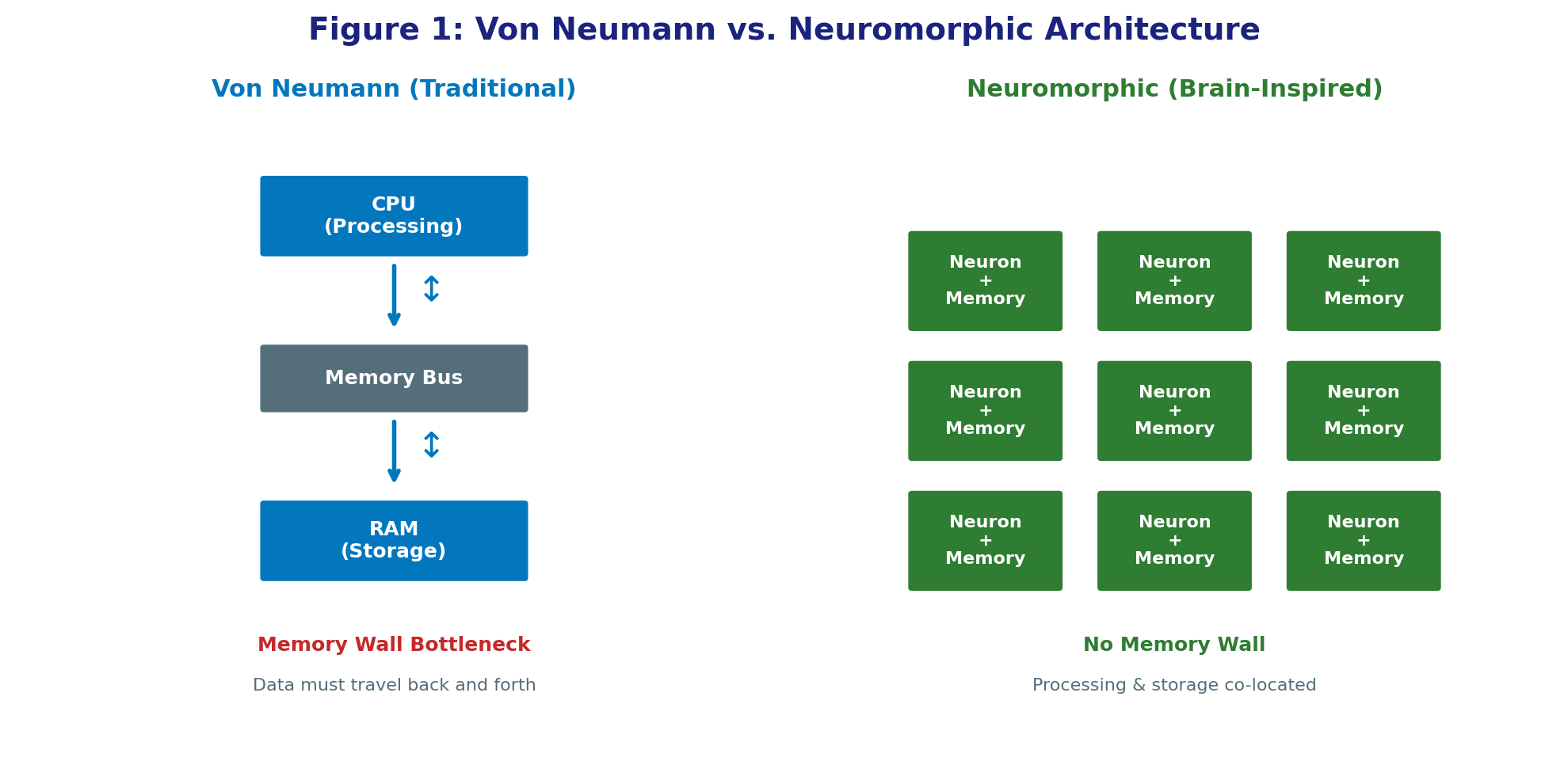
Virtually every computing device in existence — whether a smartphone, laptop, or supercomputer — adheres to architectural principles established by John von Neumann in the 1940s. This paradigm physically separates processing units (CPU) from storage (RAM), connecting them via data pathways. Every calculation requires shuttling information between these components, creating what engineers term the “memory wall” — a performance ceiling that persists regardless of processor speed improvements.
Neuromorphic architectures fundamentally dissolve this limitation by integrating memory and computation within each artificial neuron. Mirroring biological neurons — which encode information through synaptic connections while simultaneously processing signals via membrane electrical dynamics — these silicon neurons unify storage and processing. Information remains stationary; computation happens in-place.
Spiking Neural Networks: Event-Driven Computation
Conventional artificial neural networks — powering applications from large language models to computer vision — operate on continuous numerical activations. Each artificial neuron produces a floating-point value, typically normalized between zero and one, indicating its activation intensity. Spiking Neural Networks (SNNs), the computational substrate of neuromorphic hardware, operate entirely differently — communicating exclusively through discrete electrical impulses called spikes.
Each spike constitutes a binary occurrence: neurons either discharge or remain silent. The transformative insight underlying SNNs is that meaningful information resides not in spike occurrence alone, but critically in spike timing. This temporal encoding mechanism enables neuromorphic systems’ remarkable efficiency while simultaneously presenting the core verification challenge for QA teams.
Spike Information Encoding Strategies
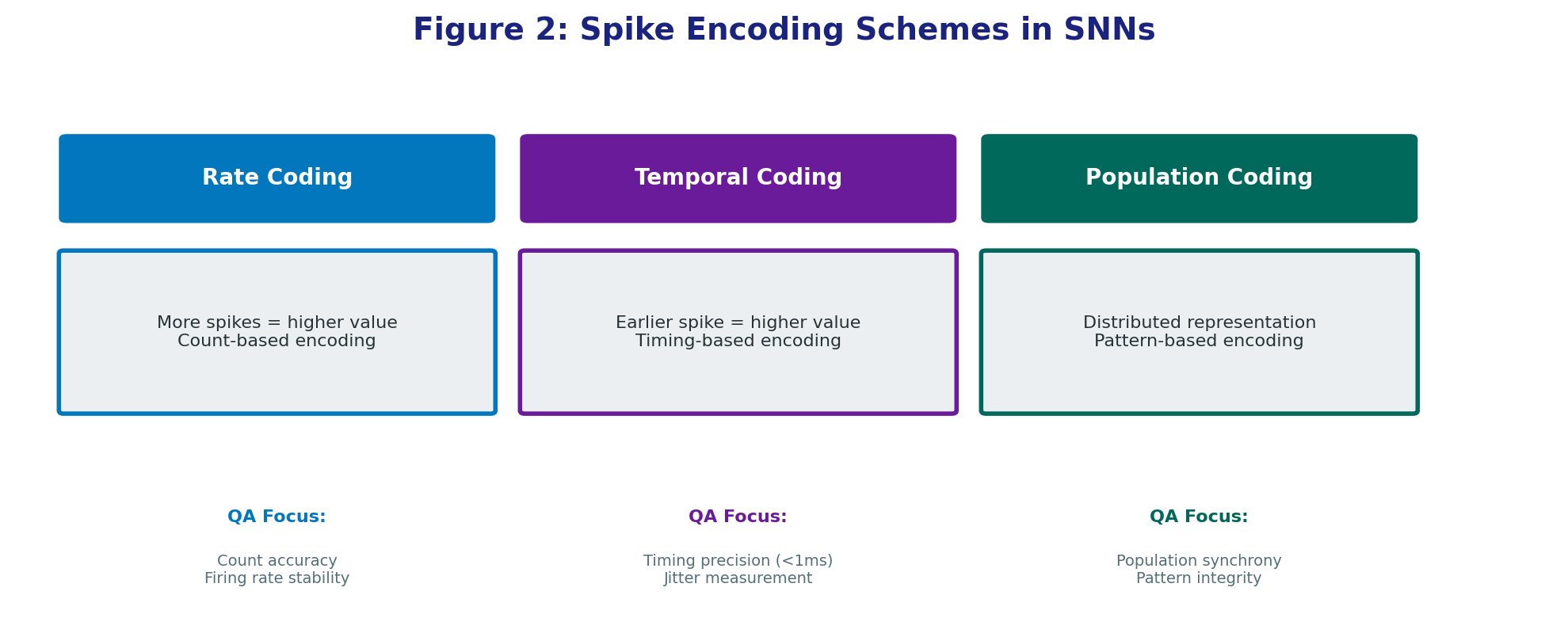
Rate-Based Encoding: This straightforward approach maps signal magnitude to firing frequency. Neurons representing larger values discharge more frequently — a neuron firing 50 times per second encodes a value five times greater than one firing 10 times per second. QA validation must confirm that observed spike frequencies accurately correspond to input signal strengths.
Timing-Based Encoding: Here, information resides in precise spike timing rather than frequency. Earlier discharges might signal high-confidence detections; delayed spikes indicate uncertainty. First-to-fire winner-take-all mechanisms demand sub-millisecond temporal precision. QA protocols must validate timing accuracy at microsecond granularity.
Distributed Population Encoding: Information spreads across neuron ensembles rather than individual cells. No single neuron conveys complete information — the collective spatiotemporal firing pattern encodes the message. QA methodologies must assess ensemble-level dynamics beyond isolated neuron behavior.
The LIF Neuron: Core Computational Primitive
The Leaky Integrate-and-Fire (LIF) model serves as the predominant computational abstraction in neuromorphic implementations. Mastering this model proves essential for constructing meaningful QA test strategies.
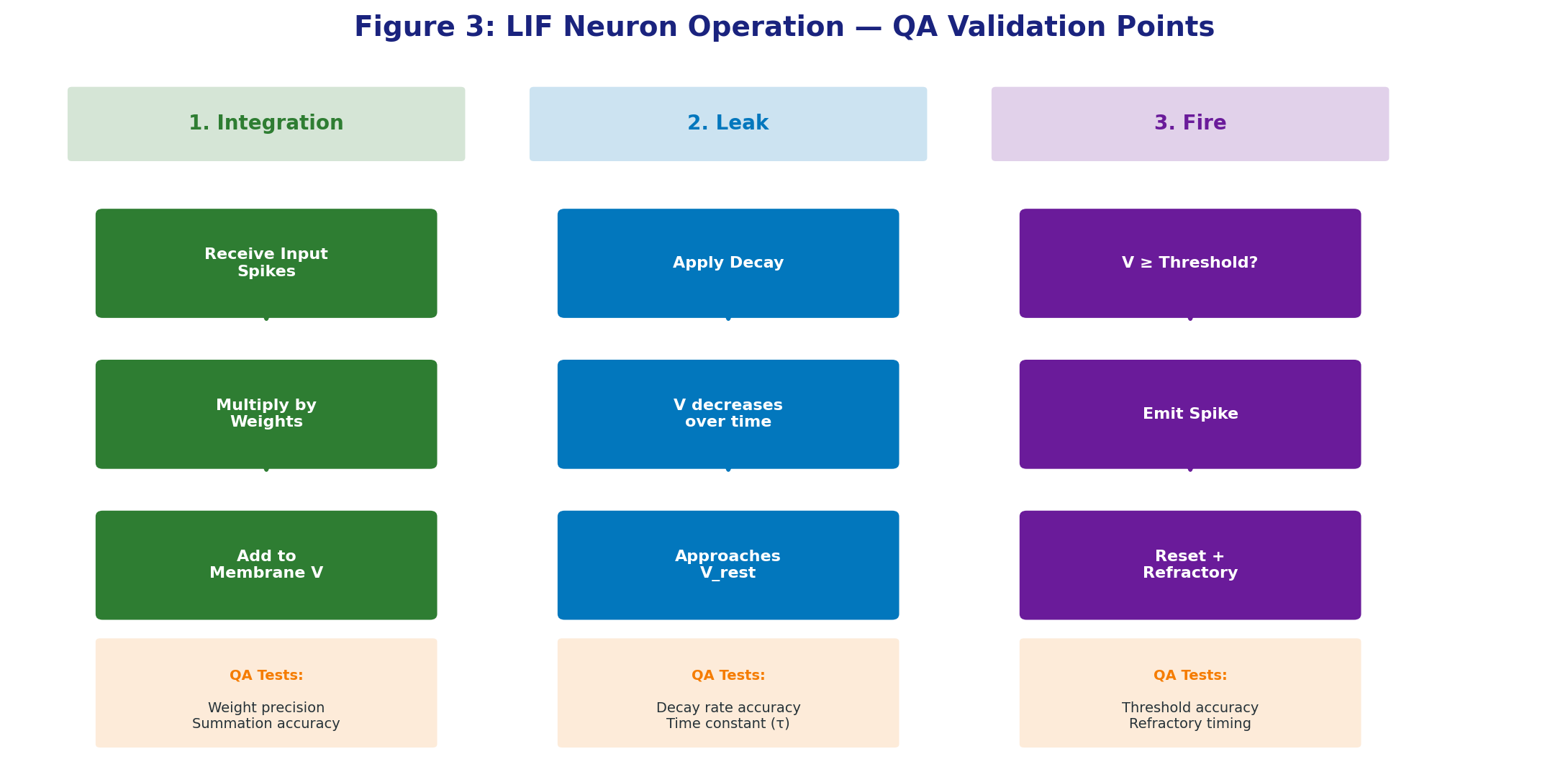
LIF neurons execute three interleaved operational phases:
Phase 1 — Signal Accumulation: Arriving spikes from upstream neurons undergo multiplication by synaptic weights (connection strength coefficients) before accumulating into the neuron’s membrane voltage. Visualize this as water entering a container — each input contributes incrementally.
Phase 2 — Voltage Dissipation: During quiescent intervals, membrane voltage progressively decays toward baseline. This dissipation reflects biological reality — neurons cannot indefinitely maintain elevated states. Decay velocity follows an exponential time constant (τ), typically spanning 10-20 milliseconds. The container slowly drains through a small aperture.
Phase 3 — Spike Generation: Once membrane voltage surpasses a defined threshold, the neuron discharges — propagating a spike to all downstream connections. Post-discharge, voltage resets to baseline and the neuron enters a brief refractory interval preventing immediate re-firing. The container overflows and empties completely.
Adaptive Synapses: Continuous On-Chip Learning
Among neuromorphic computing’s most compelling capabilities — and most demanding QA challenges — is hardware-native learning. Unlike conventional AI requiring separate training phases, neuromorphic processors continuously adapt during operation via Spike-Timing Dependent Plasticity (STDP) mechanisms.
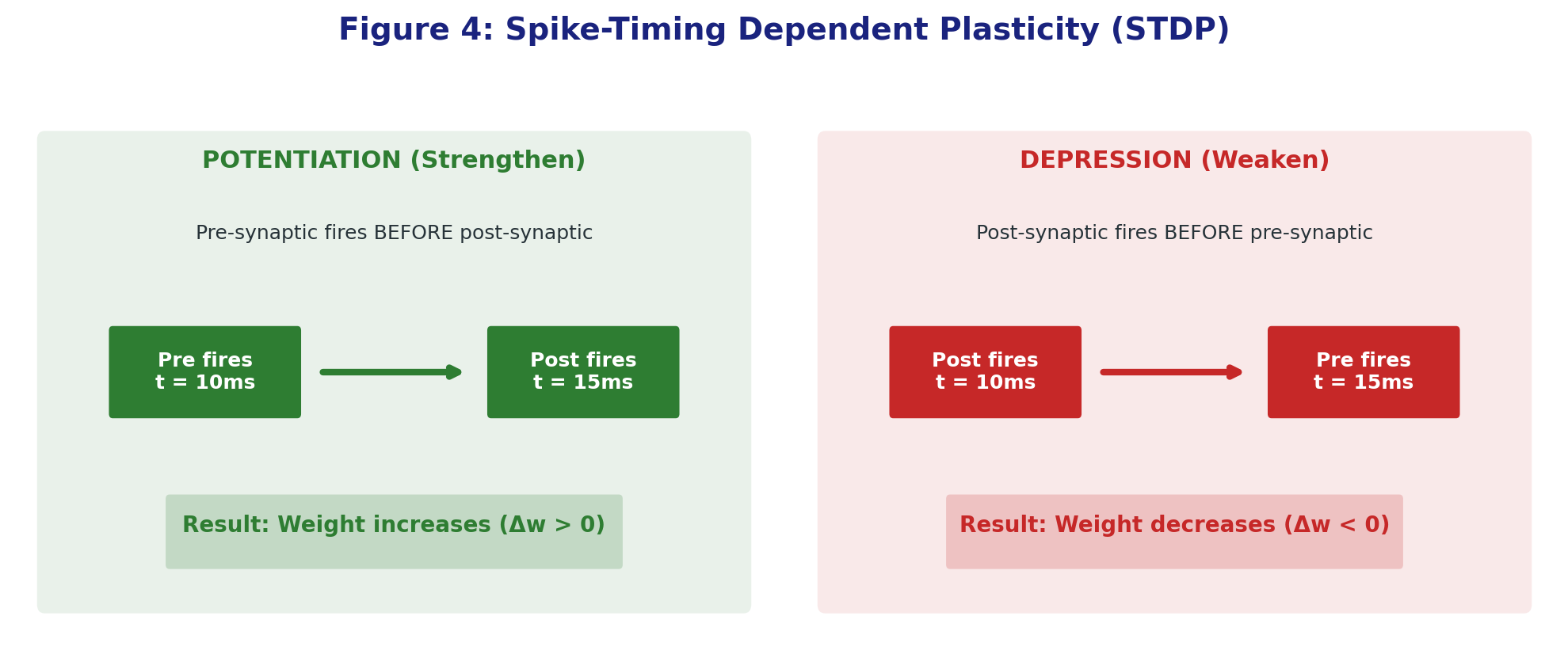
STDP modulates synaptic strengths based on relative spike timing between connected neurons:
- Causal firing sequences (presynaptic neuron activates before postsynaptic) trigger synaptic strengthening — Long-Term Potentiation (LTP). The network reinforces pathways that contributed to outputs.
- Anti-causal sequences (postsynaptic activates before presynaptic) induce synaptic weakening — Long-Term Depression (LTD). Non-contributory connections attenuate.
This continuous adaptation creates a moving target for QA: systems tested today may exhibit different behavior tomorrow. Verification strategies must either suppress learning mechanisms or explicitly validate that adaptation converges appropriately without erasing previously acquired capabilities.
Hardware Platforms: What You’re Testing
The neuromorphic landscape includes several major hardware platforms, each with unique characteristics that affect QA approaches:
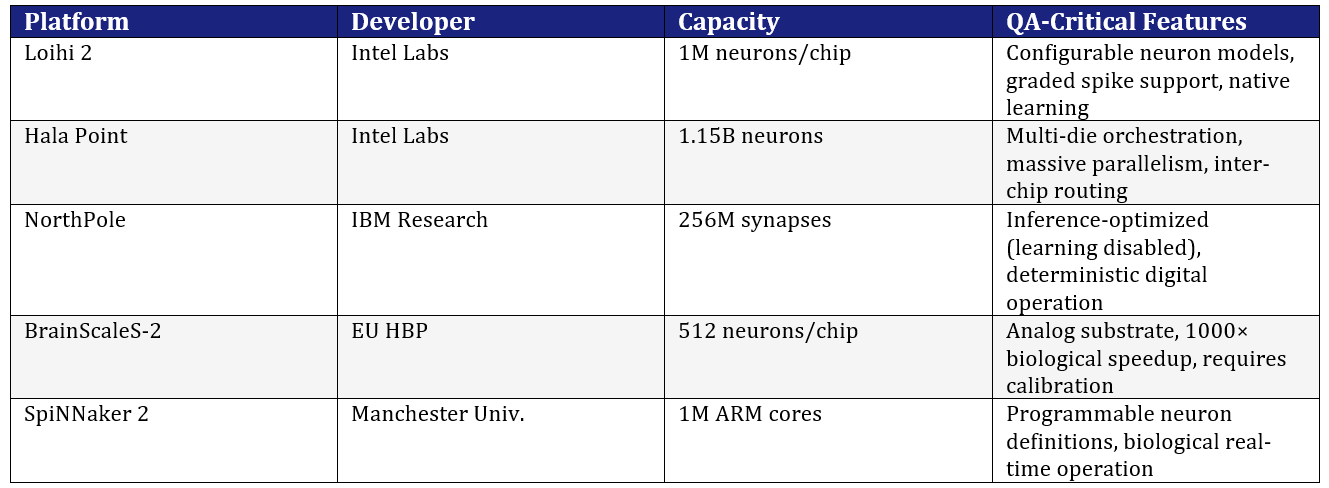
Key QA Insight: Each hardware platform has different precision, timing characteristics, and capabilities. Your test framework must be parameterized to accommodate platform-specific behaviors while validating functional equivalence across platforms.
Summary: What Makes Neuromorphic QA Different
Understanding neuromorphic architecture reveals why traditional QA approaches fail:
1. Time is a first-class citizen: Information is encoded in when events occur, not just what values are computed. Tests must validate temporal relationships with microsecond precision.
2. Hardware and software are inseparable: The neural network is physically embodied in chip architecture. Bugs can exist at any layer from algorithm to silicon.
3. The system learns and changes: On-chip plasticity means the system you deploy isn’t the system you tested. QA must validate learning dynamics, not just static behavior.
4. Behavior can be emergent and stochastic: Complex patterns emerge from simple neuronal rules, and some implementations deliberately include randomness. Deterministic assertions don’t work.
Conclusion:
Embracing the Neuromorphic Paradigm
Understanding neuromorphic architecture isn’t merely academic curiosity — it’s foundational preparation for the next wave of computing. The concepts explored here — in-memory computing, spiking neural networks, LIF neurons, and STDP-based learning — represent a fundamental departure from seven decades of von Neumann computing orthodoxy.
For QA practitioners, this paradigm shift demands equally fundamental changes in verification thinking. When computation is temporal, when hardware and software merge, and when systems continuously adapt through learning, traditional testing approaches fall short. Mastering these architectural principles provides the conceptual foundation needed to construct meaningful validation strategies.
The neuromorphic era has arrived. Intel’s Hala Point, IBM’s NorthPole, and academic platforms like BrainScaleS are no longer laboratory curiosities — they’re production-ready systems demanding production-quality assurance. QA professionals who invest in understanding these architectures today will lead the testing practices of tomorrow.
References
- Intel Loihi 2 Documentation: https://www.intel.com/content/www/us/en/research/neuromorphic-computing.html
- IBM NorthPole Architecture Paper: https://research.ibm.com/blog/northpole-ibm-ai-chip
- BrainScaleS-2 Platform: https://www.humanbrainproject.eu/en/science-development/focus-areas/neuromorphic-computing/