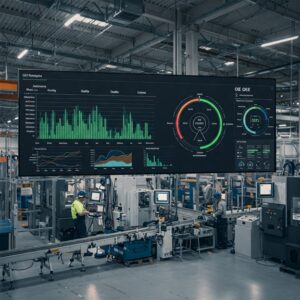
The PLM Maturity Framework
Building the Semantic Backbone of the Smart IMO Factory
Introduction
Every manufacturing enterprise today faces a deceptively simple question: How mature is your product lifecycle, really? Not just whether you have a PLM system installed, but whether your data flows autonomously across design, manufacturing, quality, and service — and whether machines can reason over that data without a human translating between systems.
The answer matters more than ever. As factories evolve from connected to cognitive to fully autonomous, the gap between organizations stuck at basic digitization and those operating with closed-loop lifecycle intelligence is no longer incremental — it is existential.
This is why we developed the PLM Maturity Framework, an eight-level model (Levels 0 through 7) that maps every stage of the journey from siloed manual processes to self-optimizing digital twins. But the framework is not just an assessment ladder. Embedded within it is a concept that quietly determines whether your Intelligent Manufacturing Operation (IMO) and smart factory investments will succeed or stall: the semantic layer.
The Eight Levels at a Glance
The PLM Maturity Framework traces an organization’s evolution across eight distinct stages, from manual foundations through closed-loop autonomy:
0 – PLM Foundations – Manual processes, siloed systems
1 – Process Digitization – Basic PLM workflow automation
2 – System Integration – PLM–CAD–ERP–MES connectivity, single source of truth
3 – Data Intelligence – AI-driven identification & classification
4 – Cognitive Change Mgmt. – AI-triggered ECO/ECN, predictive events
5 – Digital Thread – Connected lifecycle data flows
6 – Agentic Autonomy – Autonomous PLM-MES-ERP orchestration
7 – Closed-Loop Autonomy – Self-optimizing lifecycle, digital twins
Level 0 — PLM Foundations. Manual processes dominate. Engineering data lives in siloed file systems, spreadsheets, and disconnected PDM tools. There is no single source of truth for product data.
Level 1 — Process Digitization. Basic PLM workflow automation is in place. Document vaulting, release workflows, and rudimentary change management operate within the PLM platform, but integrations remain point-to-point and fragile.
Level 2 — System Integration. PLM is connected to CAD, ERP, and MES in a meaningful way. EBOM-to-MBOM transformation is governed, and a single source of truth begins to emerge for part, BOM, and change data across engineering and manufacturing.
Level 3 — Data Intelligence. AI begins to play a role — not in orchestrating processes, but in identifying patterns, classifying parts, detecting anomalies in change data, and recommending actions. This is the stage where machine learning models first touch lifecycle data.
Level 4 — Cognitive Change Management. Change processes become predictive. AI-triggered ECOs and ECNs fire based on upstream signals — a supplier risk alert, a field failure pattern, a regulatory shift — rather than waiting for a human to initiate them.
Level 5 — Digital Thread. Connected lifecycle data flows span requirements through design, manufacturing, quality, and field service. Traceability is end-to-end. A change in a DOORS requirement can be traced forward to the affected BOM line, work instruction, and installed-base configuration.
Level 6 — Agentic Autonomy. Autonomous AI agents orchestrate cross-system workflows. A PLM agent detects a design change, a MES agent adjusts routing, an ERP agent updates procurement schedules — all coordinated without human intervention for routine scenarios.
Level 7 — Closed-Loop Autonomy. The lifecycle is self-optimizing. Digital twins continuously reconcile as-designed, as-built, and as-maintained states. Field telemetry feeds back into design and manufacturing parameters. The enterprise operates as a learning system.
Where the Semantic Layer Enters the Picture
Most discussions about PLM maturity focus on process automation, system connectivity, and AI capabilities. These are necessary — but they overlook the foundational layer that makes Levels 3 through 7 actually achievable: the semantic layer.
What Is a Semantic Layer in a PLM Context?
A semantic layer is an abstraction that sits between raw system data and the consumers of that data — whether those consumers are human analysts, BI dashboards, or AI agents. It provides a unified, business-meaningful vocabulary over the heterogeneous data models of PLM, ERP, MES, QMS, and field service systems.
Consider a practical example. In Aras Innovator, a released part revision is represented as an Item with a specific lifecycle state and generation count. In SAP S/4HANA, the same part appears as a material master record with a material status and revision level. In Siemens Teamcenter, it is an Item Revision linked through a BOM View Revision structure. In the MES, it may be a product definition with a process-specific identifier.
Without a semantic layer, every integration, every analytics query, and every AI model must understand these system-specific representations individually. This creates a brittleness that compounds at scale: each new integration multiplies the translation burden, each new AI use case requires custom data wrangling, and each system upgrade risks breaking downstream consumers.
The semantic layer resolves this by providing a canonical ontology — a shared data model where “Part,” “BOM,” “Change Order,” “Work Instruction,” and “Field Event” have consistent, platform-agnostic definitions enriched with business context.
Why the Semantic Layer Is Non-Negotiable for Intelligent Manufacturing Operations (IMO)
The Smart IMO Factory is not just a connected factory. It is a factory where AI agents monitor, predict, decide, and act across the manufacturing value chain — from production scheduling and quality control to predictive maintenance and supply chain adaptation. This vision depends entirely on the quality, consistency, and interpretability of the data those agents consume.
Enabling Cross-System Agentic Orchestration
At Level 6, AI agents span system boundaries. A PLM change agent must interact with an ERP procurement agent and a MES routing agent. Without a shared semantic foundation, these agents cannot communicate meaningfully. The semantic layer provides the common language for multi-agent orchestration. Each agent reasons in terms of business entities and relationships — not database tables and API payloads. This is what makes the agentic architecture composable and extensible rather than brittle and bespoke.
Powering Predictive and Prescriptive Analytics
IMO in a factory context relies on correlating signals across domains. A quality excursion on the shop floor might correlate with a recent material substitution in the BOM, a supplier change flagged in the ERP, and a design tolerance revision in the PLM. Detecting this correlation requires data from four different systems to be aligned semantically. Without the semantic layer, data scientists spend 70 to 80 percent of their time on data preparation rather than building models.
Accelerating Digital Thread and Digital Twin Maturity
The digital thread (Level 5) and digital twin (Level 7) are both, at their core, semantic constructs. A digital thread is a chain of semantically linked lifecycle artifacts — from requirement to design to process plan to as-built record to field event. A digital twin is a semantically rich model that continuously reconciles multiple representations of the same physical entity. Neither can be assembled from raw system data without an intermediary that provides meaning, context, and traceability.
Regulatory and Compliance Traceability
In regulated industries — aerospace (AS9100), medical devices (ISO 13485, 21 CFR Part 11), and automotive (AIAG VDA, IATF 16949) — traceability is not optional. Auditors do not want to see database joins across five systems. They want to see a coherent, end-to-end trail from requirement to verified, validated, and released product configuration. The semantic layer provides the abstraction necessary to present this trail in business terms, regardless of how many underlying systems contributed to it.
Mapping the Semantic Layer to PLM Maturity Levels
The semantic layer does not appear fully formed at a single maturity level. It evolves in tandem with the overall framework:
Levels 0–1: There is no semantic layer. Data definitions are local to each system or spreadsheet. The same part number may mean different things in different contexts.
Level 2: Basic master data governance introduces the first semantic agreements — shared part numbering schemes, common lifecycle state definitions, and standardized BOM structures. This is a manual semantic layer, maintained through governance policies and integration specifications.
Level 3: The semantic layer begins to be codified. AI-driven classification and identification require formalized taxonomies and ontologies. Parts are tagged with machine-readable attributes that go beyond simple descriptions.
Levels 4–5: The semantic layer becomes a managed enterprise asset. Ontology management tools govern the canonical data model. The digital thread relies on semantic links that are maintained programmatically, not manually.
Levels 6–7: The semantic layer is the nervous system of the enterprise. Agentic AI reads from it, writes to it, and reasons over it. It is continuously enriched by machine learning — new entity types, new relationships, new inference rules are added as the system learns from operational data.
Practical Implications: Starting the Journey
For organizations assessing where they stand today, three actionable takeaways emerge:
- Assess semantic readiness alongside process maturity. It is entirely possible to be at Level 2 in process terms (well-integrated PLM-ERP-MES) but at Level 0 semantically (no consistent data definitions across systems). This mismatch will block your AI and IMO ambitions.
- Invest in ontology and master data governance early. The semantic layer cannot be retrofitted cheaply. Organizations that establish canonical data models and taxonomies at Level 2–3 find the path to Levels 5–7 dramatically smoother than those that defer this work.
- Choose PLM platforms that support semantic extensibility. Platforms like Aras Innovator, with their open data model and federation capabilities, lend themselves naturally to semantic layer construction. Rigid, monolithic architectures make it harder.
Conclusion
The PLM Maturity Framework’s eight levels describe a journey from manual chaos to closed-loop autonomy. But the hidden enabler of that journey — the layer that determines whether your AI investments generate insight or just noise — is the semantic layer.
In the Smart IMO Factory, where autonomous agents must reason across PLM, ERP, MES, and the shop floor in real time, the semantic layer is not a nice-to-have architectural refinement. It is the difference between a factory that has AI and a factory that is intelligent.
The maturity framework tells you where you are. The semantic layer determines how far you can go.