Context & Problem
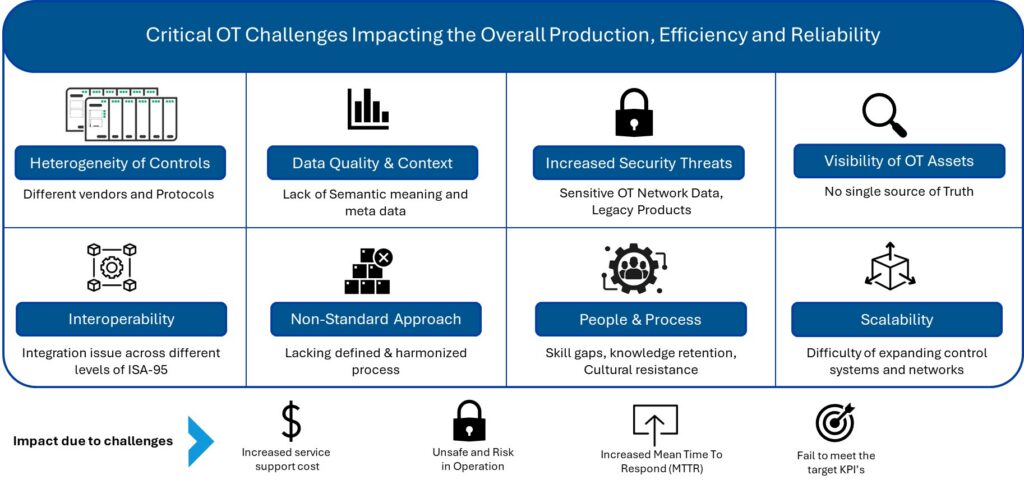
IT/OT convergence is a critical priority for every manufacturing and process Industry, however, achieving this convergence is challenging due to industrial heterogeneity, plants operate with multiple PLCs from different vendors (Siemens, Rockwell, ABB, Schneider, etc.), varied firmware versions, and mixed communication protocols (OPC UA/DA, Modbus, DNP3, IEC 61850, Profinet).
This fragmentation creates significant challenges in Data Quality & Context, Interoperability, Visibility of OT Assets, Increased Security Threats, People & Process gaps, Scalability.
Digital Backbone – Why It Matters
Delivering business value through advanced analytics, predictive maintenance, and digital transformation requires a Digital Backbone—a trusted, contextualized data foundation spanning IT, OT, and ET domains.
Why the Semantic Layer is Core to the Digital Backbone?
A semantic layer is a data abstraction layer that sits between raw data sources and end-user applications, providing a unified, business-friendly representation of data.
The semantic layer forms the core of the digital backbone by standardizing and contextualizing industrial data. It unifies fragmented OT signals into meaningful entities, adds metadata and asset hierarchies for business context, and bridges OT, IT, and ET systems for seamless interoperability. This approach ensures scalability, governance, and security while enabling advanced analytics use cases such as AI/ML, digital twins, and reliability engineering—accelerating business outcomes and digital transformation.
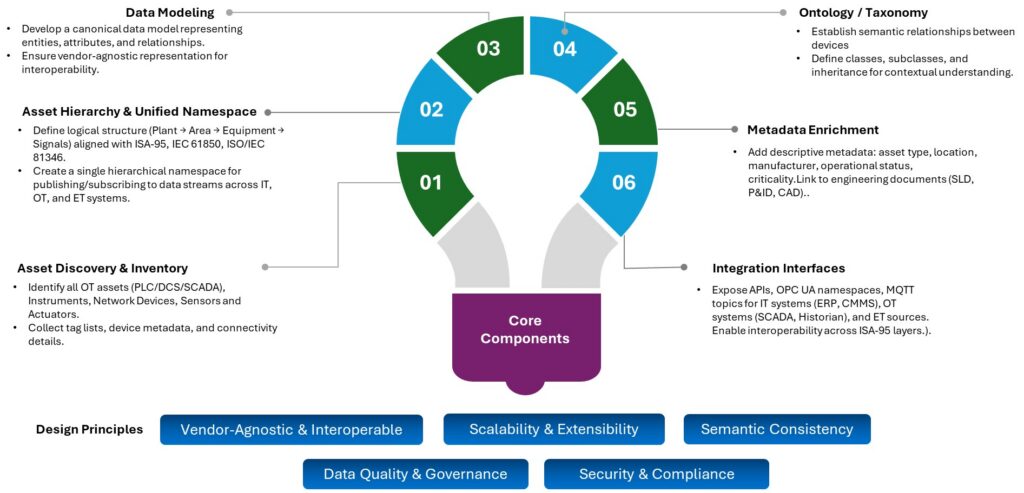
Core Components of Semantic Layer
The core components of a semantic layer are the foundational building blocks that enable data to be standardized, contextualized, and made interoperable across diverse systems.
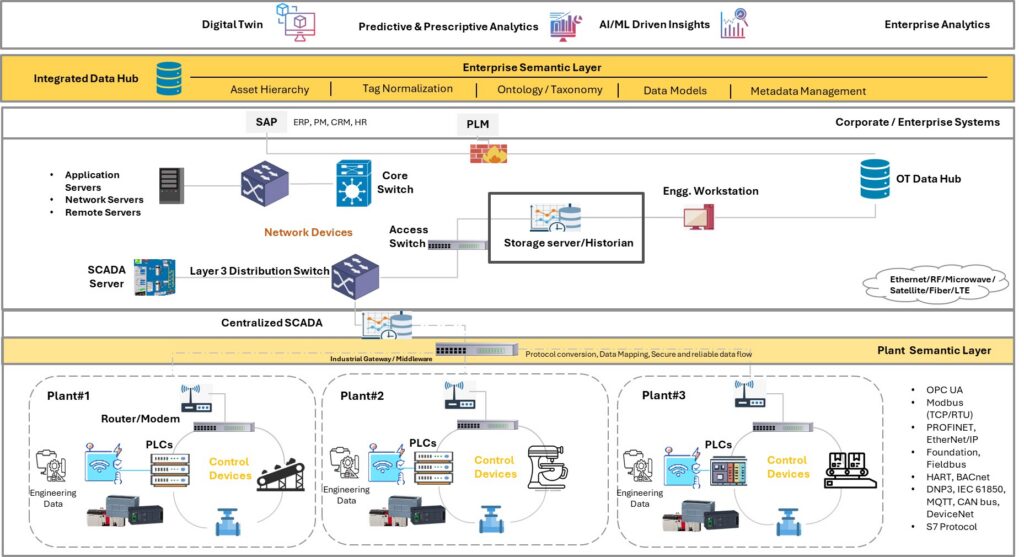
Positioning of the Semantic Layer
The challenges stem from the IT-OT trust gap and limited contextualization of operational data. To build advanced analytics solutions, it is equally important to integrate Engineering Technology (ET) with IT and OT for a holistic approach.
- Plant-Level Semantic Layer: Essential for harmonizing diverse PLCs and control systems.
- Enterprise-Level Semantic Layer: Critical for integrating IT, OT, and ET data. The plant semantic layer becomes the foundational building block for achieving end-to-end data consistency and interoperability.
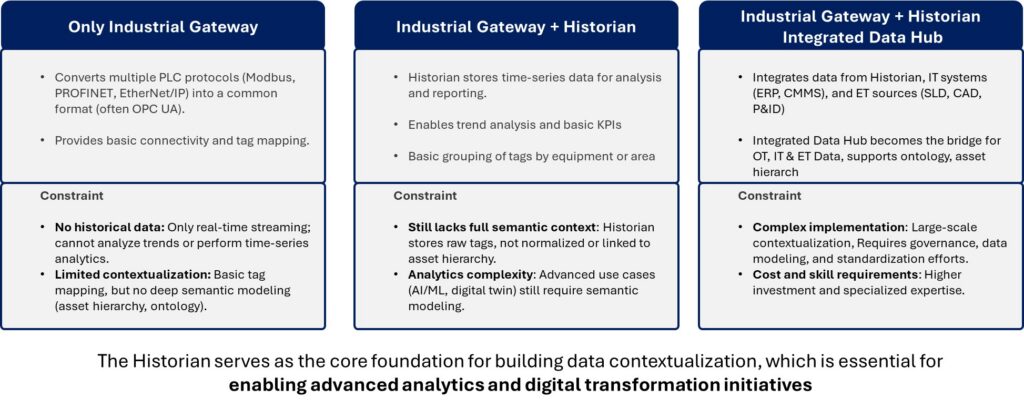
Progressive path to Semantic Layer implementation
Instead of implementing a full-scale semantic layer upfront, a progressive, staged approach is more practical and lowers delivery risk (as illustrated in the figure). Infosys recommends building semantic capabilities incrementally starting with connectivity, then adding time‑series persistence, and finally evolving into an enterprise-wide integrated data hub.
This approach reduces complexity; controls cost and creates a scalable foundation for advanced analytics and digital twin initiatives.
Stage 1: Industrial Gateway Only
Begin with an industrial gateway to establish basic connectivity and interoperability. The gateway collects data from multiple PLC protocols and converts it into a common format (e.g., OPC UA), enabling real-time streaming and basic tag mapping.
Constraint: No historical storage, limited ability to perform trend analysis or time-series analytics, contextualization remains minimal.
Stage 2: Industrial Gateway + Historian
Introduce a historian to store time-series data for reporting, trending, and basic KPI monitoring. This stage supports trend analysis and basic grouping of tags by equipment or area.
Constraint: While history is available, the data still lacks full semantic context, tags are not consistently normalized or linked to a governed asset hierarchy, limiting advanced use cases.
Stage 3: Industrial Gateway + Historian + Integrated Data Hub
Finally, we evolve into an integrated data hub that combines historian data with enterprise IT systems (e.g., ERP/CMMS) and ET sources (e.g., SLD, CAD, P&IDs). At this stage, the data hub becomes the bridge across IT, OT, and ET, supporting asset hierarchy, ontology, and standardized contextualization, enabling scalable advanced analytics and digital twin capabilities.
Constraint: More complex to implement due to governance, data modeling, standardization, and higher skill requirements.
Impact on Business Value Delivery
- Improved Asset Reliability: Contextualized data enables predictive maintenance and reduces downtime.
- Operational Efficiency: Standardized data accelerates root cause analysis and process optimization.
- Faster Digital Initiatives: A semantic layer reduces integration complexity, speeding up deployment of analytics and AI solutions.
- Enhanced Compliance & Security: Centralized governance ensures secure, auditable data flows across domains.
Conclusion:
The semantic layer leverages the Historian as a foundation but goes beyond by adding contextualization and integration at both plant and enterprise levels. Without this, data remains siloed and analytics cannot scale. The enterprise semantic layer ensures normalized, enriched data across IT, OT, and ET domains, while the plant semantic layer provides the foundational mapping from raw PLC tags to meaningful entities.