Introduction
The advancement of immersive computing and digital engineering has positioned 3D assets at the core of modern technological infrastructure. From product development to real-time experiences, their impact is profound. In such a landscape, technical accuracy is not a refinement, it is a prerequisite for excellence.
In today’s technology-driven world, 3D assets play a crucial role across diverse domains, demanding both visual quality and technical reliability. Industries such as gaming, film, simulation, extended reality (XR), and product visualization increasingly depend on high-quality 3D assets. In these domains, visual appeal alone is not enough, technical accuracy is also essential for reliability and scalability. One of the most critical yet often overlooked elements of this accuracy is UV mapping and its validation.
UV Mapping
UV mapping is the process of assigning coordinates from a two-dimensional space to the surface of a three-dimensional model. This mapping establishes a direct correspondence between points on the 3D geometry and points on a 2D plane, allowing detailed surface information – such as color, material attributes, or patterns – to be accurately positioned and scaled across the model.
A well-constructed UV map ensures that all surface details are distributed as intended, maintaining correct proportions and alignment. Conversely, poorly structured UVs can lead to stretching, compression, or misalignment of these details, resulting in visible artifacts or technical issues, regardless of the quality of the underlying data.
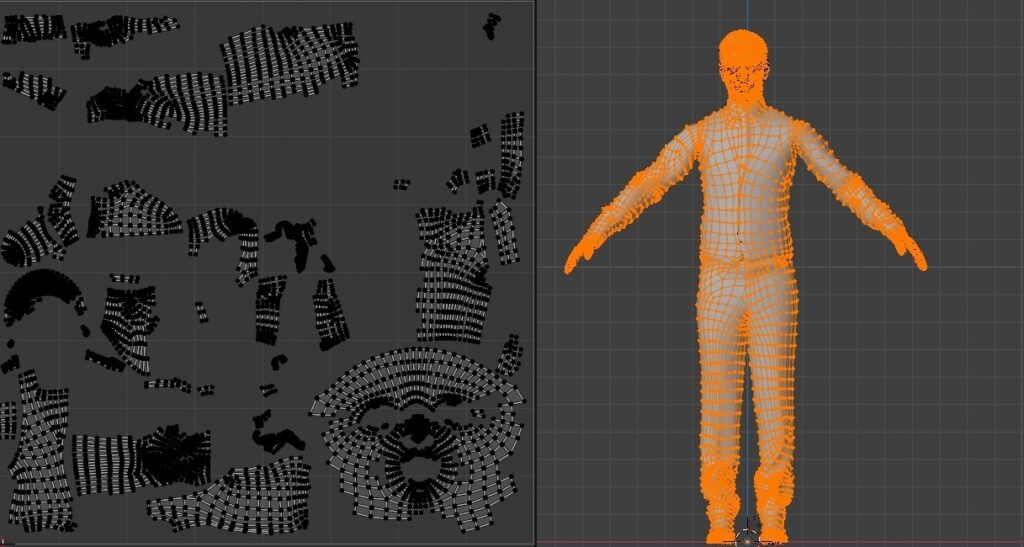 UV Map of a 3D Avatar model
UV validation
UV validation is the process of checking whether a UV layout meets technical and visual standards required for consistent rendering and performance. Rather than fixing visible problems after texturing or rendering, validation ensures that issues are identified early in the pipeline.
Typical validation checks include:
Out-of-Bounds UVs:
Out-of-bounds UVs occur when any UV coordinate falls outside the standard [0,1] range. Although some rendering engines allow UVs to wrap or tile, this is generally undesirable for most assets, as it can cause visual glitches, unintentional repetition, or missing surface data. To validate, each UV coordinate is checked to ensure it remains within the normalized range, and any face or vertex with a value outside this boundary is flagged for correction. This process helps maintain compatibility with pipelines that expect normalized UVs and prevents wasted texture space or unpredictable rendering results.
Overlapping UVs:
Overlapping UVs happen when multiple faces or islands share the same area in UV space, which can lead to texture bleeding, lighting errors, or artifacts during baking processes like ambient occlusion or normal maps. Validation involves detecting faces or islands that occupy identical or intersecting regions in the UV layout, allowing artists to separate or repack them as needed. Addressing overlaps ensures that each part of the model receives unique surface detail, resulting in cleaner bakes and more consistent shading.
Non-Uniform UV Scaling:
Non-uniform scaling in UVs means that some islands are disproportionately scaled compared to the underlying 3D geometry, causing inconsistent detail density—some areas may appear blurry while others are overly sharp. Validation checks the ratio between the 3D surface area and the corresponding UV area, flagging islands that deviate significantly from the average. Correcting these discrepancies ensures that surface details are distributed evenly, improving both visual quality and technical accuracy.
Flipped or Inverted UVs:
Flipped or inverted UVs are faces whose UV orientation is reversed, which can cause issues with shading, normal maps, or mirrored details. Validation detects faces with negative area or reversed winding in UV space, highlighting them for correction. Fixing flipped UVs is essential for workflows that rely on consistent orientation, such as normal mapping or procedural texturing, and helps avoid unexpected visual artifacts.
UV Seams and Discontinuities:
UV seams are the edges where the UV map splits, and poor seam placement can result in visible lines or mismatches in surface details. Validation examines the placement and management of seams, ensuring they are positioned in less noticeable areas and that the transitions across seams are as smooth as possible. Proper seam management minimizes visible artifacts and supports high-quality surface rendering.
Unused or Overlapping UV Space:
Inefficient UV layouts may leave large areas of the UV map empty or pack islands too closely, wasting resources or reducing the effective resolution of surface details. Validation identifies unused or inefficiently packed regions, encouraging better use of available UV space. Optimizing the layout maximizes texture resolution and improves performance, especially in memory-constrained environments.
UV Distortion:
UV distortion refers to the stretching or compression of the 2D UV space relative to the 3D surface, which can cause surface details to appear warped. Validation analyzes the mapping to detect areas of high distortion, allowing artists to adjust the layout for more uniform distribution. Reducing distortion ensures that all surface details are represented accurately, maintaining the intended appearance and quality.
Significance of UV Validation
Validating UVs on a 3D model ensures the asset’s technical integrity and readiness for further use. Early UV validation helps identify and resolve mapping issues, leading to more reliable and predictable results in any subsequent workflow.
Benefits of early UV validation include:
• Reducing errors: Detecting and fixing UV problems early prevents issues from propagating through the pipeline.
• Improving asset quality: Well-structured UVs contribute to cleaner, more professional assets.
• Supporting compatibility: Standardized UV layouts help maintain consistency across different tools and platforms.
• Enhancing efficiency: Clean UVs can streamline later processes, saving time and resources.
Conclusion
UV validation is a foundational step in ensuring the reliability and excellence of 3D assets. By identifying issues before texturing, developers can guarantee that their assets are robust, scalable, and ready for any application—from real-time XR to high-end visualization. As 3D assets continue to power the next generation of digital experiences, technical accuracy in UV mapping and validation will remain a key driver of quality and innovation.
Incorporating UV validation into standard workflows not only minimizes the risk of downstream complications but also supports smoother collaboration across teams. Consistent UV standards help maintain asset integrity throughout the production lifecycle, enabling faster iteration and higher creative output. Ultimately, prioritizing UV validation empowers creators to deliver visually compelling and technically sound results across diverse platforms and industries.
Reference
- https://arxiv.org/html/2312.05283v1
- https://openaccess.thecvf.com/content/CVPR2022/papers/Chen_AUV-Net_Learning_Aligned_UV_Maps_for_Texture_Transfer_and_Synthesis_CVPR_2022_paper.pdf
- https://www.renderhub.com/blog/uv-mapping-in-3d-exploring-techniques-essential-tools-and-industry-applications
- https://www.renderhub.com/blog/uv-mapping-in-3d-exploring-techniques-essential-tools-and-industry-applications