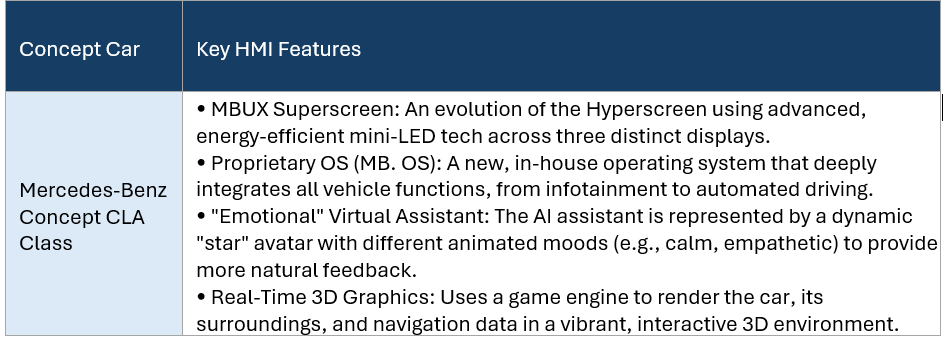
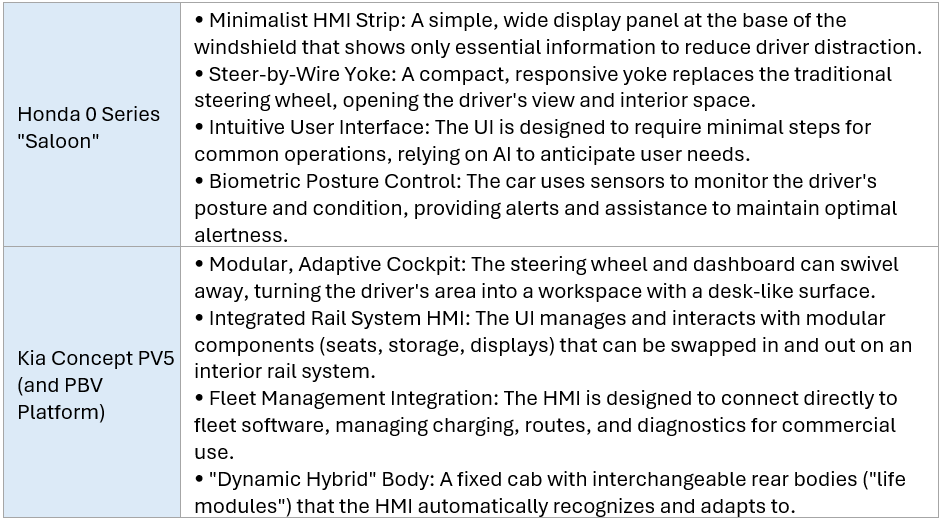
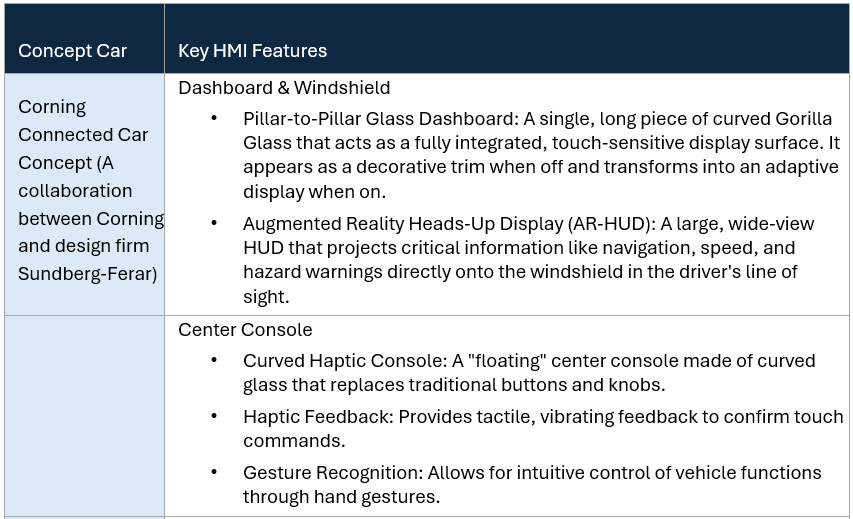
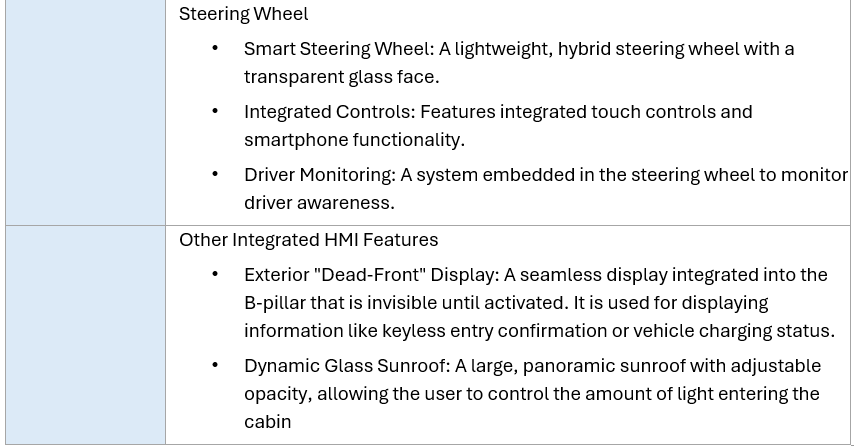
Concept cars are more than just eye candy at auto shows — they’re the crystal ball of the automotive world. These vehicles are designed to push boundaries, challenge conventions, and showcase what’s possible when engineers and designers are given the freedom to dream big. They often feature experimental technologies that haven’t yet hit the market but give us a glimpse into what’s coming. From AI-powered assistants with personalities to dashboards made entirely of smart glass, concept cars are the playground where future HMI innovations are born.
What’s especially exciting is how these vehicles reimagine the entire driving experience — not just how we control the car, but how we feel inside it. Whether it’s transforming the cabin into a workspace, syncing lighting with your mood, or projecting holograms onto the road, concept cars show us that the future of mobility is not just autonomous — it’s immersive, intuitive, and deeply human-centered.
Hyundai made significant strides in in-cabin HMI with the 2025 Palisade, particularly with the integration of an improved Forward Attention Warning (FAW) system. The system continuously monitors the driver’s eye movement, eyelid closure, and head orientation by utilizing an infrared camera that is mounted above the steering column. It generates alerts when indicators of fatigue or inattention are identified, particularly during the operation of Lane Following Assist and Smart Cruise Control. In order to enhance sensitivity and mitigate false alarms caused by obstructions such as sunglasses or hand movements, a targeted calibration update was implemented.
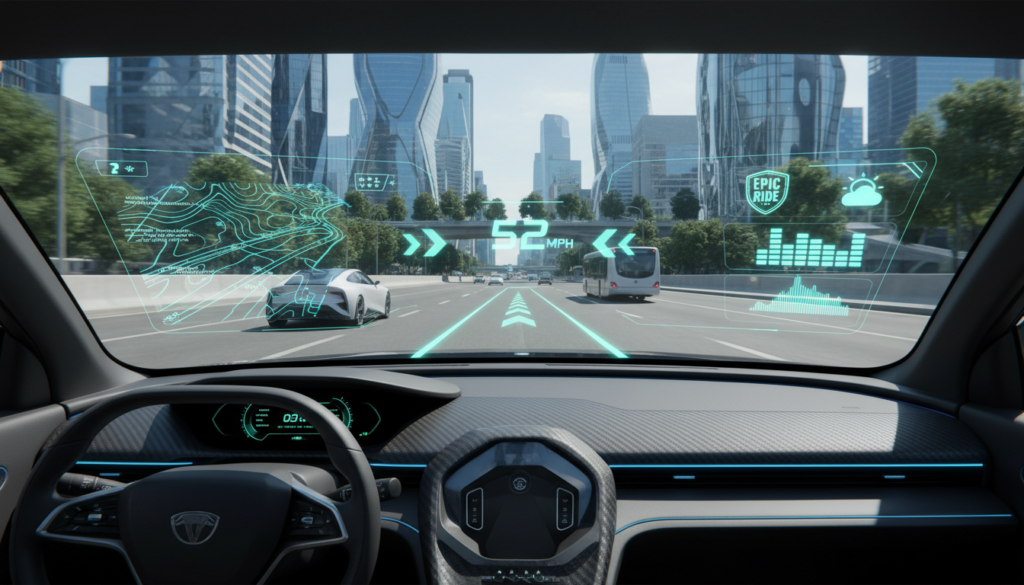
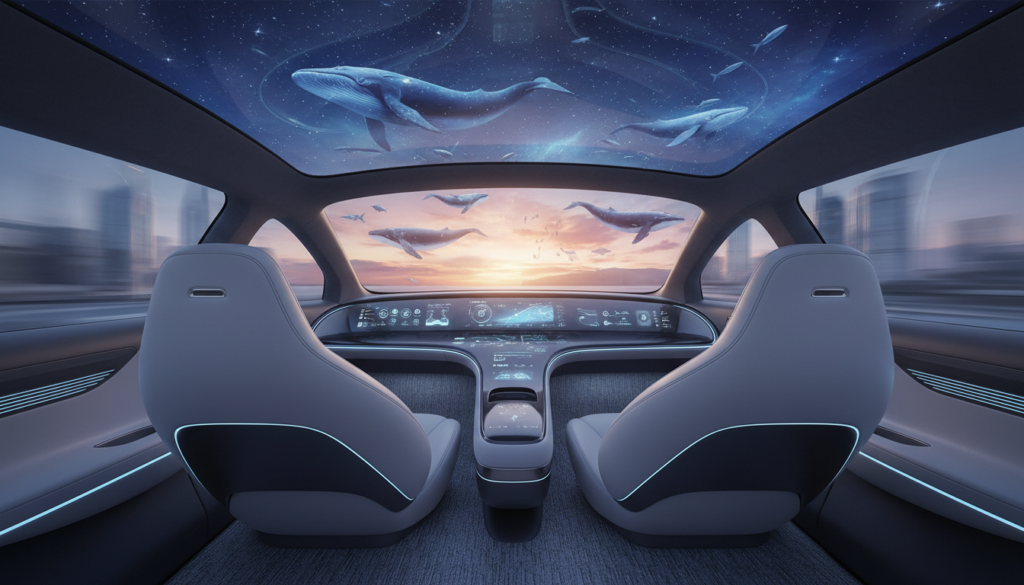
In addition, Hyundai Mobis has initiated field testing of a full-windshield holographic AR display. This display projects dynamic vehicle data to the driver while simultaneously enabling multimedia content for passengers only. This method enhances both operational safety and occupant entertainment by distinguishing the visual domains of the driver and passenger.
The Micro LED Smart Cockpit, a transformative concept for display integration, was introduced by AUO and BHTC at CES 2025. This innovative design incorporates flexible transparent displays into the sunroof, door panels, and even the steering wheel. The “Virtual Sky Canopy” is a configuration that enables distributed infotainment, contextual notifications, and immersive ambient experiences. Also unveiled was the Morphing Center Console, which dynamically emerges or retracts physical control surfaces based on the operational mode, enabling real-time ergonomic adaptation. The Foldable Cruise Pilot Display, which transitions between condensed driving mode visuals and expanded infotainment layouts based on whether the vehicle is operating manually or autonomously, complemented these innovations. These modular HMI components indicate a transition to cockpit architecture that is responsive to the environment.
The Driver system, which Helm.ai introduced in April 2025, represented a significant advancement in the transparency of AI that’s driven by HMI. Driver eliminates the necessity for lidar, radar, or preloaded HD maps by employing a camera-only transformer-based perception stack. Rather, it utilizes real-time vision data to forecast system behavior and trajectory. These forecasts are displayed in the cockpit as directional overlays and motion paths, which enable the driver to anticipate system actions with intuitive clarity. This advancement addresses a critical challenge in human-machine trust: the ability to elucidate the intent of autonomous systems in real time without overwhelming the user. Helm. Ai’s solution is consistent with the fundamental HMI principles of predictability, explainability, and minimal cognitive burden by incorporating real-time AI visual feedback into the interface.

In 2025, BMW continued to enhance its interface ecosystem by expanding upon the Panoramic iDrive system, which was introduced at CES and features a continuous digital display that extends across the dashboard. This expansive screen is intended to integrate instrument cluster, infotainment, and augmented reality feedback. It enables the allocation of modular interfaces, the customization of layouts, and the presentation of layered contextual data. In parallel, the company initiated the deployment of its production-ready augmented reality head-up display (AR-HUD), which is capable of projecting dynamic lane guidance, obstacle warnings, and navigation cues directly onto the windshield.
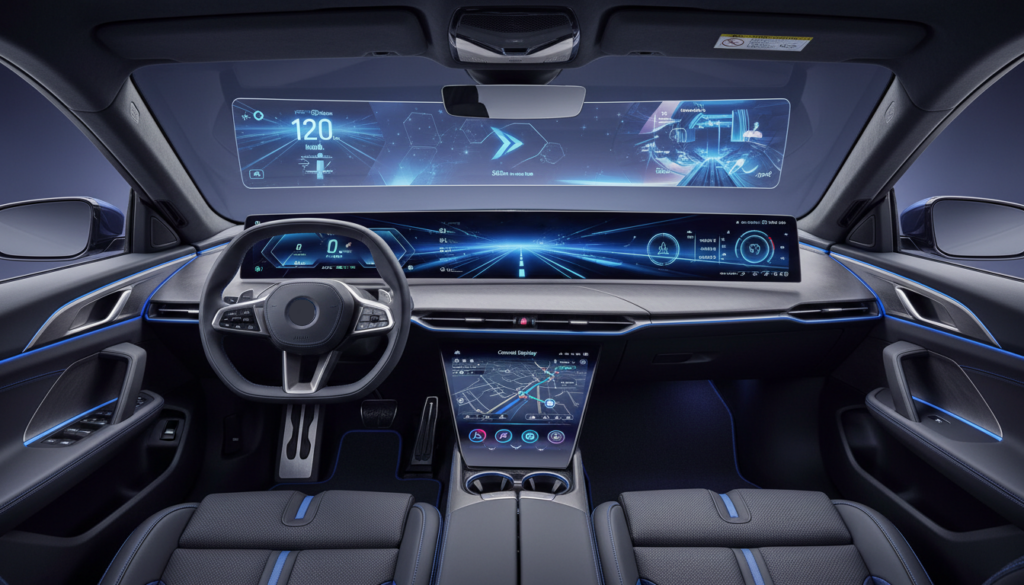
In order to optimize situational awareness and minimize distraction, the system intelligently prioritizes information based on driving mode, visibility conditions, and environmental input. BMW’s emphasis on multimodal interaction—which encompasses touch, gesture, haptics, and voice—responsively adjusts to user preference and driving scenarios, thereby reinforcing a user-driven, adaptable HMI design paradigm.
Here are Few More Concept Cars with the Key HMI Features Highlighted